Samenvatting International
Finance & Economics 2 (IFE2)
B-Accountancy
Collegejaar: 2022-2023
,Samenvatting International Finance & Economics 2 (IFE2) | B-Accountancy
Inleiding
Voor deze samenvatting is gebruik gemaakt van de volgende literatuur:
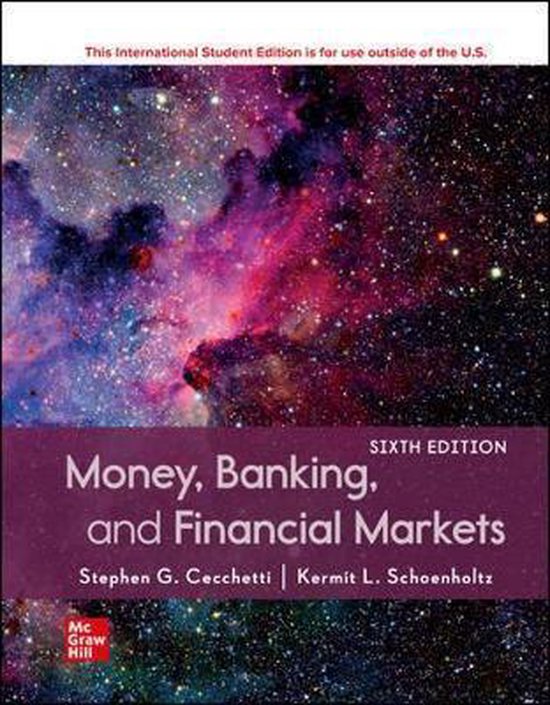
• Money, Banking and Financial Markets (MBFM) – 6e druk
• Algemene economie en bedrijfsomgeving (AEEB) – 6e druk
Naast bovenstaande literatuur is gebruik gemaakt van de PowerPoint presentaties van het vak
International Finance & Economics 2 (IFE2), lesweek 1 t/m lesweek 6.
Achter elk hoofdstuk zal de afkorting van boek weergegeven worden zodat het duidelijk is
welk boek betrekking heeft op het betreffende hoofdstuk. De afkortingen staan hierboven
vermeld.
Aan het eind van elk hoofdstuk (vooral de hoofdstukken die betrekking hebben op Money,
Banking and Financial Markets) staan de chapter lessons vermeld. Lees deze en controleer of
je de stof begrepen hebt.
Maak naast deze samenvatting gebruik van het proeftentamen, de online omgeving van beide
boeken en de gemaakte opgaves tijdens de werkcolleges. Kijk daarnaast naar de statistiek
colleges en de betreffende opdrachten die hier bij horen.
Veel succes met de voorbereiding voor het tentamen!
2
,Samenvatting International Finance & Economics 2 (IFE2) | B-Accountancy
Inhoudsopgave:
Chapter 1: Introduction to Money and the Financial System (MBFM) ................................................. 6
1.1 The Six Parts of the Financial System ............................................................................................ 6
1.2 The Five Core Principles of Money and Banking ........................................................................... 6
1.3 Chapter Lessons............................................................................................................................. 7
Chapter 2: Money and the Payments System (MBFM) ......................................................................... 8
2.1 Money and How We Use It............................................................................................................ 8
2.2 Measuring Money ......................................................................................................................... 8
2.3 Chapter Lessons............................................................................................................................. 9
Chapter 3: Financial Instruments, Financial Markets, and Financial Institutions (MBFM) ................ 10
3.1 Financial Instruments .................................................................................................................. 10
3.2 Financial Markets ........................................................................................................................ 11
3.3 Financial Institutions ................................................................................................................... 12
3.4 Chapter Lessons........................................................................................................................... 13
Chapter 4: Future Value, Present Value, and Interest Rates (MBFM) ................................................ 14
4.1 Valuing Monetary Payments Now and in the Future .................................................................. 14
4.2 Applying Present Value ............................................................................................................... 16
4.3 Real and Nominal Interest Rates ................................................................................................. 17
4.4 Chapter Lessons........................................................................................................................... 17
Chapter 5: Understanding Risk (MBFM) .............................................................................................. 18
5.1 Defining Risk ................................................................................................................................ 18
5.2 Measuring Risk ............................................................................................................................ 18
5.3 Risk Aversion, the Risk Premium, and the Risk-Return Tradeoff ................................................ 21
5.4 Sources of Risk: Idiosyncratic and Systematic Risk ..................................................................... 22
5.5 Reducing Risk through Diversification ......................................................................................... 22
5.6 Chapter Lessons........................................................................................................................... 23
Chapter 6: Bonds, Bond Prices, and the Determination of Interest Rates (MBFM) ........................... 24
6.1 Bond Prices .................................................................................................................................. 24
6.2 Bond Yields .................................................................................................................................. 25
6.3 The Bond Market and the Determination of Interest Rates ....................................................... 28
6.4 Why Bonds Are Risky ................................................................................................................... 31
6.5 Chapter Lessons........................................................................................................................... 32
Chapter 7: The Risk and Term Structure of Interest Rates (MBFM) ................................................... 33
7.1 Ratings and the Risk Structure of Interest Rates ......................................................................... 33
7.2 Differences in Tax Status and Munical Bonds ............................................................................. 35
7.3 The Term Structure of Interest Rates .......................................................................................... 36
3
,Samenvatting International Finance & Economics 2 (IFE2) | B-Accountancy
7.4 Chapter Lessons........................................................................................................................... 38
Chapter 8: Stocks, Stock Markets, and Market Efficiency (MBFM) .................................................... 39
8.1 The Essential Characteristics of Common Stock ......................................................................... 39
8.2 Measuring the Level of the Stock Market ................................................................................... 39
8.3 Valuing Stocks.............................................................................................................................. 40
8.4 Investing in Stocks for the Long Run ........................................................................................... 43
8.5 Chapter Lessons........................................................................................................................... 44
Chapter 9: Derivatives: Futures and Options (MBFM) ........................................................................ 45
9.1 The Basics: Defining Derivatives .................................................................................................. 45
9.2 Forwards and Futures.................................................................................................................. 45
9.3 Options ........................................................................................................................................ 47
9.4 Chapter Lessons........................................................................................................................... 50
Chapter 10: Foreign Exchange (MBFM) ............................................................................................... 51
10.1 Foreign Exchange Basics ............................................................................................................ 51
10.2 Exchange Rates in the Long Run................................................................................................ 53
10.3 Exchange Rates in the Short Run............................................................................................... 55
10.4 Government Policy and Foreign Exchange Intervention ........................................................... 58
10.5 Chapter lessons ......................................................................................................................... 58
Hoofdstuk 22: Vrijhandel en protectionisme (AEEB) .......................................................................... 59
22.1 Comparatieve kostentheorie en vrijhandel............................................................................... 59
22.2 Protectionisme .......................................................................................................................... 62
22.3 Betalingsbalans .......................................................................................................................... 65
Hoofdstuk 23: Internationale samenwerking (AEEB) .......................................................................... 69
23.1 Regionale economische samenwerking .................................................................................... 69
23.2 De Europese Unie ...................................................................................................................... 71
23.3 Internationale organisaties ....................................................................................................... 72
Hoofdstuk 27: Landenrisico (AEEB) ...................................................................................................... 75
27.1 Economisch en politiek risico .................................................................................................... 75
27.2 Analyse van het landenrisico ..................................................................................................... 75
27.3 Beheersing van het landenrisico ............................................................................................... 77
Chapter 15: Central Banks in the World Today (MBFM) ..................................................................... 79
15.1 The Basics: How Central Banks Originated and Their Role Today............................................. 79
15.2 Stability: The Primary Objective of All Central Banks ................................................................ 80
15.3 Meeting the Challenge: Creating a Succesful Central Bank ...................................................... 81
15.4 Chapter Lessons......................................................................................................................... 82
Chapter 17: The Central Bank Balance Sheet and the Money Supply Process (MBFM) .................... 83
4
,Samenvatting International Finance & Economics 2 (IFE2) | B-Accountancy
17.1 The Central Bank’s Balance Sheet ............................................................................................. 83
17.2 Changing the Size and Compostition of the Balance Sheet ...................................................... 84
17.3 The Deposit Expansion Multiplier ............................................................................................. 87
17.4 The Monetary Base and the Money Supply .............................................................................. 91
17.5 Chapter Lessons......................................................................................................................... 93
Chapter 18: Monetary Policy: Stabilizing the Domestic Economy (MBFM) ....................................... 94
18.1 The Federal Reserve’s Conventional Policy Toolbox ................................................................. 94
18.2 Unconventional Policy Tools ..................................................................................................... 95
18.3 A Guide to Central Bank Interest Rates: The Taylor Rule .......................................................... 96
18.4 Chapter Lessons......................................................................................................................... 97
5
, Samenvatting International Finance & Economics 2 (IFE2) | B-Accountancy
Chapter 1: Introduction to Money and the Financial System (MBFM)
1.1 The Six Parts of the Financial System
Het financiële systeem bestaat uit 6 onderdelen die allemaal één voor één een belangrijke rol
spelen in onze economie. Deze 6 onderdelen zijn:
• Geld: om te betalen voor onze inkopen en om onze liquide middelen op te slaan.
• Financiële instrumenten: middelen om over te hevelen van spaarders naar beleggers
en het risico over te hevelen naar degenen die het best in staat zijn deze te dragen.
Voorbeelden van financiële instrumenten zijn aandelen, hypotheken en
verzekeringen.
• Financiële markten: biedt ons de mogelijkheid om financiële instrumenten snel en
goedkoop te kopen of te verkopen. Een voorbeeld van een financiële markt is ‘’The
New York Stock Exchange’’.
• Financiële instituten: biedt een verzameling van diensten, inclusief toegang tot de
financiële markten en het verzamelen van informatie om te controleren en te
verzekeren dat eventuele leners kredietwaardig zijn. Voorbeelden van financiële
instituten zijn: banken en verzekering aanbieders.
• Regelgevende instanties: zijn verantwoordelijk dat de elementen van het financiële
systeem – inclusief zijn instrumenten, markten en instituties – op een veilige en
verantwoordelijke manier handelen.
• Centrale banken: monitoren en stabiliseren de economie. De meest belangrijke
centrale banken zijn de Europese Centrale Bank (ECB) en de U.S. Federal Reserve (FED).
1.2 The Five Core Principles of Money and Banking
De analyse van het financiële stelsel en zijn interactie met de reële economie berust zich op
vijf kernbeginselen (core principles). Wanneer je deze kernbeginselen snapt, heb je een beter
idee van wat er gebeurt in de financiële wereld, maar ook van wat er waarschijnlijk gebeurt in
de toekomst. De vijf kernbeginselen zijn gebaseerd op tijd, risico, informatie, markten en
stabiliteit.
Kernbeginsel 1: Time Has Value
Tijd heeft een prijs. Tijd heeft effect op de waarde van financiële transacties.
Kernbeginsel 2: Risk Requires Compensation
Risico kan overgeheveld worden van een ene partij naar een andere partij. Alleen niemand
zal dit voor niets doen. Hoe meer risico hier bij komt kijken, hoe meer compensatie hier voor
gegeven moet worden.
6
Finance & Economics 2 (IFE2)
B-Accountancy
Collegejaar: 2022-2023
,Samenvatting International Finance & Economics 2 (IFE2) | B-Accountancy
Inleiding
Voor deze samenvatting is gebruik gemaakt van de volgende literatuur:
• Money, Banking and Financial Markets (MBFM) – 6e druk
• Algemene economie en bedrijfsomgeving (AEEB) – 6e druk
Naast bovenstaande literatuur is gebruik gemaakt van de PowerPoint presentaties van het vak
International Finance & Economics 2 (IFE2), lesweek 1 t/m lesweek 6.
Achter elk hoofdstuk zal de afkorting van boek weergegeven worden zodat het duidelijk is
welk boek betrekking heeft op het betreffende hoofdstuk. De afkortingen staan hierboven
vermeld.
Aan het eind van elk hoofdstuk (vooral de hoofdstukken die betrekking hebben op Money,
Banking and Financial Markets) staan de chapter lessons vermeld. Lees deze en controleer of
je de stof begrepen hebt.
Maak naast deze samenvatting gebruik van het proeftentamen, de online omgeving van beide
boeken en de gemaakte opgaves tijdens de werkcolleges. Kijk daarnaast naar de statistiek
colleges en de betreffende opdrachten die hier bij horen.
Veel succes met de voorbereiding voor het tentamen!
2
,Samenvatting International Finance & Economics 2 (IFE2) | B-Accountancy
Inhoudsopgave:
Chapter 1: Introduction to Money and the Financial System (MBFM) ................................................. 6
1.1 The Six Parts of the Financial System ............................................................................................ 6
1.2 The Five Core Principles of Money and Banking ........................................................................... 6
1.3 Chapter Lessons............................................................................................................................. 7
Chapter 2: Money and the Payments System (MBFM) ......................................................................... 8
2.1 Money and How We Use It............................................................................................................ 8
2.2 Measuring Money ......................................................................................................................... 8
2.3 Chapter Lessons............................................................................................................................. 9
Chapter 3: Financial Instruments, Financial Markets, and Financial Institutions (MBFM) ................ 10
3.1 Financial Instruments .................................................................................................................. 10
3.2 Financial Markets ........................................................................................................................ 11
3.3 Financial Institutions ................................................................................................................... 12
3.4 Chapter Lessons........................................................................................................................... 13
Chapter 4: Future Value, Present Value, and Interest Rates (MBFM) ................................................ 14
4.1 Valuing Monetary Payments Now and in the Future .................................................................. 14
4.2 Applying Present Value ............................................................................................................... 16
4.3 Real and Nominal Interest Rates ................................................................................................. 17
4.4 Chapter Lessons........................................................................................................................... 17
Chapter 5: Understanding Risk (MBFM) .............................................................................................. 18
5.1 Defining Risk ................................................................................................................................ 18
5.2 Measuring Risk ............................................................................................................................ 18
5.3 Risk Aversion, the Risk Premium, and the Risk-Return Tradeoff ................................................ 21
5.4 Sources of Risk: Idiosyncratic and Systematic Risk ..................................................................... 22
5.5 Reducing Risk through Diversification ......................................................................................... 22
5.6 Chapter Lessons........................................................................................................................... 23
Chapter 6: Bonds, Bond Prices, and the Determination of Interest Rates (MBFM) ........................... 24
6.1 Bond Prices .................................................................................................................................. 24
6.2 Bond Yields .................................................................................................................................. 25
6.3 The Bond Market and the Determination of Interest Rates ....................................................... 28
6.4 Why Bonds Are Risky ................................................................................................................... 31
6.5 Chapter Lessons........................................................................................................................... 32
Chapter 7: The Risk and Term Structure of Interest Rates (MBFM) ................................................... 33
7.1 Ratings and the Risk Structure of Interest Rates ......................................................................... 33
7.2 Differences in Tax Status and Munical Bonds ............................................................................. 35
7.3 The Term Structure of Interest Rates .......................................................................................... 36
3
,Samenvatting International Finance & Economics 2 (IFE2) | B-Accountancy
7.4 Chapter Lessons........................................................................................................................... 38
Chapter 8: Stocks, Stock Markets, and Market Efficiency (MBFM) .................................................... 39
8.1 The Essential Characteristics of Common Stock ......................................................................... 39
8.2 Measuring the Level of the Stock Market ................................................................................... 39
8.3 Valuing Stocks.............................................................................................................................. 40
8.4 Investing in Stocks for the Long Run ........................................................................................... 43
8.5 Chapter Lessons........................................................................................................................... 44
Chapter 9: Derivatives: Futures and Options (MBFM) ........................................................................ 45
9.1 The Basics: Defining Derivatives .................................................................................................. 45
9.2 Forwards and Futures.................................................................................................................. 45
9.3 Options ........................................................................................................................................ 47
9.4 Chapter Lessons........................................................................................................................... 50
Chapter 10: Foreign Exchange (MBFM) ............................................................................................... 51
10.1 Foreign Exchange Basics ............................................................................................................ 51
10.2 Exchange Rates in the Long Run................................................................................................ 53
10.3 Exchange Rates in the Short Run............................................................................................... 55
10.4 Government Policy and Foreign Exchange Intervention ........................................................... 58
10.5 Chapter lessons ......................................................................................................................... 58
Hoofdstuk 22: Vrijhandel en protectionisme (AEEB) .......................................................................... 59
22.1 Comparatieve kostentheorie en vrijhandel............................................................................... 59
22.2 Protectionisme .......................................................................................................................... 62
22.3 Betalingsbalans .......................................................................................................................... 65
Hoofdstuk 23: Internationale samenwerking (AEEB) .......................................................................... 69
23.1 Regionale economische samenwerking .................................................................................... 69
23.2 De Europese Unie ...................................................................................................................... 71
23.3 Internationale organisaties ....................................................................................................... 72
Hoofdstuk 27: Landenrisico (AEEB) ...................................................................................................... 75
27.1 Economisch en politiek risico .................................................................................................... 75
27.2 Analyse van het landenrisico ..................................................................................................... 75
27.3 Beheersing van het landenrisico ............................................................................................... 77
Chapter 15: Central Banks in the World Today (MBFM) ..................................................................... 79
15.1 The Basics: How Central Banks Originated and Their Role Today............................................. 79
15.2 Stability: The Primary Objective of All Central Banks ................................................................ 80
15.3 Meeting the Challenge: Creating a Succesful Central Bank ...................................................... 81
15.4 Chapter Lessons......................................................................................................................... 82
Chapter 17: The Central Bank Balance Sheet and the Money Supply Process (MBFM) .................... 83
4
,Samenvatting International Finance & Economics 2 (IFE2) | B-Accountancy
17.1 The Central Bank’s Balance Sheet ............................................................................................. 83
17.2 Changing the Size and Compostition of the Balance Sheet ...................................................... 84
17.3 The Deposit Expansion Multiplier ............................................................................................. 87
17.4 The Monetary Base and the Money Supply .............................................................................. 91
17.5 Chapter Lessons......................................................................................................................... 93
Chapter 18: Monetary Policy: Stabilizing the Domestic Economy (MBFM) ....................................... 94
18.1 The Federal Reserve’s Conventional Policy Toolbox ................................................................. 94
18.2 Unconventional Policy Tools ..................................................................................................... 95
18.3 A Guide to Central Bank Interest Rates: The Taylor Rule .......................................................... 96
18.4 Chapter Lessons......................................................................................................................... 97
5
, Samenvatting International Finance & Economics 2 (IFE2) | B-Accountancy
Chapter 1: Introduction to Money and the Financial System (MBFM)
1.1 The Six Parts of the Financial System
Het financiële systeem bestaat uit 6 onderdelen die allemaal één voor één een belangrijke rol
spelen in onze economie. Deze 6 onderdelen zijn:
• Geld: om te betalen voor onze inkopen en om onze liquide middelen op te slaan.
• Financiële instrumenten: middelen om over te hevelen van spaarders naar beleggers
en het risico over te hevelen naar degenen die het best in staat zijn deze te dragen.
Voorbeelden van financiële instrumenten zijn aandelen, hypotheken en
verzekeringen.
• Financiële markten: biedt ons de mogelijkheid om financiële instrumenten snel en
goedkoop te kopen of te verkopen. Een voorbeeld van een financiële markt is ‘’The
New York Stock Exchange’’.
• Financiële instituten: biedt een verzameling van diensten, inclusief toegang tot de
financiële markten en het verzamelen van informatie om te controleren en te
verzekeren dat eventuele leners kredietwaardig zijn. Voorbeelden van financiële
instituten zijn: banken en verzekering aanbieders.
• Regelgevende instanties: zijn verantwoordelijk dat de elementen van het financiële
systeem – inclusief zijn instrumenten, markten en instituties – op een veilige en
verantwoordelijke manier handelen.
• Centrale banken: monitoren en stabiliseren de economie. De meest belangrijke
centrale banken zijn de Europese Centrale Bank (ECB) en de U.S. Federal Reserve (FED).
1.2 The Five Core Principles of Money and Banking
De analyse van het financiële stelsel en zijn interactie met de reële economie berust zich op
vijf kernbeginselen (core principles). Wanneer je deze kernbeginselen snapt, heb je een beter
idee van wat er gebeurt in de financiële wereld, maar ook van wat er waarschijnlijk gebeurt in
de toekomst. De vijf kernbeginselen zijn gebaseerd op tijd, risico, informatie, markten en
stabiliteit.
Kernbeginsel 1: Time Has Value
Tijd heeft een prijs. Tijd heeft effect op de waarde van financiële transacties.
Kernbeginsel 2: Risk Requires Compensation
Risico kan overgeheveld worden van een ene partij naar een andere partij. Alleen niemand
zal dit voor niets doen. Hoe meer risico hier bij komt kijken, hoe meer compensatie hier voor
gegeven moet worden.
6