Topic 4: Ecology
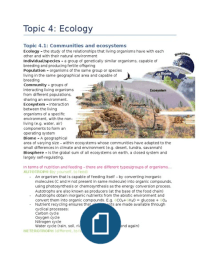
Topic 4.1: Communities and ecosystems
Ecology – the study of the relationships that living organisms have with each
other and with their natural environment
Individual/species – a group of genetically similar organisms, capable of
breeding and producing fertile offspring
Population – organisms of the same group or species
living in the same geographical area and capable of
breeding
Community – groups of
interacting living organisms
from different populations,
sharing an environment.
Ecosystem – Interaction
between the living
organisms of a specific
environment, with the non-
living (e.g. water, air)
components to form an
operating system
Biome – A geographical
area of varying size – within ecosystems whose communities have adapted to the
small differences in climate and environment (e.g. desert, tundra, savannah)
Biosphere – Is the global sum of all ecosystems on earth, a closed system and
largely self-regulating.
In terms of nutrition and feeding – there are different types/groups of organisms…
AUTOTROPH (by yourself, to feed)
- An organism that is capable of feeding itself – by converting inorganic
molecules (C and H not present in same molecule) into organic compounds,
using photosynthesis or chemosynthesis as the energy conversion process.
Autotrophs are also known as producers (at the base of the food chain)
- Autotrophs obtain inorganic nutrients from the abiotic environment and
convert them into organic compounds. E.g. 6CO₂+6H₂O = glucose + 6O₂
- Nutrient recycling ensures that all elements are made available through
cyclical processes:
Carbon cycle
Oxygen cycle
Nitrogen cycle
Water cycle (rain, soil, river, sea, vaporization, and again)
HETEROTROPH (different, to feed)
Topic 4.1: Communities and ecosystems
Ecology – the study of the relationships that living organisms have with each
other and with their natural environment
Individual/species – a group of genetically similar organisms, capable of
breeding and producing fertile offspring
Population – organisms of the same group or species
living in the same geographical area and capable of
breeding
Community – groups of
interacting living organisms
from different populations,
sharing an environment.
Ecosystem – Interaction
between the living
organisms of a specific
environment, with the non-
living (e.g. water, air)
components to form an
operating system
Biome – A geographical
area of varying size – within ecosystems whose communities have adapted to the
small differences in climate and environment (e.g. desert, tundra, savannah)
Biosphere – Is the global sum of all ecosystems on earth, a closed system and
largely self-regulating.
In terms of nutrition and feeding – there are different types/groups of organisms…
AUTOTROPH (by yourself, to feed)
- An organism that is capable of feeding itself – by converting inorganic
molecules (C and H not present in same molecule) into organic compounds,
using photosynthesis or chemosynthesis as the energy conversion process.
Autotrophs are also known as producers (at the base of the food chain)
- Autotrophs obtain inorganic nutrients from the abiotic environment and
convert them into organic compounds. E.g. 6CO₂+6H₂O = glucose + 6O₂
- Nutrient recycling ensures that all elements are made available through
cyclical processes:
Carbon cycle
Oxygen cycle
Nitrogen cycle
Water cycle (rain, soil, river, sea, vaporization, and again)
HETEROTROPH (different, to feed)