

ATI Detailed Answer Key Student Success.N4581 Airway. Chest Tube Mgmt
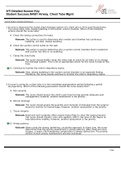
ATI Detailed Answer Key Student Success.N4581 Airway. Chest Tube Mgmt QUESTIONS AND RATIONALE 1. A nurse is observing the closed chest drainage system of a client who is 24 hr post thoracotomy. The nurse notes slow, steady bubbling in the suction control chamber. Which of the following actions should the nurse take? A. Check the tubing connections for leaks. Rationale: This action is used to determine why a water seal chamber has continuous bubbling, not slow, steady bubbling. B. Check the suction control outlet on the wall. Rationale: This action is used to determine why a suction control chamber that is hooked to wall suction has little or no bubbling. C. Clamp the chest tube. Rationale: The nurse should briefly clamp the chest tube to check for air leaks or to change the drainage system. This is not an appropriate action for the nurse to take at this time. D. Continue to monitor the client's respiratory status. Rationale: Slow, steady bubbling in the suction control chamber is an expected finding. Therefore, the nurse should continue to monitor the client's respiratory status. 2. A nurse is caring for a client who is in the immediate postoperative period following a partial laryngectomy. Which of the following parameters should the nurse assess first? A. Pain severity Rationale: The nurse should assess the client's pain level to help provide adequate pain management; however, another assessment is the priority. B. Wound drainage Rationale: The nurse should assess the quantity and character of drainage from the surgical wound to monitor for hemorrhage; however, another assessment is the priority. C. Tissue integrity Rationale: Head and neck surgeries often require tissue flaps to close the surgical wound. The nurse should monitor color and capillary refill in the area of the flap(s) to help determine viability; however, another assessment is the priority. D. Airway patency Rationale: When using the airway, breathing, circulation approach to client care, the nurse determines that the priority assessment is airway patency. After head and neck surgery, a major, life-threatening complication is airway obstruction. The priority actions involve airway maintenance and gas exchange. 3. A nurse is caring for a client who has a chest tube connected to a closed drainage system and needs to be transported to the x-ray department. Which of the following actions should the nurse take? A. Clamp the chest tube prior to transferring the client to a wheelchair. Rationale: Clamping the tube can lead to a tension pneumothorax (collapse of the lung) due to increased intrathoracic pressure from gas and fluid that cannot be drained from the pleural space. B. Disconnect the chest tube from the drainage system during transport. Rationale: The chest tube should not be disconnected from the drainage system. C. Keep the drainage system below the level of the client's chest at all times. Rationale: During transport, the drainage system should be kept below the level of the client's chest to prevent air and drainage fluid from re-entering the thoracic cavity. D. Empty the collection chamber prior to transport. Rationale: Emptying the collection chamber prior to transport is unnecessary. 4. A nurse is assessing a client who has a pneumothorax with a chest tube in place. For which of the following findings should the nurse notify the provider? A. Movement of the trachea toward the unaffected side Rationale: A chest tube inserted for a spontaneous pneumothorax may result in the development of a tension pneumothorax, a medical emergency. This results from air in the pleural space compressing the blood vessels of the thorax and limiting blood return to the heart. An assessment of tracheal deviation, or movement of the trachea toward the unaffected side, is indicative of tension pneumothorax and should be reported to the provider immediately. B. Bubbling of the water in the water seal chamber with exhalation Rationale: The water seal chamber prevents air from re-entering the pleural space. Bubbling in this chamber indicates air is being removed from the client’s pleural space, allowing re-expansion of the lung. It should occur during exhalation, coughing, and sneezing. When the air from the pleural space is removed, the bubbling will stop. Excessive bubbling in this chamber may indicate an air leak and should be further investigated by the nurse. C. Crepitus in the area above and surrounding the insertion site Rationale: Crepitus, or subcutaneous emphysema, sounds like a crackling noise when palpated. It can be an expected finding in the client who has a pneumothorax and will persist for several hours (or longer, depending on how long it takes the air to be reabsorbed) following evacuation of the pneumothorax. D. Eyelets are not visible Rationale: The observation of eyelets would indicate to the nurse that the chest tube has been become dislodged from the pleural space and would necessitate reporting to the provider. 5. A nurse is suctioning the endotracheal tube of a client who is on a ventilator. The client's heart rate increases from 86/min to 110/min and becomes irregular. Which of the following actions should the nurse take? A. Obtain a cardiology consult. Rationale: These manifestations are not related to a cardiac condition in this situation. B. Suction the client less frequently. Rationale: These manifestations are not the result of suctioning too frequently. C. Administer an antidysrhythmic medication. Rationale: These manifestations cannot be corrected with the use of an antidysrhythmic medication. D. Perform pre-oxygenation prior to suctioning. Rationale: Suctioning should be performed on the endotracheal tube of a client who is mechanically ventilated to remove accumulated secretions from the airways. Possible complications of the procedure include hypoxemia, manifested by tachycardia and arrhythmia, and tissue injury. . In preparation for suctioning, and to prevent hypoxemia, the client should be pre-oxygenated using a manual resuscitator bag set at 100% oxygen. 6. A nurse is caring for a client who is 1-day postoperative following a left lower lobectomy and has a chest tube in place. When assessing the client's three-chamber drainage system, the nurse notes that there is no bubbling in the suction control chamber. Which of the following actions should the nurse take? A. Continue to monitor the client as this is an expected finding. Rationale: The expected finding would be a gentle bubbling of the water in the suction control chamber. B. Add more water to the suction control chamber of the drainage system. Rationale: More water should not be added to the closed system. C. Verify that the suction regulator is on and check the tubing for leaks. Rationale: A lack of bubbling may indicate that either the suction regulator is turned off or that there is a leak in the tubing. D. Milk the chest tube and dislodge any clots in the tubing that are occluding it. Rationale: Stripping, or milking, can pull too hard on the chest cavity and may cause a tissue injury to the lung. Stripping is only done when specifically indicated. 7. A nurse in the post-anesthesia care unit is caring for a client who is postoperative following a thoracotomy and lobectomy. Which of the following postoperative assessments should the nurse give highest priority to? A. Arterial blood gases Rationale: According to the ABC priority-setting framework, the postoperative surgical client may need supplemental oxygen in order to maintain normal blood oxygen levels. The effectiveness of oxygenation is monitored using pulse oximetry and arterial blood gases. B. Urinary output Rationale: The nurse should monitor the client’s urinary output in order to monitor fluid status and cardiac output of the client who is postoperative; however, there is another assessment that would take priority. C. Chest tube drainage Rationale: The nurse should monitor the amount and characteristics of chest tube drainage because drainage in excess of 70 mL/hr may indicate acute bleeding or require that administration of blood products. While this is an appropriate intervention, there is another intervention that would take priority. D. Pain level Rationale: The nurse should monitor for and treat pain in the client who is postoperative following a thoracotomy to provide comfort and to enhance the client’s ability to deep breathe. However, there is another assessment that would take priority. 8. A nurse is caring for a client following a total laryngectomy. Which of the following is the priority observation in the client's care? A. Patency of the intravenous line. Rationale: While ensuring patency of the intravenous line is included in the postoperative plan of care, this is not the priority observation. B. Level of pain. Rationale: While collecting data about a client's level of pain is included in the postoperative plan of care, this is not the priority observation. C. Integrity of the dressing. Rationale: While ensuring the integrity of the client's dressing is included in the postoperative plan of care, this is not the priority observation. D. Need for suctioning. Rationale: Using the airway, breathing, circulation (ABC) priority-setting framework, confirming a patent airway is the priority observation for a postoperative client after a total laryngectomy. 9. A nurse is caring for a client who is 12 hr postoperative and has a chest tube to a disposable water-seal drainage system with suction. The nurse should intervene for which of the following observations? A. Constant bubbling in the suction-control chamber Rationale: Constant, gentle bubbling in the suction control chamber indicates that the suction is functioning. B. Continuous bubbling in the water-seal chamber Rationale: Continuous or excessive bubbling in the water-seal chamber indicates an air leak between the water seal and the client’s chest. However, gentle bubbling on forceful exhalation or coughing is normal. C. Bloody drainage in the collection chamber Rationale: For the first few hours after surgery, the drainage is likely to be bloody, transitioning to blood-tinged after that. Since the nurse doesn’t empty a disposable system but replaces it when it is full, bloody drainage in the collection chamber at 12 hr is an expected finding. D. Fluid-level fluctuations in the water-seal chamber Rationale: Fluid in the water-seal chamber should fluctuate with inspiration and exhalation, a process called tidaling, because pressure in the pleural space changes during respiration. 10. The nurse is caring for a postoperative client who has a chest tube connected to suction and a water seal drainage system. Which of the following indicates to the nurse that the chest tube is functioning properly? A. Fluctuation of the fluid level within the water seal chamber Rationale: Fluctuation of fluid within the water seal chamber occurs with inspiration and expiration until the client’s lungs have re-expanded or the system is occluded. B. Absence of fluid in the drainage tubing Rationale: Chest tube systems drain both air and blood from the pleural space. If no fluid drainage is present in the tubing and collection chamber, there may be an obstruction. C. Continuous bubbling within the water seal chamber Rationale: Bubbling within the water seal chamber is normal during forceful expiration or coughing, but continuous bubbling indicates an air leak and should be further investigated. D. Equal amounts of fluid drainage in each collection chamber Rationale: Drainage collects in the first chamber until it is full, and will then begin to fill the second chamber. 11.A A nurse is caring for a client who has a newly inserted chest drainage system with a water seal. Which of the following actions should the nurse take? A. Clamp the tube when the client is ambulating. Rationale: The nurse should clamp the client's chest tube only when replacing the drainage system or when checking for air leaks. B. Keep the collection device below the level of the client's chest. Rationale: The nurse should keep the drainage system lower than the client's chest to facilitate drainage from the chest cavity. C. Coil the tubes carefully to prevent kinking. Rationale: The nurse should keep the tubing as straight as possible, without any kinks or dependent loops. This can impair the function of the chest tube. D. Lay the client flat to avoid leaks in the tubing. Rationale: Upright positioning allows optimal lung expansion. The nurse should elevate the head of the client's bed at least 30°. 12.A A nurse is caring for a client who has a chest tube in place to a closed chest drainage system. Which of the following findings should indicate to the nurse that the client's lung has re-expanded? A. Oxygen saturation of 95% Rationale: A client can have an oxygen saturation of 95% with or without lung re-expansion. B. No fluctuations in the water seal chamber Rationale: Fluctuation stops when the lung has re-expanded, but the nurse should check for other indications of re-expansion, such as equal breath sounds bilaterally, because fluctuation can also stop when the tubing is obstructed, a dependent loop hangs below the rest of the tubing, or the suction source is not functioning. C. No reports of pleuritic chest pain Rationale: The client might not report pain if his pain management is effective, not because his lung has re-expanded. D. Occasional bubbling in the water-seal chamber Rationale: Occasional bubbling indicates the removal of air from the pleural space, indicating that the lung is not fully re-expanded. 13.A A nurse is monitoring a client who has a chest tube in place connected to wall suction due to a right-sided pneumothorax. The client complains of chest burning. Which of the following actions should the nurse take? A. Increase the client’s wall suction. Rationale: The nurse increasing the wall suction does not affect the amount of negative pressure of the chest tube and would not relieve the client’s chest burning. B. Strip the client’s chest tube. Rationale: The nurse stripping the chest tube increases negative pressure and may damage lung tissue and would not resolve the client’s chest burning. C. Clamp the client’s chest tube. Rationale: The nurse clamping the chest tube briefly to change the chamber or check for an air leak is recommended but would not resolve the client’s chest burning. D. Reposition the client. Rationale: The nurse repositioning the client is an appropriate action to relieve chest burning from the chest tube. 14. A nurse is caring for a client who has a disposable three-chamber chest tube in place. Which of the following findings should indicate to the nurse that the client is experiencing a complication? A. Continuous bubbling in the water-seal chamber Rationale: Excessive and continuous bubbling in the water-seal chamber indicates an air leak in the drainage system. B. Occasional bubbling in the water-seal chamber Rationale: The nurse should expect continuous bubbling in the water-seal chamber initially and occasional bubbling after that. The bubbles indicate the removal of air from the pleural space, which is the expected result. C. Constant bubbling in the suction-control chamber Rationale: The nurse should expect constant, gentle bubbling in the suction control chamber. D. Fluctuations in the fluid level in the water-seal chamber Rationale: The nurse should expect to see fluctuation with inspiration and exhalation, as this reflects the expected pressure changes in the pleural space during respiration. 15.A A client is planning to perform nasotracheal suction for a client who has COPD and an artificial airway. Which of the following actions should the nurse take? A. Perform suctioning for up to four passes. Rationale: To prevent hypoxemia and fatigue, the nurse should only suction the client for up to three passes. B. Apply suction to the catheter when advancing it into the trachea. Rationale: The nurse should advance the catheter without applying suction to prevent injury to the respiratory mucosa. When withdrawing the catheter the nurse should gently rotate the catheter to ensure that she reaches all surface areas and does not place undue pressure on any one area. C. Preoxygenate the client with 100% oxygen for up to 3 min. Rationale: To prevent hypoxemia, the nurse should preoxygenate the client with 100% oxygen for 30 seconds to 3 min prior to suctioning. D. Limit each suction pass to 25 seconds. Rationale: The nurse should limit each suction pass to 5 to 10 seconds to prevent trauma to the respiratory mucosa and minimize the risk of hypoxemia. 16. A nurse is caring for a client who has a three-chamber closed chest tube system. Which of the following actions should the nurse take after noticing a rise in the water seal chamber with client inspiration? A. Continue to monitor the client. Rationale: The fluid in the water seal chamber rises 2 to 4 inches during inhalation and falls during exhalation. This is a process called tidaling. An absence of tidaling might indicate a fully expanded lung or an obstruction in the chest tube. B. Immediately notify the provider. Rationale: The nurse does not need to contact the provider at this time. The fluid in the water seal chamber is expected to rise during inhalation and fall during exhalation. C. Reposition the client toward the left side. Rationale: Repositioning the client can aid in comfort and prevention of pressure ulcers; however, repositioning is not indicated in this situation. D. Clamp the chest tube near the water seal. Rationale: Chest tube manipulation should be kept at a minimum. Clamping the chest tube is not recommended. It should be clamped only for brief periods to check for an air leak or change the drainage system. 17.A A nurse is caring for a client who has a tracheostomy. Which of the following interventions should the nurse implement when performing tracheostomy care? A. Use aseptic technique. Rationale: The nurse should maintain sterile technique when providing tracheostomy care. B. Clean the inner cannula with mild soap and water. Rationale: The nurse should clean the inner cannula with sterile saline. If the inner cannula is disposable, the nurse should remove it and replace it with a new one. C. Secure new tracheostomy ties before removing old ones. Rationale: Tube dislodgement and accidental decannulation are potential complications of a tracheostomy. Both can be prevented by securing the tube in place. By keeping the old ties in place while applying new ties, the nurse can secure the tube and prevent dislodgement. D. Apply suction when inserting the catheter. Rationale: The nurse should apply suction only when withdrawing the catheter. Applying suction during catheter insertion causes trauma to the tracheal mucosa. Prior to suctioning, the nurse should hyperoxygenate the client with 100% oxygen. Because prolonged suctioning can cause hypoxia, tissue trauma, or alveolar collapse, the nurse should limit suctioning passes to 10 to 15 seconds. 18.A A nurse is assessing a client who is 1 day postoperative following a lobectomy and has a chest tube drainage system in place. Which of the following findings by the nurse indicates a need for intervention? A. Chest tube eyelets not visible Rationale: Eyelets allow for drainage from the pleural space. The eyelets should not be visible when inspecting the insertion site. B. Continuous bubbling in the suction control chamber Rationale: The suction control chamber regulates the amount of negative pressure being applied to the pleural space. When suction is applied, the water in this chamber should bubble continuously. C. Presence of tidal fluctuation in the water seal chamber Rationale: The water contained in the water seal chamber prevents air from re-entering the pleural space. The water level in this chamber rises with inhalation and falls with exhalation, which referred to as tidaling and is an expected finding D. Development of subcutaneous emphysema Rationale: Subcutaneous emphysema is an indication that air is trapped in and under the skin, which be the result of a pneumothorax and should be reported to the provider. 19.A A nurse caring for a client who is vomiting. Which of the following actions should the nurse take first? A. Provide the client with an emesis basin. Rationale: The nurse should provide the client with an emesis basin to reduce discomfort; however, another action is the priority. B. Notify housekeeping. Rationale: The nurse should notify housekeeping to clean the contaminated are to prevent transmission of an infectious disease; however, another action is the priority. C. Prevent the client from aspirating. Rationale: When using the airway, breathing, circulation approach to client care, the nurse determines the priority action is to prevent the client from aspiration by turning the client to his side and suctioning his airway. D. Administer an antiemetic to the client. Rationale: The nurse should administer an antiemetic to the client as prescribed to reduce nausea; however, another action is the priority.
Document information
- Uploaded on
- October 31, 2022
- Number of pages
- 14
- Written in
- 2022/2023
- Type
- Exam (elaborations)
- Contains
- Questions & answers



