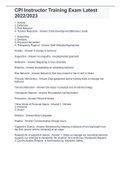
CPI Instructor Training Exam Latest 2022/2023
1. Anxiety
2. Defensive
3. Risk Behavior
4. Tension Reduction - Answer Crisis Development/Behavior Levels
1. Supportive
2. Directive
3. Physical Intervention
4. Therapeutic Rapport - Answer Staff Attitudes/Approaches
Anxiety - Answer A change in behavior
Supportive - Answer An empathic, nonjudgmental approach
Defensive - Answer Beginning to lose rationality
Directive - Answer Decelerating an escalating behavior
Risk Behavior - Answer Behaviors that may present a risk to self or others
Physical Intervention - Answer Disengagement and/or holding skills to manage risk behavior
Tension Reduction - Answer Decrease in physical and emotional energy
Therapeutic Rapport - Answer Re-establish communication
Proxemics - Answer Personal Space
Three Zones of Personal Space - Answer 1. Intimate
2. Personal
3. Social
Kinesics - Answer Body Language
Haptics - Answer Communication through touch
Supportive Stance - Answer Maintained by keeping a distance of one leg-length from the from person and by remaining at an angle.
Reasons for a supportive stance - Answer 1. Helps us manage our nonverbal behavior, supports our attempts to decelerate the situation, and reinforces Therapeutic Rapport.
2. Communicates Respect, is Nonthreatening, Maintains Safety CPI Instructor Training Exam Latest 2022/2023
Position - Answer Where we are in relation to others -- our orientation
Posture - Answer How we hold and move our body
Proximity - Answer Distance between individuals
What are the 3 Ps - Answer Position, Posture, Proximity
Paraverbal Communication - Answer The vocal part of speech, excluding the actual words one uses.
Three key components of paraverbal communication - Answer Tone, Volume, Cadence
Tone - Answer Inflection of voice
Volume - Answer How loud or soft we speak
Cadence - Answer The rate or rhythm of speech
Verbal Escalation Continuum - Answer Intimidation, Tension Reduction, Release, Refusal, Questioning
Intimidation - Answer The individual is verbally and/or nonverbally threatening staff
Intimidation Interventions - Answer 1. Take all threats seriously
2. Seek assistance
3. Try to avoid individual intervention
Tension Reduction Interventions - Answer Establish Therapeutic Rapport
Release - Answer Verbal and emotional outburst
Release Interventions - Answer 1. Allow venting (remove audience)
2. State directives that are nonthreatening
3. Use an understanding, reasonable approach
4. Be prepared to enforce any limits you set
Refusal - Answer Noncompliance
Refusal Interventions - Answer Set limits; redirect focus
Questioning Interventions - Answer 1. Information-seeking: A rational question seeking a rational response (give a rational response)
1. Anxiety
2. Defensive
3. Risk Behavior
4. Tension Reduction - Answer Crisis Development/Behavior Levels
1. Supportive
2. Directive
3. Physical Intervention
4. Therapeutic Rapport - Answer Staff Attitudes/Approaches
Anxiety - Answer A change in behavior
Supportive - Answer An empathic, nonjudgmental approach
Defensive - Answer Beginning to lose rationality
Directive - Answer Decelerating an escalating behavior
Risk Behavior - Answer Behaviors that may present a risk to self or others
Physical Intervention - Answer Disengagement and/or holding skills to manage risk behavior
Tension Reduction - Answer Decrease in physical and emotional energy
Therapeutic Rapport - Answer Re-establish communication
Proxemics - Answer Personal Space
Three Zones of Personal Space - Answer 1. Intimate
2. Personal
3. Social
Kinesics - Answer Body Language
Haptics - Answer Communication through touch
Supportive Stance - Answer Maintained by keeping a distance of one leg-length from the from person and by remaining at an angle.
Reasons for a supportive stance - Answer 1. Helps us manage our nonverbal behavior, supports our attempts to decelerate the situation, and reinforces Therapeutic Rapport.
2. Communicates Respect, is Nonthreatening, Maintains Safety CPI Instructor Training Exam Latest 2022/2023
Position - Answer Where we are in relation to others -- our orientation
Posture - Answer How we hold and move our body
Proximity - Answer Distance between individuals
What are the 3 Ps - Answer Position, Posture, Proximity
Paraverbal Communication - Answer The vocal part of speech, excluding the actual words one uses.
Three key components of paraverbal communication - Answer Tone, Volume, Cadence
Tone - Answer Inflection of voice
Volume - Answer How loud or soft we speak
Cadence - Answer The rate or rhythm of speech
Verbal Escalation Continuum - Answer Intimidation, Tension Reduction, Release, Refusal, Questioning
Intimidation - Answer The individual is verbally and/or nonverbally threatening staff
Intimidation Interventions - Answer 1. Take all threats seriously
2. Seek assistance
3. Try to avoid individual intervention
Tension Reduction Interventions - Answer Establish Therapeutic Rapport
Release - Answer Verbal and emotional outburst
Release Interventions - Answer 1. Allow venting (remove audience)
2. State directives that are nonthreatening
3. Use an understanding, reasonable approach
4. Be prepared to enforce any limits you set
Refusal - Answer Noncompliance
Refusal Interventions - Answer Set limits; redirect focus
Questioning Interventions - Answer 1. Information-seeking: A rational question seeking a rational response (give a rational response)