Explanation for obedience: The agentic state
Definition: when a person obeys an authority figure and feels no personal responsibility for their
own behaviour and the consequences that derive from following the order.
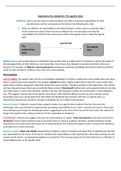
There Is a diffusion of responsibility to the authority figure, which causes an opposite effect
of the autonomous state (where we act according to our own principles) and take full
responsibility, the shift from the autonomous state to the agentic state is called the agentic
shift.
Agentic Shift
The The agentic
autonomous state
state
Binding factors such as denial keeps an individual in the agentic state as it allows them to minimise or ignore the extent of
the damaging effects of their behaviour and reduce their moral strain, that being the awareness that their actions are
immoral. For example, In Milgram’s shock experiment participants sometimes unwillingly pressed the shock but felt they
could not quit and had to continue in fear they seem rude/arrogant.
A03 Evaluation
Lack of validity: The agentic state may be an incomplete explanation as it fails to explain why some people obey even when
there Is a lack of perceived authority. For example, Mandel describes a WW2 incident where German reserve police shot
polish citizens despite being given alternative duties that were harmless. Though according to this explanation, they should
not have obeyed because there was no authority figure present. (Developed) Furthermore, some people simply do not obey
even when there is a perceived authority, evident in the fact that obedience studies very rarely obtain a 100% obedience
rate. This suggests that the idea of the agentic state doesn’t take individual differences into account, perhaps certain
personality traits are a strong determiner that effects the likelihood that someone will enter an agentic state, i.e.,
dispositional explanations should be considered alongside this for a better understanding.
Research support: Milgram’s research does support an idea of an agentic state. Evident in the fact that when his
participants were assured that the experimenter was taking responsibility for any ‘harm’ caused to the learner, they were
more willing to go through the shocking procedure, suggesting that the moral strain to commit that action was reduced by
being in the agentic state, acting as evidence for this explanation to obedience.
Counterpoint: research also suggests that one can resist acting as an ‘agent’. Rank and Jacobson found that 16/18 nurses
disobeyed a doctor when ordered to give an excessive dose of a drug to a patient, therefore, people sometimes remain
autonomous even when given instructions by an authority figure, this criticises the agentic state in its pursuit of obedience,
as perhaps this is easily overcome.
Research support: Blass and Schmitt showed films of Milgram’s study to students and asked them to identify who they felt
was responsible for the ‘harm’ of the learner. Students put responsibility on the experimenter rather than participants who
carried out the shocks, recognising the legitimacy of authority. This is strong support for the idea that there is a diffusion of
responsibility known as the agentic state.
Definition: when a person obeys an authority figure and feels no personal responsibility for their
own behaviour and the consequences that derive from following the order.
There Is a diffusion of responsibility to the authority figure, which causes an opposite effect
of the autonomous state (where we act according to our own principles) and take full
responsibility, the shift from the autonomous state to the agentic state is called the agentic
shift.
Agentic Shift
The The agentic
autonomous state
state
Binding factors such as denial keeps an individual in the agentic state as it allows them to minimise or ignore the extent of
the damaging effects of their behaviour and reduce their moral strain, that being the awareness that their actions are
immoral. For example, In Milgram’s shock experiment participants sometimes unwillingly pressed the shock but felt they
could not quit and had to continue in fear they seem rude/arrogant.
A03 Evaluation
Lack of validity: The agentic state may be an incomplete explanation as it fails to explain why some people obey even when
there Is a lack of perceived authority. For example, Mandel describes a WW2 incident where German reserve police shot
polish citizens despite being given alternative duties that were harmless. Though according to this explanation, they should
not have obeyed because there was no authority figure present. (Developed) Furthermore, some people simply do not obey
even when there is a perceived authority, evident in the fact that obedience studies very rarely obtain a 100% obedience
rate. This suggests that the idea of the agentic state doesn’t take individual differences into account, perhaps certain
personality traits are a strong determiner that effects the likelihood that someone will enter an agentic state, i.e.,
dispositional explanations should be considered alongside this for a better understanding.
Research support: Milgram’s research does support an idea of an agentic state. Evident in the fact that when his
participants were assured that the experimenter was taking responsibility for any ‘harm’ caused to the learner, they were
more willing to go through the shocking procedure, suggesting that the moral strain to commit that action was reduced by
being in the agentic state, acting as evidence for this explanation to obedience.
Counterpoint: research also suggests that one can resist acting as an ‘agent’. Rank and Jacobson found that 16/18 nurses
disobeyed a doctor when ordered to give an excessive dose of a drug to a patient, therefore, people sometimes remain
autonomous even when given instructions by an authority figure, this criticises the agentic state in its pursuit of obedience,
as perhaps this is easily overcome.
Research support: Blass and Schmitt showed films of Milgram’s study to students and asked them to identify who they felt
was responsible for the ‘harm’ of the learner. Students put responsibility on the experimenter rather than participants who
carried out the shocks, recognising the legitimacy of authority. This is strong support for the idea that there is a diffusion of
responsibility known as the agentic state.