Summary Motivation
Number of pages: 42
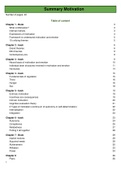
Table of content
Chapter 1 - Book 3
What is Motivation? 3
Internal motives 3
Expressions of motivation 4
Framework to understand motivation and emotion 5
10 unifying themes 5
Chapter 2 - book 6
Grand theories 6
Mini-theories 9
Contemporary era 9
Chapter 3 - book 9
Neural basis of motivation and emotion 10
Individual brain structures involved in motivation and emotion 11
Hormones 14
Chapter 4 - book 15
Fundamentals of regulation 15
Thirst 16
Hunger 16
Sex 18
Chapter 5 - book 19
Extrinsic motivation 19
Incentives are consequences 19
Intrinsic motivation 20
Cognitive evaluation theory 21
3 Types of motivation (continuum of autonomy or self-determination) 22
Internalisation 22
Integration 23
Chapter 6 - book 23
Autonomy 24
Competence 25
Relatedness 27
Putting it all together 28
Chapter 7 - Book 29
Implicit motives 29
Acquired needs 29
Achievement 30
Affiliation 33
Power 34
Chapter 8 36
Plans 36
1
, Goal 37
Goal striving 39
Goal disengagement 40
The Architecture of Goal Systems: Multifinality, Equifinality, and Counterfinality in Means-End
Relations (Kruglanski et al., 2015) 40
Multifinality 40
Equifinality 41
Counterfinality 42
2
, Chapter 1 - Book
What is Motivation?
Motivation is wanting change
The study of motivation concerns those internal processes that give behaviour its energy, direction, and
persistence:
● Energy - behaviour has strength
● Direction - behaviour has purpose
● Persistence - behaviour has endurance
Motivational science
To understand the nature of something such as achievement motivation and to explain how it works, a theory
of achievement motivation needs to do two things:
1. It needs to identify the relations that exist among naturally occurring, observable phenomena
2. It needs to explain why those relations exist.
This illustrates the function and utility of a good theory
Two perennial questions
1. What causes behaviour
2. Why does behaviour vary in its intensity
Internal motives
Needs:
- Needs are conditions within the individual that are essential and necessary for the maintenance of life
and for the nurturance of growth and well-being.
Cognitions
- Cognitions refer to mental events. Cognitive sources of motivation involve the person’s way of thinking.
Emotions
- Emotions are complex but coordinated feeling-arousal-expressive reactions to the significant events in
our lives. They happen rapidly and automatically generate and synchronise four interrelated aspects
(which react adaptively to the important events in our lives) of experience into a unified whole:
- Feelings: subjective, verbal descriptions of emotional experience
- arousal : bodily mobilisation to cope with situational demands
- Purpose: motivational urge to accomplish something specific at that moment
- Expression: nonverbal communication of our emotional experience to others
3
, External events and social context
External events are environmental, social, and cultural offerings that affect a person’s internal motives.
Environmental events include specific attractive stimuli such as money and events such as being praised.
Environmental events can also be unattractive stimuli. Social contexts include general situations, such as
classroom or workplace climate, a parenting style, or the culture at large.
Motivation versus influence
Influence is the social process in which one requests that the other change their behaviour or thought.
Motivation, however, is a private, internal process.
The study of motivation is not about manipulating people, rather, it is about understanding the conditions under
which people can energise and direct (i.e., motivate) their own behaviour.
Expressions of motivation
Motivation is a private and unobservable (internal) experience. There are 5 ways you can know (measure)
motivation when you see it.
1. Behaviour
a. Seven aspects of behaviour express presence, intensity, and quality of motivation
i. Effort Exertion during task
ii. Persistence Duration of behaviour
iii. Latency Time for person to start task after given opportunity
iv. Choice Preferring one course of action over the other
v. Probability of response Probability that the person acts in a goal-directed way
vi. Facial expression Facial movements
vii. Bodily gestures Bodily gestures
2. Engagement - how actively involved a person is in a task
a. Behaviour engagement is how
effortfully involved a person is
during activity in terms of effort
and persistence
b. Emotional engagement is the
presence of positive emotions
during task involvement, and the
absence of negative emotions.
c. Cognitive engagement is how
strategically the person attempts
to process information and to
learn in terms of employing
sophisticated rather than
superficial learning strategies.
d. Agentic engagement is the
extent of the person’s proactive
and constructive contribution
into the flow of the activity (i.e. asking questions, saying what you want or need, etc.)
3. Psychophysiology (neurotransmitters, hormones) - the process by which physiological states
(motivation, emotion) produce downstream changes in one’s physiology. It is the study of the
interaction between bodily and mental states.
a. Hormonal activity Chemicals in saliva or blood
b. Cardiovascular activity Contractions and relaxation of heart and blood vessels
c. Ocular activity Eye behaviour
d. Electrodermal activity Electrical changes on the surface of the skin
e. Skeletal activity Activity of the musculature
4
Number of pages: 42
Table of content
Chapter 1 - Book 3
What is Motivation? 3
Internal motives 3
Expressions of motivation 4
Framework to understand motivation and emotion 5
10 unifying themes 5
Chapter 2 - book 6
Grand theories 6
Mini-theories 9
Contemporary era 9
Chapter 3 - book 9
Neural basis of motivation and emotion 10
Individual brain structures involved in motivation and emotion 11
Hormones 14
Chapter 4 - book 15
Fundamentals of regulation 15
Thirst 16
Hunger 16
Sex 18
Chapter 5 - book 19
Extrinsic motivation 19
Incentives are consequences 19
Intrinsic motivation 20
Cognitive evaluation theory 21
3 Types of motivation (continuum of autonomy or self-determination) 22
Internalisation 22
Integration 23
Chapter 6 - book 23
Autonomy 24
Competence 25
Relatedness 27
Putting it all together 28
Chapter 7 - Book 29
Implicit motives 29
Acquired needs 29
Achievement 30
Affiliation 33
Power 34
Chapter 8 36
Plans 36
1
, Goal 37
Goal striving 39
Goal disengagement 40
The Architecture of Goal Systems: Multifinality, Equifinality, and Counterfinality in Means-End
Relations (Kruglanski et al., 2015) 40
Multifinality 40
Equifinality 41
Counterfinality 42
2
, Chapter 1 - Book
What is Motivation?
Motivation is wanting change
The study of motivation concerns those internal processes that give behaviour its energy, direction, and
persistence:
● Energy - behaviour has strength
● Direction - behaviour has purpose
● Persistence - behaviour has endurance
Motivational science
To understand the nature of something such as achievement motivation and to explain how it works, a theory
of achievement motivation needs to do two things:
1. It needs to identify the relations that exist among naturally occurring, observable phenomena
2. It needs to explain why those relations exist.
This illustrates the function and utility of a good theory
Two perennial questions
1. What causes behaviour
2. Why does behaviour vary in its intensity
Internal motives
Needs:
- Needs are conditions within the individual that are essential and necessary for the maintenance of life
and for the nurturance of growth and well-being.
Cognitions
- Cognitions refer to mental events. Cognitive sources of motivation involve the person’s way of thinking.
Emotions
- Emotions are complex but coordinated feeling-arousal-expressive reactions to the significant events in
our lives. They happen rapidly and automatically generate and synchronise four interrelated aspects
(which react adaptively to the important events in our lives) of experience into a unified whole:
- Feelings: subjective, verbal descriptions of emotional experience
- arousal : bodily mobilisation to cope with situational demands
- Purpose: motivational urge to accomplish something specific at that moment
- Expression: nonverbal communication of our emotional experience to others
3
, External events and social context
External events are environmental, social, and cultural offerings that affect a person’s internal motives.
Environmental events include specific attractive stimuli such as money and events such as being praised.
Environmental events can also be unattractive stimuli. Social contexts include general situations, such as
classroom or workplace climate, a parenting style, or the culture at large.
Motivation versus influence
Influence is the social process in which one requests that the other change their behaviour or thought.
Motivation, however, is a private, internal process.
The study of motivation is not about manipulating people, rather, it is about understanding the conditions under
which people can energise and direct (i.e., motivate) their own behaviour.
Expressions of motivation
Motivation is a private and unobservable (internal) experience. There are 5 ways you can know (measure)
motivation when you see it.
1. Behaviour
a. Seven aspects of behaviour express presence, intensity, and quality of motivation
i. Effort Exertion during task
ii. Persistence Duration of behaviour
iii. Latency Time for person to start task after given opportunity
iv. Choice Preferring one course of action over the other
v. Probability of response Probability that the person acts in a goal-directed way
vi. Facial expression Facial movements
vii. Bodily gestures Bodily gestures
2. Engagement - how actively involved a person is in a task
a. Behaviour engagement is how
effortfully involved a person is
during activity in terms of effort
and persistence
b. Emotional engagement is the
presence of positive emotions
during task involvement, and the
absence of negative emotions.
c. Cognitive engagement is how
strategically the person attempts
to process information and to
learn in terms of employing
sophisticated rather than
superficial learning strategies.
d. Agentic engagement is the
extent of the person’s proactive
and constructive contribution
into the flow of the activity (i.e. asking questions, saying what you want or need, etc.)
3. Psychophysiology (neurotransmitters, hormones) - the process by which physiological states
(motivation, emotion) produce downstream changes in one’s physiology. It is the study of the
interaction between bodily and mental states.
a. Hormonal activity Chemicals in saliva or blood
b. Cardiovascular activity Contractions and relaxation of heart and blood vessels
c. Ocular activity Eye behaviour
d. Electrodermal activity Electrical changes on the surface of the skin
e. Skeletal activity Activity of the musculature
4