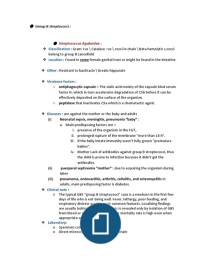
● Group B streptococci :
● Streptococcus Agalactiae :
❖ Classification:
Gram +ve \ Catalase –ve \ cocci in chain \ Beta hemolytic s.cocci
belong to group B Lancefield
❖ Location :Found in
some
female genital tract or might be found in the intestine
❖ Other
:
Resistant to bacitracin \ breaks hippurate
❖ Virulence factors:
○ antiphagocytic capsule > The sialic acid moiety of the capsule bind serum
factor H, which in turn accelerates degradation of C3b before it can be
effectively deposited on the surface of the organism.
○ peptidase that inactivates C5a which is a chemotactic agent.
❖ Diseases :
are against the mother or the baby and adults
(i) Neonatal sepsis, meningitis, pneumonia "baby" :
a. Main predisposing factors are >
i. presence of the organism in the FGT,.
ii. prolonged rupture of the membrane "more than 18 h".
iii. If the baby innate immunity wasn’t fully grown "premature
babies".
iv. Mother Lack of antibodies against group B streptococci, thus
the child is prone to infection because it didn't get the
antibodies.
(ii)
puerperal septicemia "mother" : due to acquiring the organism during
labor
(iii) pneumonia, endocarditis, arthritis, cellulitis, and osteomyelitis in
adults, main predisposing factor is diabetes.
❖ Clinical note :
o The typical GBS "group B streptococci" case is a newborn in the first few
days of life who is not doing well. Fever, lethargy, poor feeding, and
respiratory distress are the most common features. Localizing findings
are usually lacking, and the diagnosis is revealed only by isolation of GBS
from blood or cerebrospinal fluid. The mortality rate is high even when
appropriate antibiotics are used.
❖
Laboratory :
o Specimen collection : pus, CSF, sputum.
o Direct microscopy : gram +ve cocci in chain
● Streptococcus Agalactiae :
❖ Classification:
Gram +ve \ Catalase –ve \ cocci in chain \ Beta hemolytic s.cocci
belong to group B Lancefield
❖ Location :Found in
some
female genital tract or might be found in the intestine
❖ Other
:
Resistant to bacitracin \ breaks hippurate
❖ Virulence factors:
○ antiphagocytic capsule > The sialic acid moiety of the capsule bind serum
factor H, which in turn accelerates degradation of C3b before it can be
effectively deposited on the surface of the organism.
○ peptidase that inactivates C5a which is a chemotactic agent.
❖ Diseases :
are against the mother or the baby and adults
(i) Neonatal sepsis, meningitis, pneumonia "baby" :
a. Main predisposing factors are >
i. presence of the organism in the FGT,.
ii. prolonged rupture of the membrane "more than 18 h".
iii. If the baby innate immunity wasn’t fully grown "premature
babies".
iv. Mother Lack of antibodies against group B streptococci, thus
the child is prone to infection because it didn't get the
antibodies.
(ii)
puerperal septicemia "mother" : due to acquiring the organism during
labor
(iii) pneumonia, endocarditis, arthritis, cellulitis, and osteomyelitis in
adults, main predisposing factor is diabetes.
❖ Clinical note :
o The typical GBS "group B streptococci" case is a newborn in the first few
days of life who is not doing well. Fever, lethargy, poor feeding, and
respiratory distress are the most common features. Localizing findings
are usually lacking, and the diagnosis is revealed only by isolation of GBS
from blood or cerebrospinal fluid. The mortality rate is high even when
appropriate antibiotics are used.
❖
Laboratory :
o Specimen collection : pus, CSF, sputum.
o Direct microscopy : gram +ve cocci in chain