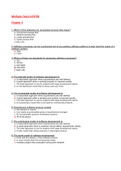
Multiple choice Inf3705
Chapter 2
1: Which of the following are recognized process flow types?
a. Concurrent process flow
b. Iterative process flow
c. Linear process flow
d. Spiral process flow
e.both a &c
2: Software processes can be constructed out of pre-existing software patterns to best meet the needs of a
software project.
a. True
b. False
3: Which of these are standards for assessing software processes?
a. SEI
b. SPICE
c. ISO 9000
d. ISO 9001
E.both b &d
4: The waterfall model of software development is
a. A reasonable approach when requirements are well defined.
b. A good approach when a working program is required quickly.
c. The best approach to use for projects with large development teams.
d. An old fashioned model that is rarely used any more.
5: The incremental model of software development is
a. A reasonable approach when requirements are well defined.
b. A good approach when a working core product is required quickly.
c. The best approach to use for projects with large development teams.
d. A revolutionary model that is not used for commercial products.
6: Evolutionary software process models
a. Are iterative in nature
b. Can easily accommodate product requirements changes
c. Do not generally produce throwaway systems
d. All of the above
7: The prototyping model of software development is
a. A reasonable approach when requirements are well defined.
b. A useful approach when a customer cannot define requirements clearly.
c. The best approach to use for projects with large development teams.
d. A risky model that rarely produces a meaningful product.
8: The spiral model of software development
a. Ends with the delivery of the software product
b. Is more chaotic than the incremental model
c. Includes project risks evaluation during each iteration
, d. All of the above
9: The concurrent development model is
a. Another name for concurrent engineering.
b. Defines events that trigger engineering activity state transitions.
c. Only used for development of parallel or distributed systems.
d. Used whenever a large number of change requests are anticipated.
10: The component-based development model is
a. Only appropriate for computer hardware design.
b. Not able to support the development of reusable components.
c. Dependent on object technologies for support.
d. Not cost effective by known quantifiable software metrics.
11: The formal methods model of software development makes use of mathematical methods to
a. Define the specification for computer-based systems
b. Develop defect free computer-based systems
c. Verify the correctness of computer-based systems
d. All of the above
12: Which of these is not one of the phase names defined by the Unified Process model for software
development?
a. Inception phase
b. Elaboration phase
c. Construction phase
d. Validation phase
13: Which of these is not a characteristic of Personal Software Process?
a. Emphasizes personal measurement of work product
b. Practitioner requires careful supervision by the project manager
c. Individual practitioner is responsible for estimating and scheduling
d. Practitioner is empowered to control quality of software work products
14: Which of these are objectives of Team Software Process?
a. Accelerate software process improvement
b. Allow better time management by highly trained professionals
c. Build self-directed software teams
d. Show managers how to reduce costs and sustain quality
e. Both b c
15: Process technology tools allow software organizations to compress schedules by skipping unimportant
activities.
a. True
b. False
16: It is generally accepted that one cannot have weak software processes and create high quality end
products.
a. True
b. False
, Chapter 3
1: Agility is nothing more than the ability of a project team to respond rapidly to change.
a. True
b. False
2: Which of the following is not necessary to apply agility to a software process?
a. Eliminate the use of project planning and testing
b. Only essential work products are produced
c. Process allows team to streamline tasks
d. Uses incremental product delivery strategy
3: How do you create agile processes to manage unpredictability?
a. Requirements gathering must be conducted very carefully
b. Risk analysis must be conducted before planning takes place
c. Software increments must be delivered in short time periods
d. Software processes must adapt to changes incrementally
e. Both e and d
4: In agile software processes the highest priorities is to satisfy the customer through early and continuous
delivery of valuable software.
a. True
b. False
5: Which of the following traits need to exist among the members of an agile software team?
a. Competence
b. Decision-making ability
c. Mutual trust and respect
d. All of the above
6: In agile development it is more important to build software that meets the customers' needs today
than worry about features that might be needed in the future.
a. True
b. False
7: What are the four framework activities found in the Extreme Programming (XP) process model?
a. analysis, design, coding, testing
b. planning, analysis, design, coding
c. planning, analysis, coding, testing
d. planning, design, coding, testing
8: All agile process models conform to a greater or lesser degree to the principles stated in the "Manifesto for
Agile Software Development".
a. True
b. False
9: What are the three framework activities for the Adaptive Software Development (ASD) process model?
a. analysis, design, coding
b. feasibility study, functional model iteration, implementation
c. requirements gathering, adaptive cycle planning, iterative development
d. speculation, collaboration, learning
10: Which is not one of the key questions that is answered by each team member at each daily Scrum
Chapter 2
1: Which of the following are recognized process flow types?
a. Concurrent process flow
b. Iterative process flow
c. Linear process flow
d. Spiral process flow
e.both a &c
2: Software processes can be constructed out of pre-existing software patterns to best meet the needs of a
software project.
a. True
b. False
3: Which of these are standards for assessing software processes?
a. SEI
b. SPICE
c. ISO 9000
d. ISO 9001
E.both b &d
4: The waterfall model of software development is
a. A reasonable approach when requirements are well defined.
b. A good approach when a working program is required quickly.
c. The best approach to use for projects with large development teams.
d. An old fashioned model that is rarely used any more.
5: The incremental model of software development is
a. A reasonable approach when requirements are well defined.
b. A good approach when a working core product is required quickly.
c. The best approach to use for projects with large development teams.
d. A revolutionary model that is not used for commercial products.
6: Evolutionary software process models
a. Are iterative in nature
b. Can easily accommodate product requirements changes
c. Do not generally produce throwaway systems
d. All of the above
7: The prototyping model of software development is
a. A reasonable approach when requirements are well defined.
b. A useful approach when a customer cannot define requirements clearly.
c. The best approach to use for projects with large development teams.
d. A risky model that rarely produces a meaningful product.
8: The spiral model of software development
a. Ends with the delivery of the software product
b. Is more chaotic than the incremental model
c. Includes project risks evaluation during each iteration
, d. All of the above
9: The concurrent development model is
a. Another name for concurrent engineering.
b. Defines events that trigger engineering activity state transitions.
c. Only used for development of parallel or distributed systems.
d. Used whenever a large number of change requests are anticipated.
10: The component-based development model is
a. Only appropriate for computer hardware design.
b. Not able to support the development of reusable components.
c. Dependent on object technologies for support.
d. Not cost effective by known quantifiable software metrics.
11: The formal methods model of software development makes use of mathematical methods to
a. Define the specification for computer-based systems
b. Develop defect free computer-based systems
c. Verify the correctness of computer-based systems
d. All of the above
12: Which of these is not one of the phase names defined by the Unified Process model for software
development?
a. Inception phase
b. Elaboration phase
c. Construction phase
d. Validation phase
13: Which of these is not a characteristic of Personal Software Process?
a. Emphasizes personal measurement of work product
b. Practitioner requires careful supervision by the project manager
c. Individual practitioner is responsible for estimating and scheduling
d. Practitioner is empowered to control quality of software work products
14: Which of these are objectives of Team Software Process?
a. Accelerate software process improvement
b. Allow better time management by highly trained professionals
c. Build self-directed software teams
d. Show managers how to reduce costs and sustain quality
e. Both b c
15: Process technology tools allow software organizations to compress schedules by skipping unimportant
activities.
a. True
b. False
16: It is generally accepted that one cannot have weak software processes and create high quality end
products.
a. True
b. False
, Chapter 3
1: Agility is nothing more than the ability of a project team to respond rapidly to change.
a. True
b. False
2: Which of the following is not necessary to apply agility to a software process?
a. Eliminate the use of project planning and testing
b. Only essential work products are produced
c. Process allows team to streamline tasks
d. Uses incremental product delivery strategy
3: How do you create agile processes to manage unpredictability?
a. Requirements gathering must be conducted very carefully
b. Risk analysis must be conducted before planning takes place
c. Software increments must be delivered in short time periods
d. Software processes must adapt to changes incrementally
e. Both e and d
4: In agile software processes the highest priorities is to satisfy the customer through early and continuous
delivery of valuable software.
a. True
b. False
5: Which of the following traits need to exist among the members of an agile software team?
a. Competence
b. Decision-making ability
c. Mutual trust and respect
d. All of the above
6: In agile development it is more important to build software that meets the customers' needs today
than worry about features that might be needed in the future.
a. True
b. False
7: What are the four framework activities found in the Extreme Programming (XP) process model?
a. analysis, design, coding, testing
b. planning, analysis, design, coding
c. planning, analysis, coding, testing
d. planning, design, coding, testing
8: All agile process models conform to a greater or lesser degree to the principles stated in the "Manifesto for
Agile Software Development".
a. True
b. False
9: What are the three framework activities for the Adaptive Software Development (ASD) process model?
a. analysis, design, coding
b. feasibility study, functional model iteration, implementation
c. requirements gathering, adaptive cycle planning, iterative development
d. speculation, collaboration, learning
10: Which is not one of the key questions that is answered by each team member at each daily Scrum