ATI TEAS 7 Science Exams tested Guaranteed A+ and 100% Verified
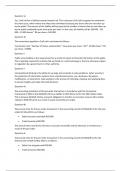
ATI TEAS 7 Science Exams tested Guaranteed A+ and 100% Verified The first four steps on the scientific method are as follows: I. Identify the problem. II. Ask questions. III. Develop a hypothesis. Iv. Collect data and experiment on that data. Which of the following is the fifth step in the scientific method? A. Observe the data. B. Analyze the results. C. Measure the data. D. Develop a conclusion. - answerB. Analyze the results. - There are six steps in the scientific process. The results of step four must be analyzed before reaching the final step. "Develop a conclusion." Which of the following is FALSE regarding the use of qualitative and quantitative data in scientific research? A. Quantitative data is collected through numerical measurements. B. Quantitative data is more accurate than qualitative data. C. Qualitative data is focused on perspectives and behavior. D. Qualitative data is collected through observation and interviews. - answerB. Quantitative data is more accurate than qualitative data. The two types of measurement important in science are qualitative (When a numerical result is used) and qualitative (when descriptions or qualities are reported). Qualitative data is collected through observation and interviews, and focuses on the informant's behavior and perspectives. THE NEXT QUESTION REFERS TO THE FOLLOWING GRAPHICS: The chart above shows the average snowfall in inches for a two on Michigan's Upper Peninsula, during the months November through April. Which of the following can be concluded based on the information that is provided in the chart? A. April is not a good month to go skiing in the Upper Peninsula. B. Snowfall blocks the sunshine reduces the number of sunny days. C. The fewest sunny days occur in the months with the heaviest snowfall. D. There is no connection between the amount of snowfall and the number of sunny days. - answerC. The chart shows two specific changes: snowfall levels from November to April and sunny days from November to April. Which of the following statements correctly describes the function of the corresponding physiologic structure? A. The trachea connects the throat and the stomach, encouraging food to follow this path through contractions. B. The esophagus is the cylindrical portion of the respiratory tract that joins the larynx with the lungs. C. the diaphragm is a muscle that controls the height of the thoracic cavity, decreasing the height on contraction, and increasing the height on relaxation causing expiration. D. The epiglottis covers the trachea during swallowing, preventing food from entering the airway. - answerD. The epiglottis covers the trachea during swelling, thus preventing food from entering the airway. - The trachea (windpipe) is cylindrical portion of the reparatory tract that joins the larynx with the lungs. - The esophagus connects the throat and the stomach. When a person swallows, the esophagus contracts to force the food down into the stomach. The esophagus secretes mucus for lubrication. - The diaphragm is a muscle that controls the height of the thoracic cavity, increasing the height on contraction (inspiration), and decreasing the height on relaxation (expiration). Which of the following is an example of the location and function of cartilage int he body? A. The dense connective tissue that comprises the better part of the structural skeleton. B. The supportive pads that provide cushion at joints, such as between the vertebrae of the spinal cord. C. The connective structure made of fibrous collagen that connects muscles and bones, such as the connection of the patella to the quadricep. D. The layer beneath the skin and on the outside of internal organs that provides cushioning and protection. - answerB. The pads that support the vertebrae are made up of cartilage. - Cartilage, a strong form of connective tissue, cushions ad supports the joints. Cartilage also makes up the larynx and the outer ear. - Bone is a form of connective tissue that comprises the better part of the skeleton. It includes both organic and inorganic substances. - Tendons connect the muscles to other structures of the body, typically bones. Tendons can increase and decrease in length as the bones move. - Fat is a combination of lipids; in humans, fat forms a layer beneath the skin and on the outside of the internal organs. Two criteria for classifying epithelial tissue are: A. Cell type and cell function B. Cell shape and cell type C. Cell layers and cell shape D. Cell function and cell layers - answerC. Cell layers and cell shape are the criteria for classifying epithelial tissue. - Cell layers refers to the amount of cells that separate the basement membrane from the surface, such as a simple single layer, a stratified layer (2 or more), or a pseudostratfied layer. - Cell shapes refer to the shape of the outer cells and can be squamous, columnar or cuboidal. Where is the parathyroid gland located? A. On the lateral lobes of the thyroid gland, on the posterior aspect. B. On the pyramidal lobe of the thyroid gland, on the posterior aspect. C. On the lateral thyroid gland, on the anterior aspect. D. On the left lateral lobe of the thyroid gland, on the anterior aspect. - answerA. The parathyroid gland is located on the lateral lobes of the thyroid gland in the neck, on the posterior aspect. - It is part of the endocrine system. - When the supply of calcium in blood diminishes to unhealthy levels, the parathyroid gland motivates the secretion of a hormone that encourages the bones to release calcium into the bloodstream. The parathyroid Gand also regulates the amount of phosphate in the blood by stimulating the excretion of phosphates in the urine. How many organ system are in the human body? A. 12 B. 15 C. 9 D. 11 - answerD. There are 11 organ systems n the human body. - Circulatory System - Digestive System - Endocrine System - Integumentary System - Lymphatic System - Muscular System - Nervous System - Reproductive System - Respiratory System - Skeletal System - Urinary System Which element or structure within the respiratory system is responsible for removing foreign matter from the lungs? A. Bronchial tubes B. Cilia C. Trachea D. Alveoli - answerB. Cilia. - The cilia are the tiny hairs in the respiratory system that are responsible for removing reign matter from the lungs. - The cilia are located within the bronchial tubes, but it is the cilia that have the responsibility for removing inappropriate materials before they enter the lungs. Organized from highest to lowest, what is the hierarchy of the human body's structures is as follows: - Organism, organ systems, organs, tissues. Which of the following comes next? A. Organs, cells, tissues, molecules, atoms B. Organ system, organism, organ, cells, tissues, atoms, molecules C. Organism, organ system, organs, tissues, cells, molecules, atoms D. Organism, organ, cells, tissues, molecules, atoms - answerC. The order of hierarchy of human body structures is as follows: - Organism - Organ systems - Organs
Written for
- Institution
- ATI TEAS 7 Science
- Course
- ATI TEAS 7 Science
Document information
- Uploaded on
- October 22, 2022
- Number of pages
- 65
- Written in
- 2022/2023
- Type
- Exam (elaborations)
- Contains
- Questions & answers
Subjects
- ati teas 7 science
- ati
- teas
- nursing
-
ati teas 7 science exams tested october 2022 guaranteed a and 100 verified

Also available in package deal