Ce
bt ?
.
.
.
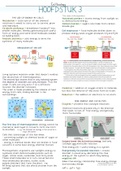
Two steps of photosynthesis
THE USE OF ENERGY BY CELLS Activated carriers = stores energy from sunlight as
Metabolism = total sum of all the chemical a chemical-bond energy
reactions it needs to carry out to survive, grow Carbon fixation = sugars are made from carbon
and reproduce. dioxide gas.
Catabolic pathways = breakdown foodstuff into
smaller molecules, thereby generating both useful Cell respiration = food molecules broken down to
form of energy and some small molecules needed produce energy (uses oxygen produces CO and H O) 2 2
as building block.
Anabolic pathway = uses energy to drive the
synthesis of many molecules
Metabolism of the cell
Living systems maintain order that doesn't violates
the second law of thermodynamics.
The second law states that in any isolated system
the degree of disorder can only increase. Thus the
order in cells can only exist if at a different
location the disorder increases. Oxidation = addition of oxygen atoms to molecule,
The order is made possible by the release of heat but also the removal of electrons form an atom.
energy from cells, making disorder in the
surroundings. Reduction = the addition of electrons to an atom.
FREE ENERGY AND CATALYSIS
Enzymes = proteins that catalyse reactions
Chemical reactions proceed only in the direction
that leads to loss of free energy, energetically
more favourable.
The first law of thermodynamics: energy cannot be
created or destroyed (it converts form one form
to another). The amount of energy in the universe is
stays the same.
Cells that advantage of this law when:
- converting sunlight to chemical bonds of sugar or
other molecules Enzyms lower the activation energy, and only
- energy in chemical bonds that are broken in food catalyse one particular reaction
converts in some heat energy (thermal motion)
Free energy (G) = useful energy in a system
Photosynthetic organisms use sunlights energy to Energetically favourable reactions = create
synthesis small chemical building blocks such as disorder in universe by decreasing the free
sugar, amino acids, nucleotide, and fatty acids. energy of the system to which they belong,
These small molecules ar in turn converted into negative G.
macromolecules (proteins, nucleic acids, Gibbs free-energy: relationship free energy change
polysaccharides) that form the plant. and entropy change = energy harnessed to do work
or drive chemical reaction
All living systems that eat plants provide from the 0 0
sunlight. G = H +T S
ij
bt ?
.
.
.
Two steps of photosynthesis
THE USE OF ENERGY BY CELLS Activated carriers = stores energy from sunlight as
Metabolism = total sum of all the chemical a chemical-bond energy
reactions it needs to carry out to survive, grow Carbon fixation = sugars are made from carbon
and reproduce. dioxide gas.
Catabolic pathways = breakdown foodstuff into
smaller molecules, thereby generating both useful Cell respiration = food molecules broken down to
form of energy and some small molecules needed produce energy (uses oxygen produces CO and H O) 2 2
as building block.
Anabolic pathway = uses energy to drive the
synthesis of many molecules
Metabolism of the cell
Living systems maintain order that doesn't violates
the second law of thermodynamics.
The second law states that in any isolated system
the degree of disorder can only increase. Thus the
order in cells can only exist if at a different
location the disorder increases. Oxidation = addition of oxygen atoms to molecule,
The order is made possible by the release of heat but also the removal of electrons form an atom.
energy from cells, making disorder in the
surroundings. Reduction = the addition of electrons to an atom.
FREE ENERGY AND CATALYSIS
Enzymes = proteins that catalyse reactions
Chemical reactions proceed only in the direction
that leads to loss of free energy, energetically
more favourable.
The first law of thermodynamics: energy cannot be
created or destroyed (it converts form one form
to another). The amount of energy in the universe is
stays the same.
Cells that advantage of this law when:
- converting sunlight to chemical bonds of sugar or
other molecules Enzyms lower the activation energy, and only
- energy in chemical bonds that are broken in food catalyse one particular reaction
converts in some heat energy (thermal motion)
Free energy (G) = useful energy in a system
Photosynthetic organisms use sunlights energy to Energetically favourable reactions = create
synthesis small chemical building blocks such as disorder in universe by decreasing the free
sugar, amino acids, nucleotide, and fatty acids. energy of the system to which they belong,
These small molecules ar in turn converted into negative G.
macromolecules (proteins, nucleic acids, Gibbs free-energy: relationship free energy change
polysaccharides) that form the plant. and entropy change = energy harnessed to do work
or drive chemical reaction
All living systems that eat plants provide from the 0 0
sunlight. G = H +T S
ij