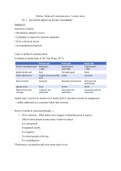
Politics, Media & Communication - Lecture notes
PT. 1 - FILTER BUBBLES & ECHO CHAMBERS
Lecture #1
Functions of media:
• Information (objective news)
• A platform or expressive function (opinions)
• To be a cheek on power
• An entertainment function
Logic of political communication.
Evolution of media logic in NL (Van Praag, 2017):
(media logic is driven by incentives of media itself to maximize income & engagement
→ public addressed as a consumer rather than citizens).
Power of media in expressed through →
1. News selection - What makes news (degree of attention given to topics)
- Affects many people/creates many victims/is topical
- It is unexpected
- It happened nearby
- It is negative
- It is about people at the top
- It is unambiguous
*Preferences of journalist and even owner plays a role
, 2. Framing
- Strategic framing, political as war/contest (limit focus to certain actors)
- Conflict framing, politics as a chicken hen
- Human interest framing, politicians as people
- Issue-specific framing
More press officers than journalists → ability to influence specific narratives/framings
3. Bias (left-wing)
• Van Dalen 2011 - comparative study of Spanish, UK, Swedish and danish journalism
→ Spanish as most partisan oriented (reporting negatively of opposing side and neutrally
about their own), UK most entertainment oriented.
• Beckers et al. 2019 - interview of Flemish journalists
→ Journalists place public opinion more to the right than it actually is
→ Journalists overcompensate for their left-wing views by adjusting stories for right-wing
audiences.
Social media as a liberation or repression technology
→ Technology as liberation:
• Johannes Gutenberg - introduction of the printing press to allow the spread of information at
a faster rate (eg. played a major role in the diffusion of Protestantism).
• The Orange revolution 2004, Green movement 2009 & Arab spring - communication
through social media to allow for mass mobilization.
→ Technology as repression
• Utilised by the autocratic government to repress dissent, eg. China
• Spread of misinformation to sway public opinion eg. Russian bots
• Creation of echo-chambers
PT. 1 - FILTER BUBBLES & ECHO CHAMBERS
Lecture #1
Functions of media:
• Information (objective news)
• A platform or expressive function (opinions)
• To be a cheek on power
• An entertainment function
Logic of political communication.
Evolution of media logic in NL (Van Praag, 2017):
(media logic is driven by incentives of media itself to maximize income & engagement
→ public addressed as a consumer rather than citizens).
Power of media in expressed through →
1. News selection - What makes news (degree of attention given to topics)
- Affects many people/creates many victims/is topical
- It is unexpected
- It happened nearby
- It is negative
- It is about people at the top
- It is unambiguous
*Preferences of journalist and even owner plays a role
, 2. Framing
- Strategic framing, political as war/contest (limit focus to certain actors)
- Conflict framing, politics as a chicken hen
- Human interest framing, politicians as people
- Issue-specific framing
More press officers than journalists → ability to influence specific narratives/framings
3. Bias (left-wing)
• Van Dalen 2011 - comparative study of Spanish, UK, Swedish and danish journalism
→ Spanish as most partisan oriented (reporting negatively of opposing side and neutrally
about their own), UK most entertainment oriented.
• Beckers et al. 2019 - interview of Flemish journalists
→ Journalists place public opinion more to the right than it actually is
→ Journalists overcompensate for their left-wing views by adjusting stories for right-wing
audiences.
Social media as a liberation or repression technology
→ Technology as liberation:
• Johannes Gutenberg - introduction of the printing press to allow the spread of information at
a faster rate (eg. played a major role in the diffusion of Protestantism).
• The Orange revolution 2004, Green movement 2009 & Arab spring - communication
through social media to allow for mass mobilization.
→ Technology as repression
• Utilised by the autocratic government to repress dissent, eg. China
• Spread of misinformation to sway public opinion eg. Russian bots
• Creation of echo-chambers