Sustainability politics lecture notes PT 2
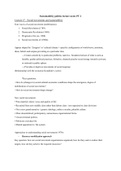
Lecture #7 - Social movements and sustainability
Four waves of social movement (mobilization)
1. French Revolution (1789)
2. Democratic Revolution (1848)
3. Progressive Era (ca. 1908)
4. Social movements of (1960s)
Appear shaped by ‘Zeitgeist’ or ‘cultural climate ́= specific configuration of worldviews, emotions,
ideas, beliefs and utopias prevailing at a particular time
→ Creates sensitivity to particular problems; narrows / broadens horizon of what is seen as
feasible; guides political practices, lifestyles; channels psycho-social energy inward to private,
or outward to public sphere
→ Provides or deprives movements of social response
(Relationship with the economic Kondratiev cycles)
*Key questions:
- How do (changes in) social-cultural-economic conditions shape the emergence, degree of
mobilization of social movements?
- How do social movements shape change?
New social movements:
• Post-material values: ways and quality of life
• Recruited from new middle class rather than labour class / not organized to class divisions
• Not a new grand narrative / generic ideology; rather a secular, pluralist culture
• More decentralized, participatory, autonomous organizational forms
• Unconventional politics
• Politicize everyday life
• Shared opposition to ‘the system
Approaches to understanding social movements 1970s:
- Resource mobilization approach
Key question: how are social movement organizations organized, how do they seek to realize their
targets; how do they achieve the required resources?
, Social movement (McCarthy & Zald)
= a set of opinions and beliefs in a population which represents preferences for changing some
elements of the social structure and/or reward distribution a society
Social movement organization (SMO)
= a complex, or formal organization which identifies its preferences with a social movement or a
counter‐movement and attempts to implement those goals.”
SMO’s differ in objectives, strategy, composition → Why do SMOs differ in recruitment success
and that individuals differ in their temptation to join?
• How do they recruit members / sponsors
• How important are leaders?
• What resources do they draw on? (Money, access to gov’t, businesses; knowledge (substantive;
legal etc.); organizational capacity, time…)
• What impacts do they achieve?
SMO impact:
→ Procedural impacts - open new channels of participation to social movement actors and involve
their recognition as legitimate representatives of demands.
→ Substantive impacts - changes of policy in response to social movement activity
→ Structural impacts - indicate a transformation of the political opportunity structures themselves as a
consequence of social movement activity.
Power depends on potential power and degree of turning it into actual power (depends on structure of
organisation) tightly knit social movement sare mutually well connected through an infrastructure of
national or international networks:
Eg. environmental / climate networks + related networks, on issues like refugees, inequity, starvation..
*Comments on RMA:
1. Kitschelt (neo-pluralist) useful insights on typology on impact and identification of relevant
features of SMOs and explanatory variable
BUT - too limited focus on internal variables, lack of attention to strategic choices and embedment in
external structures and differential access
2. Steinmetz (neo-marxist)
Fails to understand deeper nature of conflicts, and nature of movement members’ grievance
+ Reduces mobilizing to smooth organizations with strategic leadership, ignoring the relationship
between evolving social conflicts and changing identities
, + The more rational choice oriented versions overemphasize individual interest and underrate
symbolic, expressive and moral aspects
- New Social Movements approach
Key question: How to understand interaction between emergence and mobilization of movements and
broader social-cultural-economic change?
Core claims in Steinmetz (1994):
1. New social movements (NSM) pose specific problems for traditional marxist theory
2. Neo-marxist analyses of NSM have their limitations
3. The most promising of these, regulation theory, needs be made less totalizing
4. An alternative interpretation of NSM in Germany is possible
*Challenges to traditional marxism:
Collapse of real-existing socialism in M.E Europe
(Countered by reference to ‘commodification of everything’ in the west (Frankfurter School) or
acknowledgement of failure, search for better elaboration)
+ Serious challenge results from NSM: How to explain the appearance of a cluster of novel
forms of political action, recruitment patterns, and political stakes at a specific moment in
history (1960s through the 1980s), as well as the articulation of these different elements.
→ Limitations of marxist analysis - Critical on:
• Shift relations of exploitation > patterns of domination without (Foucault) or with (Beck) a
materialist basis
• Shift to infinity of stratifications, in various fields, beyond class (Bourdieu)
+ Post-structuralist elaboration of Gramsci:
• For some, both hegemonizers and hegemonized transcend their earlier identities in the process of
hegemonizing
• For others (e.g. Laclau & Mouffe), even, conflicts become only intra-discursive, i.e. loses is material
basis in social (class) relations. There are many factors, together over-determining the course of
history
Explaining patterns of support for NSMs in class terms
→ Empirically, composition of NSM is much more diverse than any specific class (if middle class is
overrepresented higher proclivity to voice concerns)
→ Political economic explanation - (Castells) Cities as sites for reproduction of labour need collective
provisions being used by all, their functioning becomes a common grievance
Steinmetz’ assessment:
Lecture #7 - Social movements and sustainability
Four waves of social movement (mobilization)
1. French Revolution (1789)
2. Democratic Revolution (1848)
3. Progressive Era (ca. 1908)
4. Social movements of (1960s)
Appear shaped by ‘Zeitgeist’ or ‘cultural climate ́= specific configuration of worldviews, emotions,
ideas, beliefs and utopias prevailing at a particular time
→ Creates sensitivity to particular problems; narrows / broadens horizon of what is seen as
feasible; guides political practices, lifestyles; channels psycho-social energy inward to private,
or outward to public sphere
→ Provides or deprives movements of social response
(Relationship with the economic Kondratiev cycles)
*Key questions:
- How do (changes in) social-cultural-economic conditions shape the emergence, degree of
mobilization of social movements?
- How do social movements shape change?
New social movements:
• Post-material values: ways and quality of life
• Recruited from new middle class rather than labour class / not organized to class divisions
• Not a new grand narrative / generic ideology; rather a secular, pluralist culture
• More decentralized, participatory, autonomous organizational forms
• Unconventional politics
• Politicize everyday life
• Shared opposition to ‘the system
Approaches to understanding social movements 1970s:
- Resource mobilization approach
Key question: how are social movement organizations organized, how do they seek to realize their
targets; how do they achieve the required resources?
, Social movement (McCarthy & Zald)
= a set of opinions and beliefs in a population which represents preferences for changing some
elements of the social structure and/or reward distribution a society
Social movement organization (SMO)
= a complex, or formal organization which identifies its preferences with a social movement or a
counter‐movement and attempts to implement those goals.”
SMO’s differ in objectives, strategy, composition → Why do SMOs differ in recruitment success
and that individuals differ in their temptation to join?
• How do they recruit members / sponsors
• How important are leaders?
• What resources do they draw on? (Money, access to gov’t, businesses; knowledge (substantive;
legal etc.); organizational capacity, time…)
• What impacts do they achieve?
SMO impact:
→ Procedural impacts - open new channels of participation to social movement actors and involve
their recognition as legitimate representatives of demands.
→ Substantive impacts - changes of policy in response to social movement activity
→ Structural impacts - indicate a transformation of the political opportunity structures themselves as a
consequence of social movement activity.
Power depends on potential power and degree of turning it into actual power (depends on structure of
organisation) tightly knit social movement sare mutually well connected through an infrastructure of
national or international networks:
Eg. environmental / climate networks + related networks, on issues like refugees, inequity, starvation..
*Comments on RMA:
1. Kitschelt (neo-pluralist) useful insights on typology on impact and identification of relevant
features of SMOs and explanatory variable
BUT - too limited focus on internal variables, lack of attention to strategic choices and embedment in
external structures and differential access
2. Steinmetz (neo-marxist)
Fails to understand deeper nature of conflicts, and nature of movement members’ grievance
+ Reduces mobilizing to smooth organizations with strategic leadership, ignoring the relationship
between evolving social conflicts and changing identities
, + The more rational choice oriented versions overemphasize individual interest and underrate
symbolic, expressive and moral aspects
- New Social Movements approach
Key question: How to understand interaction between emergence and mobilization of movements and
broader social-cultural-economic change?
Core claims in Steinmetz (1994):
1. New social movements (NSM) pose specific problems for traditional marxist theory
2. Neo-marxist analyses of NSM have their limitations
3. The most promising of these, regulation theory, needs be made less totalizing
4. An alternative interpretation of NSM in Germany is possible
*Challenges to traditional marxism:
Collapse of real-existing socialism in M.E Europe
(Countered by reference to ‘commodification of everything’ in the west (Frankfurter School) or
acknowledgement of failure, search for better elaboration)
+ Serious challenge results from NSM: How to explain the appearance of a cluster of novel
forms of political action, recruitment patterns, and political stakes at a specific moment in
history (1960s through the 1980s), as well as the articulation of these different elements.
→ Limitations of marxist analysis - Critical on:
• Shift relations of exploitation > patterns of domination without (Foucault) or with (Beck) a
materialist basis
• Shift to infinity of stratifications, in various fields, beyond class (Bourdieu)
+ Post-structuralist elaboration of Gramsci:
• For some, both hegemonizers and hegemonized transcend their earlier identities in the process of
hegemonizing
• For others (e.g. Laclau & Mouffe), even, conflicts become only intra-discursive, i.e. loses is material
basis in social (class) relations. There are many factors, together over-determining the course of
history
Explaining patterns of support for NSMs in class terms
→ Empirically, composition of NSM is much more diverse than any specific class (if middle class is
overrepresented higher proclivity to voice concerns)
→ Political economic explanation - (Castells) Cities as sites for reproduction of labour need collective
provisions being used by all, their functioning becomes a common grievance
Steinmetz’ assessment: