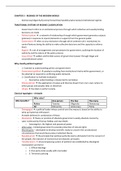
CHAPTER 5 – REGIMES OF THE MODERN WORLD
- Democracy/oligarchy/tyranny/monarchies/republics/autocracies/constitutional regimes
TRADITIONAL SYSTEMS OF REGIME CLASSIFICATION
- Government refers to an institutional process through which collective and usually binding
decisions are made
- Political system → a network of relationships through which government generates outputs
(policies) in response to inputs (demands or support) from the general public
- Government → refers to any mechanism through which ordered rule is maintained, its
central features being the ability to make collective decisions and the capacity to enforce
them
- Regime → a set of arrangements and procedures for government, outlining the location of
authority and the nature of the policy process
- Coup d’état → sudden and forcible seizure of government power through illegal and
unconstitutional action
Why classify political regimes?
- 1. Essential to understanding politics and government
- Government gridlock → paralysis resulting from institutional rivalry within government, or
the attempt to respond to conflicting public demands
- 2. Classification to facilitate evaluation
o Descriptive understanding is closely tied to normative
- Ethnocentrism → the application of values and theories drawn from one’s own culture to
other groups and peoples (bias or distortion
- Utopia → the ideal or perfect society
Classical typologies – Aristotle
Who rules?
Who benefits? One person The few The many
Rulers Tyranny Oligarchy Democracy
All Monarchy Aristocracy Polity
- Demagogue → a political leader whose control over the masses is based on the ability to
whip up hysterical enthusiasm
- Aristotle believed in combination of those
- Absolutism → theory or practice of absolute government usually absolute monarchy
- Later continued by Thomas Hobbes and Jean Bodin
o Sovereignty is the highest and perpetual power
- John Locke – limited government to provide protection of natural rights
- Montesquieu – attempted to develop scientific study to uncover the constitutional
circumstances that would best protect individual liberty
- Republicanism → the principle that political authority stems ultimately from the consent of
the people, the rejection of monarchical and dynastic principles
- Totalitarianism → all-encompassing system of political rule established by ideological
manipulation and terror
o 1. Official ideology
o 2. One-party state usually with one leader
o 3. Terroristic policing
, o 4. Monopoly in mass communication
o 5. Monopoly in armed combat
o 6. State control of economic life
The three worlds typology
- 1. Capitalist first world
o Highest level of influence
o Rivalry with the second world
o Liberal democracy
- 2. Communist second world
o Not as rich but industrial and capable of meeting the needs of the citizens
o Dominated by communist parties
- 3. Developing third world
o Economically dependent and poor
o Authoritarian
- GDP → the total financial value of final goods and services produces in an economy over one
year
- Situation has changed now
o Oil rich states of the middle east
o Third-world countries are no longer just authoritarian
o Eastern Europe revolutions in 1989-1991
- Francis Fukuyama
o Social analyst and political commentator
o Ultimately liberal democracies will win – the end of history
- System classification
o Who rules?
o How is compliance achieved?
o Is government power centralized or fragmented?
o How is government power acquired or transferred?
o What is the balance between the state and the individual?
o What is the level of material development?
o How is economic life organised?
o How stable is the regime?
Key regime features
- Western liberal democracies
o Polyarchies/democracies
o Polyarchy acknowledges that these retimes fall short
o Liberalization → the introduction of internal and external checks on government
power and/or shifts towards private enterprise and the market
o Polyarchy → (rule by many) institutions and political processes of modern
representative democracy
▪ 1. Government is based on election
▪ 2. Elections are free and fair
▪ 3. All adults have the right to vote
▪ 4. The right to run for office is unrestricted
▪ 5. Right for free expression and right to protest
▪ 6. Access to alternative sources of information
- Democracy/oligarchy/tyranny/monarchies/republics/autocracies/constitutional regimes
TRADITIONAL SYSTEMS OF REGIME CLASSIFICATION
- Government refers to an institutional process through which collective and usually binding
decisions are made
- Political system → a network of relationships through which government generates outputs
(policies) in response to inputs (demands or support) from the general public
- Government → refers to any mechanism through which ordered rule is maintained, its
central features being the ability to make collective decisions and the capacity to enforce
them
- Regime → a set of arrangements and procedures for government, outlining the location of
authority and the nature of the policy process
- Coup d’état → sudden and forcible seizure of government power through illegal and
unconstitutional action
Why classify political regimes?
- 1. Essential to understanding politics and government
- Government gridlock → paralysis resulting from institutional rivalry within government, or
the attempt to respond to conflicting public demands
- 2. Classification to facilitate evaluation
o Descriptive understanding is closely tied to normative
- Ethnocentrism → the application of values and theories drawn from one’s own culture to
other groups and peoples (bias or distortion
- Utopia → the ideal or perfect society
Classical typologies – Aristotle
Who rules?
Who benefits? One person The few The many
Rulers Tyranny Oligarchy Democracy
All Monarchy Aristocracy Polity
- Demagogue → a political leader whose control over the masses is based on the ability to
whip up hysterical enthusiasm
- Aristotle believed in combination of those
- Absolutism → theory or practice of absolute government usually absolute monarchy
- Later continued by Thomas Hobbes and Jean Bodin
o Sovereignty is the highest and perpetual power
- John Locke – limited government to provide protection of natural rights
- Montesquieu – attempted to develop scientific study to uncover the constitutional
circumstances that would best protect individual liberty
- Republicanism → the principle that political authority stems ultimately from the consent of
the people, the rejection of monarchical and dynastic principles
- Totalitarianism → all-encompassing system of political rule established by ideological
manipulation and terror
o 1. Official ideology
o 2. One-party state usually with one leader
o 3. Terroristic policing
, o 4. Monopoly in mass communication
o 5. Monopoly in armed combat
o 6. State control of economic life
The three worlds typology
- 1. Capitalist first world
o Highest level of influence
o Rivalry with the second world
o Liberal democracy
- 2. Communist second world
o Not as rich but industrial and capable of meeting the needs of the citizens
o Dominated by communist parties
- 3. Developing third world
o Economically dependent and poor
o Authoritarian
- GDP → the total financial value of final goods and services produces in an economy over one
year
- Situation has changed now
o Oil rich states of the middle east
o Third-world countries are no longer just authoritarian
o Eastern Europe revolutions in 1989-1991
- Francis Fukuyama
o Social analyst and political commentator
o Ultimately liberal democracies will win – the end of history
- System classification
o Who rules?
o How is compliance achieved?
o Is government power centralized or fragmented?
o How is government power acquired or transferred?
o What is the balance between the state and the individual?
o What is the level of material development?
o How is economic life organised?
o How stable is the regime?
Key regime features
- Western liberal democracies
o Polyarchies/democracies
o Polyarchy acknowledges that these retimes fall short
o Liberalization → the introduction of internal and external checks on government
power and/or shifts towards private enterprise and the market
o Polyarchy → (rule by many) institutions and political processes of modern
representative democracy
▪ 1. Government is based on election
▪ 2. Elections are free and fair
▪ 3. All adults have the right to vote
▪ 4. The right to run for office is unrestricted
▪ 5. Right for free expression and right to protest
▪ 6. Access to alternative sources of information