OB/GYN APGO Test Bank Questions & Answers 2022. (All Correct) With Rationale
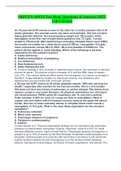
OB/GYN APGO Test Bank Questions & Answers 2022. (All Correct) An 18-year-old G1P0 woman is seen in the clinic for a routine prenatal visit at 28 weeks gestation. Her prenatal course has been unremarkable. She has not been taking prenatal vitamins. Her pre-pregnancy weight was 120 pounds. Initial hemoglobin at the first visit at eight weeks gestation was 12.3 g/dL. Current weight is 138 pounds. After performing a screening complete blood count (CBC), the results are notable for a white blood count 9,700/mL, hemoglobin 10.6 g/dL, mean corpuscular volume 88.2 fL (80.8 - 96.4) and platelets 215,000/mcL. The patient denies vaginal or rectal bleeding. Which of the following is the best explanation for this patient's anemia? A. Folate deficiency B. Relative hemodilution of pregnancy C. Iron deficiency D. Beta thalassemia trait E. Alpha thalassemia trait B. There is normally a 36% increase in maternal blood volume; the maximum is reached around 34 weeks. The plasma volume increases 47% and the RBC mass increases only 17%. This relative dilutional effect lowers the hemoglobin, but causes no change in the MCV. Folate deficiency results in a macrocytic anemia. Iron deficiency and thalassemias are associated with microcytic anemia. A 34-year-old G3P1 woman at 26 weeks gestation reports "difficulty catching her breath," especially after exertion for the last two months. She is a non-smoker. She does not have any history of pulmonary or cardiac disease. She denies fever, sputum, cough or any recent illnesses. On physical examination, her vital signs are: blood pressure 108/64, pulse 88, respiratory rate 15, and she is afebrile. Pulse oximeter is 98% on room air. Lungs are clear to auscultation. Heart is regular rate and rhythm with II/VI systolic murmur heard at the upper left sternal border. She has no lower extremity edema. A complete blood count reveals a hemoglobin of 10.0 g/dL. What is the most likely explanation for this woman's symptoms? A. Pulmonary embolism B. Mitral valve stenosis C. Physiologic dyspnea of pregnancy D. Peripartum cardiomyopathy E. Anemia Correct answer is C. Physical examination findings are not consistent with pulmonary embolus (e.g tachycardia, tachypnea, hypoxia, chest pain, signs of a DVT) or mitral stenosis (diastolic murmur, signs of heart failure). Physiologic dyspnea of pregnancy is present in up to 75% of women by the third trimester. Peripartum cardiomyopathy is an idiopathic cardiomyopathy that presents with heart failure secondary to left ventricular systolic function towards the end of pregnancy or in the several months following delivery. Symptoms include fatigue,
Written for
- Institution
- OB/GYN APGO
- Course
- OB/GYN APGO
Document information
- Uploaded on
- October 12, 2022
- Number of pages
- 35
- Written in
- 2022/2023
- Type
- Exam (elaborations)
- Contains
- Questions & answers
Subjects
-
obgyn apgo test bank questions amp answers 2022 all correct an 18 year old g1p0 woman is seen in the clinic for a routine prenatal visit at 28 weeks gestation her prenatal course has been unr

Also available in package deal