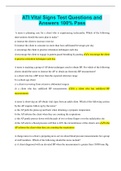
ATI Vital Signs Test Questions and Answers 100% Pass
ATI Vital Signs Test Questions and Answers 100% Pass A nurse is planning care for a client who is experiencing tachycardia. Which of the following interventions should the nurse plan to make? a) instruct the client to increase exercise b) instruct the client to consume no more than four caffeinated beverages per day c) encourage the client to practice relaxation techniques each day d) encourage the client to engage in pattern paced breathing by panting c) encourage the client to practice relaxation techniques each day A nurse is teaching a group of AP about techniques used to obtain BP. For which of the following clients should the nurse to instruct the AP to obtain an electronic BP measurement? a) a client who has a BP lower than the expected reference range b) a school-age client c) a client recovering from extensive abdominal surgery d) a client who has stabilized BP measurements d) a client who has stabilized BP measurements A nurse is observing an AP obtain vital signs from an adult client. Which of the following actions by the AP requires follow up by the nurse? a) the AP pulls the pinna up and back when obtaining a tympanic temperature b) the AP informs the client when they are counting the respirations c) the AP gently presses down with the pads of two or three fingers over the radial pulse site d) the AP selects a blood pressure cuff that is 40% the circumference of the client's arm b) the AP informs the client when they are counting the respirations A charge nurse in a clinic is preparing an in-service about blood pressure measurements for a group of staff members. Which of the following should the nurse include? a) A client diagnosed with an elevated BP when the measurement is greater than 130/80 mm Hg b) A client us experiencing a hypertensive crisis when their BP is greater than 150/90 mm Hg c) A client who has a BP of 128/86 mm Hg has stage I hypertension d) A client who has a blood pressure of 162/102 mm Hg has stage II hypertension d) A client who has a blood pressure of 162/102 mm Hg has stage II hypertension A charge nurse is reviewing documentation of vital signs by a newly licensed nurse. Which of the following pieces of documentation is correct? a) pulse 52/min b) RR 24 c) SaO2 97% right index finger, room air d) BP 132/86 mm Hg c) SaO2 97% right index finger, room air A nurse is assessing a three month old infant during a well-child visit. Which of the following actions should the nurse take when assessing the apical pulse? a) count the number of beats heard in 15 seconds and multiply by 4 b) notify the provider if the apical pulse rate is greater than 110/min c) place the stethoscope over the 4th intercostal space to the left of the sternum d) auscultate the apical pulse for an S4 heart sound c) place the stethoscope over the 4th intercostal space to the left of the sternum A nurse is caring for a group of clients. Which of the following clients is experiencing an alteration in their RR that requires intervention? a) an adolescent who has a RR of 20/min b) an older adult with RR of 16/min c) an infant with RR of 52/min d) a school-age child who has a RR of 14/min d) a school-age child who has a RR of 14/min A nurse is planning care for a group of clients. For which of the following clients should the nurse direct an AP to obtain a rectal temperature? a) a toddler who has diarrhea b) a client who is 1 day post op from hemorrhoid surgery c) an infant who is receiving IV fluids d) a client who is diaphoretic and frequently chewing ice to relieve dry mouth d) a client who is diaphoretic and frequently chewing ice to relieve dry mouth A nurse is reviewing the vitals for a group of clients obtained by an AP. The nurse should identify that which of the following clients requires a follow-up assessment due to bradycardia? a) a school-age child who has an apical pulse of 78/min b) a young adult who has a radial pulse of 56/min c) an adolescent who has a radial pulse of 76/min d) an older adult with apical pulse of 62/min b) a young adult who has a radial pulse of 56/min A nurse is teaching a group of newly licensed nurses about vital sign measurements. Which of the following factors should the nurse include in the teaching? a) anxiety can cause a decrease in RR b) body temperature is typically lower in olde adults c) caffeine can cause a temporary decrease in pulse rate in adolescents d) BP can slightly decrease immediately following the use of nicotine b) body temperature is typically lower in older adults A nurse is obtaining vital signs for a group of clients. Which of the following findings requires intervention? a) a 17 year old who has a RR of 16/min b) a young adult who has a pulse rate of 98/min c) an 11 year old who has a RR of 34/min d) an older adult who has a pulse rate of 62/min c) an 11 year old who has a RR of 34/min A nurse is reviewing the vital signs for a group of clients. Which of the following clients should the nurse identify as exhibiting tachycardia? a) an infant who has an apical pulse rate of 132/min b) a preschooler who has an apical pulse rate of 108/min c) a young adult who has an apical pulse rate of 104/min d) an older adult who has an apical pulse rate of 96/min c) a young adult who has an apical pulse rate of 104/min A charge nurse is teaching a group of AP the importance of documenting accurate vital signs. Which of the following information should the charge nurse include in the teaching? a) record vital signs at the end of the shift b) recording vital signs provides critical information regarding a client's condition c) obtaining and documenting baseline vital signs is the responsibility of the AP d) it is not necessary to record electronic BP measurements b) recording vital signs provides critical information regarding a client's condition A nurse is preparing to obtain a young adult client's apical pulse. In which of the following locations should the nurse place their stethoscope to auscultate the client's pulse? a) apex of the heart b) right side of the sternum c) 4th intercostal space d) midclavicular line below right clavicle a) apex of the heart A charge nurse is discussing mechanisms of loss of body heat with a newly licensed nurse. Which of the following statements should the nurse include? a) "Convection is the loss of body heat when a client is in contact with a cooler surface." b) "Conduction is the loss of body heat when sweat dries from a client's skin." c) "Evaporation is the loss of body heat when a client is near a current of cool air." d) "Radiation is the loss of body heat when a client is in close proximity to a cooler surface." d) "Radiation is the loss of body heat when a client is in close proximity to a cooler surface." A nurse is caring for a client who has a heart rate of 120/min. Which of the following actions should the nurse take? a) instruct the client to bear down like they are having a bowel movement b) offer the client hot caffeinated tea to drink early in the morning c) hold the client's thyroid medication d) encourage the client to take a warm shower a) instruct the client to bear down like they are having a bowel movement A nurse is preparing an in-service about factors affecting RR for a group of APs. Which of the following information should the nurse include? a) anxiety can decrease a client's RR b) opioid analgesics can increase a client's RR c) pain can decrease a client's RR d) Fever can increase a client's RR d) Fever can increase a cli
Written for
- Institution
- ATI Vital Signs
- Course
- ATI Vital Signs
Document information
- Uploaded on
- October 12, 2022
- Number of pages
- 16
- Written in
- 2022/2023
- Type
- Exam (elaborations)
- Contains
- Questions & answers
Subjects
-
ati vital signs test questions and answers 100 pass
-
a nurse is planning care for a client who is experiencing tachycardia which of the following interventions should the nurse plan to make a instr

Also available in package deal