lOMoARcPSD|17103908
RBT EXAM QUESTIONS AND ANSWERS
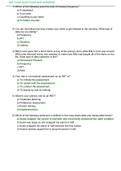
1) Which of the following would be best at tracking frequency?
a) A stopwatch
b) Your hand
c) Counting in your head
d) A clicker counter
.
2) You are recording how long it takes your client to get dressed in the morning. What type of
data are you taking?
a) Frequency
b) IRT
c) Duration
d) Latency
.
3) Billy's mom gave him a list of items to buy at the grocery store while Billy's mom was at work.
When she returned home, she checked to make sure Billy had bought all of the items on the
list. What type of data collection is this?
a) Permanent Product
b) Frequency
c) IRT
d) Rate
.
4) Your role in a functional assessment as an RBT is?
a) To criticize the assessment
b) To assist with the assessment
c) To conduct the assessment
d) To standy by and do nothing
.
5) What is your primary role as an RBT?
a) Treatment planning
b) Preference assessment
c) Parent training
d) Implementation
.
6) Which of the following behaviors is defined in the most observable and measurable terms?
a) Susie snapper her pencil in half after she incorrectly answered the math problem
b) Susie was angry so she snapped her pencil in half
c) Susie snapped her pencil in half because she has autism
d) Susie's anxiety caused her to snap her pencil in half
.
, lOMoARcPSD|17103908
7) You want to decrease the time it takes your client to eat their meal. You are told to record the
length of time in between bites. What kind of data are you collecting?
a) Duration
b) Total task
c) IRT
d) Latency
.
8) What is the difference between frequency and rate?
a) Rate is frequency with a time component added
b) Rate requires duration data
c) There is no difference between the two
d) Rate is more accurate than frequency
.
9) Before you can start collecting data, what is the first thing that should be done?
a) Collect your required materials
b) Define the target behavior
c) Report to your supervisor
d) Select a data collection method
.
10) What type of interval recording underestimates the occurrence of behavior?
a) Partial interval
b) Whole interval
c) Momentary time sampling
d) Frequency
.
11) Which of the following is a type of discontinuous measurement?
a) Frequency
b) Rate
c) Duration
d) Partial interval recording
.
12) What is the goal of a preference assessment?
a) Find out what is reinforcing to the client
b) Determine punishers for the individual
c) Identify stimuli that may be motivating
d) Allow the client to choose what they want to work on during session
.
, lOMoARcPSD|17103908
13) You are teaching your client to say "bubble." Your client says "b" and you deliver
reinforcement. Next time your client says "b" you don't deliver reinforcement. Instead, you wait
until your client says "bub". You repeat this process and slowly increase the requirements for
reinforcement up until your client says "bubble." What are you implementing?
a) Shaping
b) Task chaining
c) FCT
d) Punishment
.
14) You are trying to teach your client to wash your hands. Your BCBA instructs you to use
backwards chaining to teach this. What step might you teach first?
a) Turning the water on
b) Putting soap on their hands
c) Drying their hands off with a towel
d) Entering the bathroom
.
15) A student stands up and walks around the room at inappropriate times. You decide you are
going to deliver reinforcement on a FI-3 reinforcement schedule for the student sitting in their
chair. If the student gets up and walks around no reinforcement is delivered. What type of
procedure is this?
a) DRI
b) DRO
c) DRA
d) DRL
.
16) Your client screams for extended periods of time throughout the day. Your BCBA instructs you
to deliver reinforcement any time the client is not screaming. What type of procedure is this?
a) DRI
b) DRO
c) DRA
d) DRH
.
17) Linda elopes from the table when presented with a lengthy task. You start functional
communication training with Linda in hopes you can teach her to ask for a break. Now,
whenever Linda asks for a break when presented with a lengthy task, you provide
reinforcement. What type of reinforcement procedure is this?
a) DRI
b) DRO
c) DRD
d) DRA
.
RBT EXAM QUESTIONS AND ANSWERS
1) Which of the following would be best at tracking frequency?
a) A stopwatch
b) Your hand
c) Counting in your head
d) A clicker counter
.
2) You are recording how long it takes your client to get dressed in the morning. What type of
data are you taking?
a) Frequency
b) IRT
c) Duration
d) Latency
.
3) Billy's mom gave him a list of items to buy at the grocery store while Billy's mom was at work.
When she returned home, she checked to make sure Billy had bought all of the items on the
list. What type of data collection is this?
a) Permanent Product
b) Frequency
c) IRT
d) Rate
.
4) Your role in a functional assessment as an RBT is?
a) To criticize the assessment
b) To assist with the assessment
c) To conduct the assessment
d) To standy by and do nothing
.
5) What is your primary role as an RBT?
a) Treatment planning
b) Preference assessment
c) Parent training
d) Implementation
.
6) Which of the following behaviors is defined in the most observable and measurable terms?
a) Susie snapper her pencil in half after she incorrectly answered the math problem
b) Susie was angry so she snapped her pencil in half
c) Susie snapped her pencil in half because she has autism
d) Susie's anxiety caused her to snap her pencil in half
.
, lOMoARcPSD|17103908
7) You want to decrease the time it takes your client to eat their meal. You are told to record the
length of time in between bites. What kind of data are you collecting?
a) Duration
b) Total task
c) IRT
d) Latency
.
8) What is the difference between frequency and rate?
a) Rate is frequency with a time component added
b) Rate requires duration data
c) There is no difference between the two
d) Rate is more accurate than frequency
.
9) Before you can start collecting data, what is the first thing that should be done?
a) Collect your required materials
b) Define the target behavior
c) Report to your supervisor
d) Select a data collection method
.
10) What type of interval recording underestimates the occurrence of behavior?
a) Partial interval
b) Whole interval
c) Momentary time sampling
d) Frequency
.
11) Which of the following is a type of discontinuous measurement?
a) Frequency
b) Rate
c) Duration
d) Partial interval recording
.
12) What is the goal of a preference assessment?
a) Find out what is reinforcing to the client
b) Determine punishers for the individual
c) Identify stimuli that may be motivating
d) Allow the client to choose what they want to work on during session
.
, lOMoARcPSD|17103908
13) You are teaching your client to say "bubble." Your client says "b" and you deliver
reinforcement. Next time your client says "b" you don't deliver reinforcement. Instead, you wait
until your client says "bub". You repeat this process and slowly increase the requirements for
reinforcement up until your client says "bubble." What are you implementing?
a) Shaping
b) Task chaining
c) FCT
d) Punishment
.
14) You are trying to teach your client to wash your hands. Your BCBA instructs you to use
backwards chaining to teach this. What step might you teach first?
a) Turning the water on
b) Putting soap on their hands
c) Drying their hands off with a towel
d) Entering the bathroom
.
15) A student stands up and walks around the room at inappropriate times. You decide you are
going to deliver reinforcement on a FI-3 reinforcement schedule for the student sitting in their
chair. If the student gets up and walks around no reinforcement is delivered. What type of
procedure is this?
a) DRI
b) DRO
c) DRA
d) DRL
.
16) Your client screams for extended periods of time throughout the day. Your BCBA instructs you
to deliver reinforcement any time the client is not screaming. What type of procedure is this?
a) DRI
b) DRO
c) DRA
d) DRH
.
17) Linda elopes from the table when presented with a lengthy task. You start functional
communication training with Linda in hopes you can teach her to ask for a break. Now,
whenever Linda asks for a break when presented with a lengthy task, you provide
reinforcement. What type of reinforcement procedure is this?
a) DRI
b) DRO
c) DRD
d) DRA
.