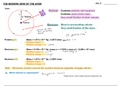
THE MODERN VIEW OF THE ATOM: (Obj. 5)
Atom :
e- n Nucleus: Contains protons and neutrons
n ++
e- +nn n Contains most of the mass
- +
(e Region) Very small fraction of atom volume
n
n
n
n
n
Nucleus
Electrons: Move in surrounding volume
e-
Very small fraction of the mass
e-
Protons (p+): - Mass = 1,673 x 10-27 Kg (1,0073 amu)
- Relative mass = 1
- Relative charge = +1
Electrons (e-) : - Mass = 9,109 x 10-31 Kg (mass e- = 1/1836 x mass p+) (5,486 x 10-4 amu)
- Relative mass = 0
- Relative charge = -1
Neutrons (no): - Mass = 1,675 x 10-27 Kg (1,0087 amu)
- Relative mass = 1
- Relative charge = 0
Note: Electrons revolve around the nucleus because opposite charges attract
Q.: Which element is represented?
Philippe Brunet, Vanier College Chemistry Department, A22
, ATOMIC NUMBER (Z): Z = number of protons (Obj 6)
All atoms of a given element have the same number of protons
1 proton Z=1 Hydrogen
6 protons Z=6 Carbon
Note: Z is the whole number above symbols in P.T.
Fixed for a given element (All H atoms of the universe contain one proton only)
Neutral atoms have same number of protons and electrons: H has 1 e- & C has 6 e-
MASS NUMBER (A): A = number of protons + number of neutrons
E.g. : A Li atom with 3 p+ and 3 n0: Z = 3 A= 3+3=6
A Li atom with 3 p+ and 4 n0: Z = 3 A= 3+4=7
A varies for a given element Isotopes
Note: A is not represented on the periodic table
Philippe Brunet, Vanier College Chemistry Department, A22
Atom :
e- n Nucleus: Contains protons and neutrons
n ++
e- +nn n Contains most of the mass
- +
(e Region) Very small fraction of atom volume
n
n
n
n
n
Nucleus
Electrons: Move in surrounding volume
e-
Very small fraction of the mass
e-
Protons (p+): - Mass = 1,673 x 10-27 Kg (1,0073 amu)
- Relative mass = 1
- Relative charge = +1
Electrons (e-) : - Mass = 9,109 x 10-31 Kg (mass e- = 1/1836 x mass p+) (5,486 x 10-4 amu)
- Relative mass = 0
- Relative charge = -1
Neutrons (no): - Mass = 1,675 x 10-27 Kg (1,0087 amu)
- Relative mass = 1
- Relative charge = 0
Note: Electrons revolve around the nucleus because opposite charges attract
Q.: Which element is represented?
Philippe Brunet, Vanier College Chemistry Department, A22
, ATOMIC NUMBER (Z): Z = number of protons (Obj 6)
All atoms of a given element have the same number of protons
1 proton Z=1 Hydrogen
6 protons Z=6 Carbon
Note: Z is the whole number above symbols in P.T.
Fixed for a given element (All H atoms of the universe contain one proton only)
Neutral atoms have same number of protons and electrons: H has 1 e- & C has 6 e-
MASS NUMBER (A): A = number of protons + number of neutrons
E.g. : A Li atom with 3 p+ and 3 n0: Z = 3 A= 3+3=6
A Li atom with 3 p+ and 4 n0: Z = 3 A= 3+4=7
A varies for a given element Isotopes
Note: A is not represented on the periodic table
Philippe Brunet, Vanier College Chemistry Department, A22