Marketing for Pre-Master Glossary
Chapter 1
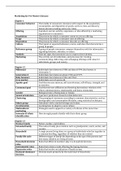
Consumer behavior The totality of consumers’ decisions with respect to the acquisition,
consumption, and disposition of goods, services, time, and ideas by
human decision-making units (over time).
Offering A product, service, activity, experience, or idea offered by a marketing
organization to consumers.
Acquisition The process by which a consumer comes to own an offering.
Usage The process by which a consumer uses an offering.
Disposition The process by which a consumer discards an offering.
Culture The typical or expected behaviors, norms, and ideas that characterize a
group of people.
Reference group A group of people consumers compare themselves with for information
regarding behavior, attitudes, or values.
Symbols External signs that consumers use to express their identity.
Marketing The activity, set of institutions, and processes for creating,
communicating, delivering, and exchanging offerings with value for
individuals, groups, and society.
Chapter 12
Millennial Individuals born between 1980 and about 1994; also known as
Generation Y.
Generation X Individuals born between about 1965 and 1979.
Baby boomers Individuals born between 1946 and 1964.
Gray market Individuals over 65 years old.
Agentic goal Goal that stresses mastery, self-assertiveness, self-efficacy, strength, and
no emotion.
Communal goal Goal that stresses affiliation and fostering harmonious relations with
others, submissiveness, emotionality, and home orientation.
Gender Biological state of being male or female.
Sexual orientation A person’s preference toward certain behaviors.
Clustering The grouping of consumers according to common characteristics, such as
demographics and consumption lifestyles, using statistical techniques.
Ethnic group Subculture with a similar heritage and values.
Acculturation Learning how to adapt to a new culture.
Multicultural Strategies used to appeal to a variety of cultures at the same time.
marketing
Intensity of ethnic How strongly people identify with their ethnic group.
identification
Chapter 13
Nuclear family Father, mother, and children.
Extended family The nuclear family plus relatives such as grandparents, aunts, uncles, and
cousins.
Household A single person living alone or a group of individuals who live together in
a common dwelling, regardless of whether they are related.
Family life cycle Different stages of family life, depending on the age of the parents and
how many children are living at home.
Household decision Roles that different members play in a household decision.
roles
Instrumental roles Roles that relate to tasks affecting the buying decision.
Expressive roles Roles that involve an indication of family norms.
Husband-dominant Decision made primarily by the male head-of-household.
decision
, Wife-dominant Decision made primarily by the female head-of-household.
decision
Autonomic decision Decision equally likely to be made by the husband or wife, but not by
both.
Syncratic decision Decision made jointly by the husband and wife.
Social class The grouping of members of society according to status, high to low.
hierarchy
Overprivileged Families with an income higher than the average in their social class.
Class average Families with an average income in a particular class.
Underprivileged Families below the average income in their class.
Trickle-down effect Trends that start in the upper classes and then are copies by lower
classes.
Status float Trends that start in the lower and middle classes and move upward.
Inherited status Status that derives from parents at birth.
Earned status Status acquired later in life through achievements.
Status crystallization When consumers are consistent across indicators of social class income,
education, occupation, etc.
Upward mobility Raising one’s status level.
Downward mobility Losing one’s social standing.
Social class The disappearance of class distinctions.
fragmentation
Conspicuous The acquisition and display of goods and services to show off one’s
consumption status.
Conspicuous waste Visibly buying products and services that one never uses.
Voluntary simplicity Limiting acquisition and consumption to live a less material life.
Status symbol Product or service that tells other about someone’s social class standing.
Parody display Status symbols that start in the lower-social classes and move upward.
Fraudulent symbol Symbol that becomes so widely adopted that it loses its status.
Compensatory The consumer behavior of buying products or services to offset
consumption frustrations or difficulties in life.
Chapter 14
Psychographics A description of consumers based on their psychological and behavioral
characteristics.
Values Enduring beliefs about abstract outcomes and behaviors that are good or
bad, such as health, independence, family life, and peace.
Value system Our total set of values and their relative importance.
Global values A person’s most enduring, strongly held, and abstract values that hold in
many situations.
Terminal values Highly desired end states such as social recognition and pleasure.
Instrumental values The values needed to achieve the desired end states such as ambition and
cheerfulness.
Domain-specific Values that may only apply to a particular area of activities.
values
Materialism Placing a high importance acquiring and owning material goods and
money.
Hedonism The principle of pleasure seeking.
Means-end chain A technique that can help to explain how values link to attributes in
analysis products and services.
Rokeach Value A survey that measures instrumental and terminal values.
Survey (RVS)
List of Values (LOV) A survey instrument that efficiently measures nine principal values
driving consumer behavior.
Personality General, enduring differences between people in terms of behavior
patterns, feeling, and thinking.
Chapter 1
Consumer behavior The totality of consumers’ decisions with respect to the acquisition,
consumption, and disposition of goods, services, time, and ideas by
human decision-making units (over time).
Offering A product, service, activity, experience, or idea offered by a marketing
organization to consumers.
Acquisition The process by which a consumer comes to own an offering.
Usage The process by which a consumer uses an offering.
Disposition The process by which a consumer discards an offering.
Culture The typical or expected behaviors, norms, and ideas that characterize a
group of people.
Reference group A group of people consumers compare themselves with for information
regarding behavior, attitudes, or values.
Symbols External signs that consumers use to express their identity.
Marketing The activity, set of institutions, and processes for creating,
communicating, delivering, and exchanging offerings with value for
individuals, groups, and society.
Chapter 12
Millennial Individuals born between 1980 and about 1994; also known as
Generation Y.
Generation X Individuals born between about 1965 and 1979.
Baby boomers Individuals born between 1946 and 1964.
Gray market Individuals over 65 years old.
Agentic goal Goal that stresses mastery, self-assertiveness, self-efficacy, strength, and
no emotion.
Communal goal Goal that stresses affiliation and fostering harmonious relations with
others, submissiveness, emotionality, and home orientation.
Gender Biological state of being male or female.
Sexual orientation A person’s preference toward certain behaviors.
Clustering The grouping of consumers according to common characteristics, such as
demographics and consumption lifestyles, using statistical techniques.
Ethnic group Subculture with a similar heritage and values.
Acculturation Learning how to adapt to a new culture.
Multicultural Strategies used to appeal to a variety of cultures at the same time.
marketing
Intensity of ethnic How strongly people identify with their ethnic group.
identification
Chapter 13
Nuclear family Father, mother, and children.
Extended family The nuclear family plus relatives such as grandparents, aunts, uncles, and
cousins.
Household A single person living alone or a group of individuals who live together in
a common dwelling, regardless of whether they are related.
Family life cycle Different stages of family life, depending on the age of the parents and
how many children are living at home.
Household decision Roles that different members play in a household decision.
roles
Instrumental roles Roles that relate to tasks affecting the buying decision.
Expressive roles Roles that involve an indication of family norms.
Husband-dominant Decision made primarily by the male head-of-household.
decision
, Wife-dominant Decision made primarily by the female head-of-household.
decision
Autonomic decision Decision equally likely to be made by the husband or wife, but not by
both.
Syncratic decision Decision made jointly by the husband and wife.
Social class The grouping of members of society according to status, high to low.
hierarchy
Overprivileged Families with an income higher than the average in their social class.
Class average Families with an average income in a particular class.
Underprivileged Families below the average income in their class.
Trickle-down effect Trends that start in the upper classes and then are copies by lower
classes.
Status float Trends that start in the lower and middle classes and move upward.
Inherited status Status that derives from parents at birth.
Earned status Status acquired later in life through achievements.
Status crystallization When consumers are consistent across indicators of social class income,
education, occupation, etc.
Upward mobility Raising one’s status level.
Downward mobility Losing one’s social standing.
Social class The disappearance of class distinctions.
fragmentation
Conspicuous The acquisition and display of goods and services to show off one’s
consumption status.
Conspicuous waste Visibly buying products and services that one never uses.
Voluntary simplicity Limiting acquisition and consumption to live a less material life.
Status symbol Product or service that tells other about someone’s social class standing.
Parody display Status symbols that start in the lower-social classes and move upward.
Fraudulent symbol Symbol that becomes so widely adopted that it loses its status.
Compensatory The consumer behavior of buying products or services to offset
consumption frustrations or difficulties in life.
Chapter 14
Psychographics A description of consumers based on their psychological and behavioral
characteristics.
Values Enduring beliefs about abstract outcomes and behaviors that are good or
bad, such as health, independence, family life, and peace.
Value system Our total set of values and their relative importance.
Global values A person’s most enduring, strongly held, and abstract values that hold in
many situations.
Terminal values Highly desired end states such as social recognition and pleasure.
Instrumental values The values needed to achieve the desired end states such as ambition and
cheerfulness.
Domain-specific Values that may only apply to a particular area of activities.
values
Materialism Placing a high importance acquiring and owning material goods and
money.
Hedonism The principle of pleasure seeking.
Means-end chain A technique that can help to explain how values link to attributes in
analysis products and services.
Rokeach Value A survey that measures instrumental and terminal values.
Survey (RVS)
List of Values (LOV) A survey instrument that efficiently measures nine principal values
driving consumer behavior.
Personality General, enduring differences between people in terms of behavior
patterns, feeling, and thinking.