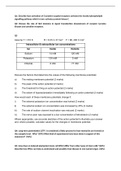
Q1: Describe how activation of G-protein-coupled receptors activates the inositol phospholipid
signalling pathway which in turn activates protein kinase C
Q2: Discuss the role of SH2 domains in signal transduction downstream of receptor tyrosine
kinases and cytokine receptors.
Q3
Assume T = 310 K R = 8.314 J K-1mol-1 F = 96, 400 C mol-1
Intracellular & extracellular ion concentrations
Ion Inside Outside
Sodium 14 mM 125 mM
Potassium 124 mM 5 mM
Chloride 6 mM 77 mM
Discuss the factors that determine the values of the following membrane potentials:
a) The resting membrane potential (2 marks)
b) The peak of the action potential (2 marks)
c) The threshold for firing an action potential (2 marks)
d) The extent of hyperpolarization immediately following an action potential (2 marks)
How would each of these membrane potentials change if:
i) The external potassium ion concentration was halved (2 marks)
ii) The external sodium ion concentration was increased by 25% (2 marks)
iii) The rate of sodium channel inactivation was reduced (2 marks)
iv) The nerve axon was exposed to a low concentration of tetrodotoxin (2 marks)
Where appropriate, use accurate sketches of the action potential to illustrate your answer
and, where possible, calculate values for the changes in membrane potential.
Q4: Long-term potentiation (LTP) is considered a likely process for how memories are formed at
the synaptic level. Why? (50%) What kind of experiments have been done in support of this
statement? (50%)
Q5. How does an induced pluripotent stem cell (iPSC) differ from other types of stem cells? (60%)
Describe how iPSCs can help us understand and possibly treat disease in one named organ. (40%)
signalling pathway which in turn activates protein kinase C
Q2: Discuss the role of SH2 domains in signal transduction downstream of receptor tyrosine
kinases and cytokine receptors.
Q3
Assume T = 310 K R = 8.314 J K-1mol-1 F = 96, 400 C mol-1
Intracellular & extracellular ion concentrations
Ion Inside Outside
Sodium 14 mM 125 mM
Potassium 124 mM 5 mM
Chloride 6 mM 77 mM
Discuss the factors that determine the values of the following membrane potentials:
a) The resting membrane potential (2 marks)
b) The peak of the action potential (2 marks)
c) The threshold for firing an action potential (2 marks)
d) The extent of hyperpolarization immediately following an action potential (2 marks)
How would each of these membrane potentials change if:
i) The external potassium ion concentration was halved (2 marks)
ii) The external sodium ion concentration was increased by 25% (2 marks)
iii) The rate of sodium channel inactivation was reduced (2 marks)
iv) The nerve axon was exposed to a low concentration of tetrodotoxin (2 marks)
Where appropriate, use accurate sketches of the action potential to illustrate your answer
and, where possible, calculate values for the changes in membrane potential.
Q4: Long-term potentiation (LTP) is considered a likely process for how memories are formed at
the synaptic level. Why? (50%) What kind of experiments have been done in support of this
statement? (50%)
Q5. How does an induced pluripotent stem cell (iPSC) differ from other types of stem cells? (60%)
Describe how iPSCs can help us understand and possibly treat disease in one named organ. (40%)