Outline and evaluate research
into the effects of leading
questions on eyewitness
testimony. (16 marks)
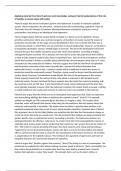
Using a sample of American students, Loftus & Palmer (1974) examined the impact of
leading questions on the reliability of eyewitness testimony. Following the viewing of an
automobile crash film by all participants, a specific question regarding the speed of the
vehicles was posed. By asking, "How fast were they cars driving when they smashed/
collided/ bumped/ hit/ interacted with each other," Loftus and Palmer were able to
change the verb. They discovered that the verb used had an impact on the projected
speed. For instance, when given the term "smashed," participants reported an average
speed of 40.5 mph, while when given the word "contacted," participants reported an
average speed of 31.8 mph, a difference of 8.7 mph overall. These findings
demonstrate unequivocally that leading questions have an impact on the veracity of
eyewitness testimony and that even a single word in a question can have a major
impact on the veracity of our conclusions.
Research by Loftus and Palmer has questionable ecological validity. On the one hand,
asking people about commonplace occurrences like a vehicle accident seems to be a
legitimate way to get eyewitness testimony. However, the participants saw a video of an
automobile accident and saw the entire sequence of events. In most stories of car
accidents, witnesses hardly ever see the entire incident; instead, they either take part in
it immediately or catch a glimpse of it in their peripheral vision. As a result, their findings
do not apply to typical vehicle accidents, and we cannot say if eyewitnesses to actual
accidents, who would have a stronger emotional attachment to the incident, would be
vulnerable to leading inquiries in the same way.
The absence of population validity in Loftus and Palmer's study is a second flaw in their
research. Only American university students were participants in their two experiments.
One could argue that because the students in their study had less driving experience,
Outline and evaluate research into the effects of leading questions on eyewitness testimony. (16 marks) 1
into the effects of leading
questions on eyewitness
testimony. (16 marks)
Using a sample of American students, Loftus & Palmer (1974) examined the impact of
leading questions on the reliability of eyewitness testimony. Following the viewing of an
automobile crash film by all participants, a specific question regarding the speed of the
vehicles was posed. By asking, "How fast were they cars driving when they smashed/
collided/ bumped/ hit/ interacted with each other," Loftus and Palmer were able to
change the verb. They discovered that the verb used had an impact on the projected
speed. For instance, when given the term "smashed," participants reported an average
speed of 40.5 mph, while when given the word "contacted," participants reported an
average speed of 31.8 mph, a difference of 8.7 mph overall. These findings
demonstrate unequivocally that leading questions have an impact on the veracity of
eyewitness testimony and that even a single word in a question can have a major
impact on the veracity of our conclusions.
Research by Loftus and Palmer has questionable ecological validity. On the one hand,
asking people about commonplace occurrences like a vehicle accident seems to be a
legitimate way to get eyewitness testimony. However, the participants saw a video of an
automobile accident and saw the entire sequence of events. In most stories of car
accidents, witnesses hardly ever see the entire incident; instead, they either take part in
it immediately or catch a glimpse of it in their peripheral vision. As a result, their findings
do not apply to typical vehicle accidents, and we cannot say if eyewitnesses to actual
accidents, who would have a stronger emotional attachment to the incident, would be
vulnerable to leading inquiries in the same way.
The absence of population validity in Loftus and Palmer's study is a second flaw in their
research. Only American university students were participants in their two experiments.
One could argue that because the students in their study had less driving experience,
Outline and evaluate research into the effects of leading questions on eyewitness testimony. (16 marks) 1