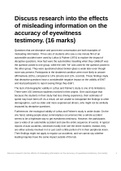
Discuss research into the effects
of misleading information on the
accuracy of eyewitness
testimony. (16 marks)
Questions that are deceptive and post-event conversation are both examples of
misleading information. Three sets of students who saw a one-minute film of an
automobile accident were used by Loftus & Palmer (1974) to explore the impact of
deceptive questions. How fast were the automobiles travelling when they collided? was
the question posed to one group, while the verb "hit" was used for the question posed to
the other group. They were questioned about broken glass a week later even though
none was present. Participants in the shattered condition were more likely to answer
affirmatively (32%), compared to 14% (struck) and 12%. (control). These findings imply
that deceptive questions have a considerable negative impact on the validity of EWT
and lead participants to report seeing things they didn't.
The lack of demographic validity in Loftus and Palmer's study is one of its limitations.
There were 150 American students involved in their project. One could argue that
because the students in their study had less driving experience, their estimates of
speed may have been off. As a result, we are unable to extrapolate the findings to other
demographics, such as older and more experienced drivers, who might not be similarly
impacted by deceptive questions.
Furthermore, the ecological validity of Loftus and Palmer's study is under doubt. On the
one hand, asking people about commonplace occurrences like a vehicle accident
seems to be a legitimate way to get eyewitness testimony. However, the participants
saw a video of an automobile accident and saw the entire sequence of events. In typical
reports of auto accidents, witnesses hardly ever see the entire incident; instead, they
are either actively involved in it or just catch a little portion of it in their peripheral vision.
Their findings might not apply to regular car accidents, and we cannot say whether
leading inquiries have the same impact outside of the lab.
Discuss research into the effects of misleading information on the accuracy of eyewitness testimony. (16 marks) 1
of misleading information on the
accuracy of eyewitness
testimony. (16 marks)
Questions that are deceptive and post-event conversation are both examples of
misleading information. Three sets of students who saw a one-minute film of an
automobile accident were used by Loftus & Palmer (1974) to explore the impact of
deceptive questions. How fast were the automobiles travelling when they collided? was
the question posed to one group, while the verb "hit" was used for the question posed to
the other group. They were questioned about broken glass a week later even though
none was present. Participants in the shattered condition were more likely to answer
affirmatively (32%), compared to 14% (struck) and 12%. (control). These findings imply
that deceptive questions have a considerable negative impact on the validity of EWT
and lead participants to report seeing things they didn't.
The lack of demographic validity in Loftus and Palmer's study is one of its limitations.
There were 150 American students involved in their project. One could argue that
because the students in their study had less driving experience, their estimates of
speed may have been off. As a result, we are unable to extrapolate the findings to other
demographics, such as older and more experienced drivers, who might not be similarly
impacted by deceptive questions.
Furthermore, the ecological validity of Loftus and Palmer's study is under doubt. On the
one hand, asking people about commonplace occurrences like a vehicle accident
seems to be a legitimate way to get eyewitness testimony. However, the participants
saw a video of an automobile accident and saw the entire sequence of events. In typical
reports of auto accidents, witnesses hardly ever see the entire incident; instead, they
are either actively involved in it or just catch a little portion of it in their peripheral vision.
Their findings might not apply to regular car accidents, and we cannot say whether
leading inquiries have the same impact outside of the lab.
Discuss research into the effects of misleading information on the accuracy of eyewitness testimony. (16 marks) 1