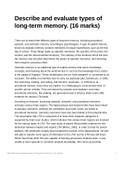
Describe and evaluate types of
long‐term memory. (16 marks)
There are at least three different types of long-term memory, including procedural,
episodic, and semantic memory, according to psychologists. A type of explicit memory
known as episodic memory contains memories of unique experiences, such as the first
day of school. Three things make up episodic memories: the specifics of the event, the
context, and the interconnected emotions. The intensity of the emotions felt at the time
the memory was encoded determines the power of episodic memories, and retrieving
them requires conscious effort.
Semantic memory is an additional type of explicit memory that stores knowledge,
concepts, and meaning about the world we live in, such as the knowledge that London
is the capital of England. These recollections are not "time-stamped" or connected to an
occasion. The ability to remember how to carry out particular jobs, behaviours, or skills,
like swimming, reading, and writing, that become "automatic," is referred to as
procedural memory. Since they are implicit, it is challenging to communicate them to
another person verbally. They are learned by practise and repetition, and many
procedural memories, like walking, are generated early in infancy. Brain scans offer
evidence for various LTM kinds.
According to research, accessing episodic, semantic, and procedural memories
activates various brain regions. The hippocampus and temporal lobe have been linked
to episodic memories, whereas the cerebellum and motor cortex are linked to
procedural memories. Semantic memories have also been linked to the temporal lobe.
The assumption that LTM is composed of at least three separate categories is
supported by brain scan studies, which indicates that various brain regions are involved
for the various types of LTM. The case study of patient HM provides evidence for the
distinction between implicit and explicit LTM (Milner, 1962). In order to treat his severe
epilepsy, HM underwent surgery that included the excision of his hippocampus. He was
still able to transfer some types of information to his LTM, but his STM was still intact.
Milner found that while HM was capable of learning procedural (implicit) tasks, it was
unable to learn episodic or semantic (explicit) knowledge. HM could successfully
Describe and evaluate types of long‐term memory. (16 marks) 1
long‐term memory. (16 marks)
There are at least three different types of long-term memory, including procedural,
episodic, and semantic memory, according to psychologists. A type of explicit memory
known as episodic memory contains memories of unique experiences, such as the first
day of school. Three things make up episodic memories: the specifics of the event, the
context, and the interconnected emotions. The intensity of the emotions felt at the time
the memory was encoded determines the power of episodic memories, and retrieving
them requires conscious effort.
Semantic memory is an additional type of explicit memory that stores knowledge,
concepts, and meaning about the world we live in, such as the knowledge that London
is the capital of England. These recollections are not "time-stamped" or connected to an
occasion. The ability to remember how to carry out particular jobs, behaviours, or skills,
like swimming, reading, and writing, that become "automatic," is referred to as
procedural memory. Since they are implicit, it is challenging to communicate them to
another person verbally. They are learned by practise and repetition, and many
procedural memories, like walking, are generated early in infancy. Brain scans offer
evidence for various LTM kinds.
According to research, accessing episodic, semantic, and procedural memories
activates various brain regions. The hippocampus and temporal lobe have been linked
to episodic memories, whereas the cerebellum and motor cortex are linked to
procedural memories. Semantic memories have also been linked to the temporal lobe.
The assumption that LTM is composed of at least three separate categories is
supported by brain scan studies, which indicates that various brain regions are involved
for the various types of LTM. The case study of patient HM provides evidence for the
distinction between implicit and explicit LTM (Milner, 1962). In order to treat his severe
epilepsy, HM underwent surgery that included the excision of his hippocampus. He was
still able to transfer some types of information to his LTM, but his STM was still intact.
Milner found that while HM was capable of learning procedural (implicit) tasks, it was
unable to learn episodic or semantic (explicit) knowledge. HM could successfully
Describe and evaluate types of long‐term memory. (16 marks) 1