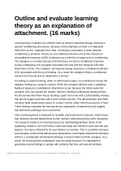
Outline and evaluate learning
theory as an explanation of
attachment. (16 marks)
Learning theory explains how children learn to become attached through classical or
operant conditioning procedures. Because of the emphasis on food, it is frequently
referred to as the "cupboard love" idea. Learning by association is what classical
conditioning is all about. Food is an unconditioned stimulus (UCS) that induces an
unconditioned response (UCR) of pleasure as a relief from hunger prior to conditioning.
The caregiver is a neutral stimulus (NS) that does not elicit a conditioned response.
During conditioning, the youngster associates the food with the caregiver (NS) who
feeds them (UCS). The caregiver, via frequent pairing, becomes a conditioned stimulus
(CS) associated with the joy of feeding. As a result, the caregiver elicits a conditioned
reaction from the kid and an attachment is formed.
According to operant training, when an infant feels hungry, it is motivated to lessen the
negative feelings by crying for comfort. When the caregiver delivers food, a gratifying
feeling of pleasure is established. Attachment occurs because the infant seeks the
caregiver who can provide the reward. Harlow's research undermines learning theory.
He discovered that infant rhesus monkeys spent more time with a soft towelling monkey
that did not supply food than with a wire monkey that did. This demonstrates that infant
monkeys build relationships based on contact comfort rather than the presence of food.
These findings contradict the learning theory explanation of attachment and suggest
that alternative pathways were overlooked.
This counterargument is bolstered by Schaffer and Emmerson's research, which found
that newborns formed attachments to their mothers while being fed by other caregivers.
The research evidence for learning theory has methodological flaws. Much of the
supporting research, such as Pavlov's work with dogs and Skinner's work with rats and
pigeons, has been criticised for its over-reliance on animals. This is a problem because
psychologists contend that behaviourist explanations oversimplify attachment formation,
which is a complicated emotional tie between a human infant and their caregiver. As a
result, the learning theory explanation may be invalid because it is impossible to
generalise animal findings to people with certainty that they will respond similarly.
Outline and evaluate learning theory as an explanation of attachment. (16 marks) 1
theory as an explanation of
attachment. (16 marks)
Learning theory explains how children learn to become attached through classical or
operant conditioning procedures. Because of the emphasis on food, it is frequently
referred to as the "cupboard love" idea. Learning by association is what classical
conditioning is all about. Food is an unconditioned stimulus (UCS) that induces an
unconditioned response (UCR) of pleasure as a relief from hunger prior to conditioning.
The caregiver is a neutral stimulus (NS) that does not elicit a conditioned response.
During conditioning, the youngster associates the food with the caregiver (NS) who
feeds them (UCS). The caregiver, via frequent pairing, becomes a conditioned stimulus
(CS) associated with the joy of feeding. As a result, the caregiver elicits a conditioned
reaction from the kid and an attachment is formed.
According to operant training, when an infant feels hungry, it is motivated to lessen the
negative feelings by crying for comfort. When the caregiver delivers food, a gratifying
feeling of pleasure is established. Attachment occurs because the infant seeks the
caregiver who can provide the reward. Harlow's research undermines learning theory.
He discovered that infant rhesus monkeys spent more time with a soft towelling monkey
that did not supply food than with a wire monkey that did. This demonstrates that infant
monkeys build relationships based on contact comfort rather than the presence of food.
These findings contradict the learning theory explanation of attachment and suggest
that alternative pathways were overlooked.
This counterargument is bolstered by Schaffer and Emmerson's research, which found
that newborns formed attachments to their mothers while being fed by other caregivers.
The research evidence for learning theory has methodological flaws. Much of the
supporting research, such as Pavlov's work with dogs and Skinner's work with rats and
pigeons, has been criticised for its over-reliance on animals. This is a problem because
psychologists contend that behaviourist explanations oversimplify attachment formation,
which is a complicated emotional tie between a human infant and their caregiver. As a
result, the learning theory explanation may be invalid because it is impossible to
generalise animal findings to people with certainty that they will respond similarly.
Outline and evaluate learning theory as an explanation of attachment. (16 marks) 1