14.1 - Control and Co-ordination in
Mammals
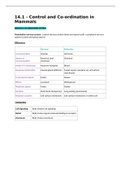
NERVOUS VS ENDOCRINE SYSTEM
Mammalian nervous system - central nervous system (brain and spinal cord) + peripheral nervous
system (cranial and spinal nerves)
Differences
Nervous Endocrine
Communication Impulse Hormone
Nature of Electrical (and Chemical
Communication chemical)
Mode of Transmission Neurone (synapse) Blood
Response Destination Muscle/gland (effector) Target organs (receptor on cell surface
membrane)
Transmission Speed Faster Slower
Effects Localised Widespread
Response Speed Faster Slower
Duration Short-lived (temporary) Long-lasting (permanent)
Receptor Location Cell surface membrane Cell surface membrane or within cell
*Similarities
Cell Signaling Both involve cell signaling
Detail Both involve signal molecule binding to receptor
Chemicals Both involve chemicals
,NEURONES
SENSORY NEURONE
1.Transmit impulses from sensory receptors to the central nervous system (CNS)
Cell body in middle of axon
Nucleus in cell body
Long dendron
Shorter axon
Many mitochondria (in cell body)
Many RER (in cell body)
Synaptic knobs
Terminal dendrites
Schwann cells
Myelin sheath - covers some of length, made by Schwann cells
Nodes of Ranvier
MOTOR NEURONE
3.Transmit impulses from the CNS to the effectors (muscles and glands)
Cell body at one end of axon
Nucleus in cell body
Short dendron
Long axon
Many mitochondria (at synaptic knob)
Many RER (in cell body)
Synaptic vesicles
Schwann cells - make myelin sheath
Node of Ranvier
Dendrites have receptors for neurotransmitters
, RELAY NEURONE
2.Pass impulses on to the motor neurone
Found in the central nervous system
Name of Cell Part Function/Description of Cell Part
Mitochondria Providing ATP for active transport
Nucleus Control the functions of the nerve cell and contains cell's DNA
Dendrites Connect to other neurones or receptors - carry information towards cell
body
Cell Body Where most of the processes take place - e.g. metabolism
Myelin Sheath Lipid covering around the axon of a neurone - insulates axon
Schwann Cell Surround the axon - form the myelin sheath
Mammals
NERVOUS VS ENDOCRINE SYSTEM
Mammalian nervous system - central nervous system (brain and spinal cord) + peripheral nervous
system (cranial and spinal nerves)
Differences
Nervous Endocrine
Communication Impulse Hormone
Nature of Electrical (and Chemical
Communication chemical)
Mode of Transmission Neurone (synapse) Blood
Response Destination Muscle/gland (effector) Target organs (receptor on cell surface
membrane)
Transmission Speed Faster Slower
Effects Localised Widespread
Response Speed Faster Slower
Duration Short-lived (temporary) Long-lasting (permanent)
Receptor Location Cell surface membrane Cell surface membrane or within cell
*Similarities
Cell Signaling Both involve cell signaling
Detail Both involve signal molecule binding to receptor
Chemicals Both involve chemicals
,NEURONES
SENSORY NEURONE
1.Transmit impulses from sensory receptors to the central nervous system (CNS)
Cell body in middle of axon
Nucleus in cell body
Long dendron
Shorter axon
Many mitochondria (in cell body)
Many RER (in cell body)
Synaptic knobs
Terminal dendrites
Schwann cells
Myelin sheath - covers some of length, made by Schwann cells
Nodes of Ranvier
MOTOR NEURONE
3.Transmit impulses from the CNS to the effectors (muscles and glands)
Cell body at one end of axon
Nucleus in cell body
Short dendron
Long axon
Many mitochondria (at synaptic knob)
Many RER (in cell body)
Synaptic vesicles
Schwann cells - make myelin sheath
Node of Ranvier
Dendrites have receptors for neurotransmitters
, RELAY NEURONE
2.Pass impulses on to the motor neurone
Found in the central nervous system
Name of Cell Part Function/Description of Cell Part
Mitochondria Providing ATP for active transport
Nucleus Control the functions of the nerve cell and contains cell's DNA
Dendrites Connect to other neurones or receptors - carry information towards cell
body
Cell Body Where most of the processes take place - e.g. metabolism
Myelin Sheath Lipid covering around the axon of a neurone - insulates axon
Schwann Cell Surround the axon - form the myelin sheath