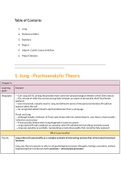
Table of Contents
1. Jung
2. Dollard & Miller
3. Bandura
4. Rogers
5. Allport, Catell, Costa & McRae
6. Major Debates
_______________________________________________________________________________________________
____________________________________________________
1: Jung - Psychoanalytic Theory
Chapter 3
Learning Content
goals
Biography → Carl Jung (1875), among the greatest/most controversial psychological thinkers of the 20th century
→ His concept of collective unconscious greatly enlarges an aspect of personality that Freud barely
explored
→ was introverted, maturity was for Jung not defined in terms of interpersonal relations (Freud) but
balance within the self
→ he recognized within himself a spiritual dimension from a young age.
Freud and Jung
→ Although initially a follower of Freud, later broke with him and develop his own theory of personality -
‘collective unconscious’
→ Freud actually fainted when Jung disagreed on some occasions
→ Jung rejected Freud’s emphasis on sexuality, which Freud believed everything revolved around
→ Jung saw sexuality as symbolic, representing a mysterious quality that cannot be fully analysed
What is personality?
Psyche Jung referred to personality as a complex network of interacting systems that strive toward eventual
harmony
Jung uses the term psyche to refer to all psychological processes (thoughts, feelings, sensations, wishes)
emphasising that it embraces both conscious + unconscious processes
,Freud vs.
Jung Aspect Freud Jung
Structure of 3 conflicting forces Compex network of interacting systems
Personality → id, ego, superego striving toward harmony
→ ego, personal unconscious, collective
unconscious (archetypes)
Concept of The motive force of personality, Used more generalised, a sort of appetite that
Libido according to Freud refers to sexuality or other hunger.
Sexuality Freud emphasized sexuality, Argues Freud's emphasis on sexuality was
reducing/drawing all activities back to reductionist, sees sexuality as symbolic having
sexual. a mysterious quality that can’t be fully
described.
Center of Ego is the executor/center of For jung, lies elsewhere, center of personality is
personality personality the self
Psychic Psychichic energy operates according to principles of entropy: seeks a balance and moves person forward
energy toward the process of self-realisation
,Building
blocks
Example of a complex: motherhood
, Jung’s Jung's Unique contribution to psychology
unique → Freud’s concept of unconscious forces was mostly limited to personal experiences that have been
contributio forgotten
n → Freud minimized the power of unconscious forces
→ Jung place greater emphasis on them stressed qualities that we share with other people ‘Transpersonal’
→ Jung saw that all people have certain things in common
Freud Jung
→ concept of unconscious forces is implied in → more clearly articulated the concept of
Freud’ Oedipus theory, although not clearly unconscious forces
articulated
→ emphasized unique unfolding of unconscious → emphasized shared and collective aspects of
forces and personal unconscious unconscious forces
4 Archetypes → universal thought forms/predisposition to respond to the world in a certain way. Never fully
archetypes enter consciousness as symbolized form or through dreams.
Archetypes represent potentialities: different potential ways in which we may express our humanness
4 universal archetypes (manifested): persona, shadow, anima/animus, self
Cultural archetypes(expressed): grandmother, wise old man, hero, trickster, child-god, hermaphrodite
The persona → one’s social role in society
‘The social mask’ → personae = the mask one wears to adjust to demands of society
→ Compromise between one’s true identity and social identity
→ neglecting persona development → running risk of becoming asocial
→ identifying too completely with persona → hide true identity/hampers development
of other aspects of personality
The shadow → unsocial thoughts, feelings, behaviours we possess but don’t accept
‘The devil within’ → desires/emotions incompatible to social standards/ideal personality (opposite of
persona)
→ it's necessary: there can be no sun without shadow, Jung: “recognize our animalistic
impulses”
Anima/Animus → anima: feminist side of male psyche
1. Jung
2. Dollard & Miller
3. Bandura
4. Rogers
5. Allport, Catell, Costa & McRae
6. Major Debates
_______________________________________________________________________________________________
____________________________________________________
1: Jung - Psychoanalytic Theory
Chapter 3
Learning Content
goals
Biography → Carl Jung (1875), among the greatest/most controversial psychological thinkers of the 20th century
→ His concept of collective unconscious greatly enlarges an aspect of personality that Freud barely
explored
→ was introverted, maturity was for Jung not defined in terms of interpersonal relations (Freud) but
balance within the self
→ he recognized within himself a spiritual dimension from a young age.
Freud and Jung
→ Although initially a follower of Freud, later broke with him and develop his own theory of personality -
‘collective unconscious’
→ Freud actually fainted when Jung disagreed on some occasions
→ Jung rejected Freud’s emphasis on sexuality, which Freud believed everything revolved around
→ Jung saw sexuality as symbolic, representing a mysterious quality that cannot be fully analysed
What is personality?
Psyche Jung referred to personality as a complex network of interacting systems that strive toward eventual
harmony
Jung uses the term psyche to refer to all psychological processes (thoughts, feelings, sensations, wishes)
emphasising that it embraces both conscious + unconscious processes
,Freud vs.
Jung Aspect Freud Jung
Structure of 3 conflicting forces Compex network of interacting systems
Personality → id, ego, superego striving toward harmony
→ ego, personal unconscious, collective
unconscious (archetypes)
Concept of The motive force of personality, Used more generalised, a sort of appetite that
Libido according to Freud refers to sexuality or other hunger.
Sexuality Freud emphasized sexuality, Argues Freud's emphasis on sexuality was
reducing/drawing all activities back to reductionist, sees sexuality as symbolic having
sexual. a mysterious quality that can’t be fully
described.
Center of Ego is the executor/center of For jung, lies elsewhere, center of personality is
personality personality the self
Psychic Psychichic energy operates according to principles of entropy: seeks a balance and moves person forward
energy toward the process of self-realisation
,Building
blocks
Example of a complex: motherhood
, Jung’s Jung's Unique contribution to psychology
unique → Freud’s concept of unconscious forces was mostly limited to personal experiences that have been
contributio forgotten
n → Freud minimized the power of unconscious forces
→ Jung place greater emphasis on them stressed qualities that we share with other people ‘Transpersonal’
→ Jung saw that all people have certain things in common
Freud Jung
→ concept of unconscious forces is implied in → more clearly articulated the concept of
Freud’ Oedipus theory, although not clearly unconscious forces
articulated
→ emphasized unique unfolding of unconscious → emphasized shared and collective aspects of
forces and personal unconscious unconscious forces
4 Archetypes → universal thought forms/predisposition to respond to the world in a certain way. Never fully
archetypes enter consciousness as symbolized form or through dreams.
Archetypes represent potentialities: different potential ways in which we may express our humanness
4 universal archetypes (manifested): persona, shadow, anima/animus, self
Cultural archetypes(expressed): grandmother, wise old man, hero, trickster, child-god, hermaphrodite
The persona → one’s social role in society
‘The social mask’ → personae = the mask one wears to adjust to demands of society
→ Compromise between one’s true identity and social identity
→ neglecting persona development → running risk of becoming asocial
→ identifying too completely with persona → hide true identity/hampers development
of other aspects of personality
The shadow → unsocial thoughts, feelings, behaviours we possess but don’t accept
‘The devil within’ → desires/emotions incompatible to social standards/ideal personality (opposite of
persona)
→ it's necessary: there can be no sun without shadow, Jung: “recognize our animalistic
impulses”
Anima/Animus → anima: feminist side of male psyche