Accounting
Limited Companies
There are two forms of limited companies: Public Limited Company (PLC) and Private
Limited Company (LTD).
Main Features of Limited Companies
Legal nature
- Separate legal entity
- They are owned by the shareholders
- Owners are separated from managers
Perpetual life
- They don’t die as a human dies
- They can be terminated through liquidation
Limited liability
- The company itself is liable for its debts and losses
- Whereas the owner’s liability is limited to the amount they have paid for in
shares
- Investors are thus protected and creditors take more risk
Legal safeguards
- The business has the publish their annual financial statements
- Audits are required for bigger organisations
- Shareholders aren’t able to withdraw share capital
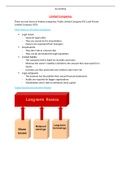
Typical Sources of Long-term Finance
Long-term finance
Long-term
Retained
borrowings
Share earnings
issues
, Accounting
Returns to Shareholders and Lenders
A loan needs to paid on or by the due date, with the addition of interest that the company
agreed to pay. A loan repayment affects both assets (bank) and liabilities (loan). Interest in
expressed as an expense.
When producing a profit the company is able to retain those profits in the business
(increasing the owner’s equity) or they can be paid as dividends to shareholders. Paying
dividends reduces equity and therefore is not an expense
The Role of the Stock Exchange
Primary market
Not a physical market, but is a term used to describe when securities, such as stocks and
bonds, are created and sold. This enables public limited companies to raise new finance
from investors as they aren’t buying and selling these securities form each other, as they do
on secondary markets, they’re buying straight from the banks that are responsible for
underwriting the initial public offering.
Depending on the needs and the stage of the organisation there are a few ways in which it
can generate money from the primary market, and may all three may be utilised, including:
a public issue, rights issue, and preferential allotment.
- Public issue means that investors are able to purchase their shares directly from the
stock exchange.
- Rights issue means that investors get offered new shares at a discounted rate, this is
determined by the shares they already own.
- Preferential allotment means that only a select investors get offered shares at a
discounted rate, of which won’t be found in public issue.
Benefits include:
- A good way for organisations to generate capital at low costs
- A great way in which an organisation is able to reduce their risk with
diversification
- Isn’t effected by market fluctuations
- A highly liquid market due to the fact securities can be sold immediately
- Directly lead to foreign investors
Secondary Markets
Also known as the stock market, wherein investors trade directly amongst themselves and
with all the major indices, meaning: the New York Stock Exchange, NASDAQ, S&P 500 and all
global exchanges. The secondary market differs from the primary market in that securities
are traded without any involvement on behalf of the issuing companies.
Limited Companies
There are two forms of limited companies: Public Limited Company (PLC) and Private
Limited Company (LTD).
Main Features of Limited Companies
Legal nature
- Separate legal entity
- They are owned by the shareholders
- Owners are separated from managers
Perpetual life
- They don’t die as a human dies
- They can be terminated through liquidation
Limited liability
- The company itself is liable for its debts and losses
- Whereas the owner’s liability is limited to the amount they have paid for in
shares
- Investors are thus protected and creditors take more risk
Legal safeguards
- The business has the publish their annual financial statements
- Audits are required for bigger organisations
- Shareholders aren’t able to withdraw share capital
Typical Sources of Long-term Finance
Long-term finance
Long-term
Retained
borrowings
Share earnings
issues
, Accounting
Returns to Shareholders and Lenders
A loan needs to paid on or by the due date, with the addition of interest that the company
agreed to pay. A loan repayment affects both assets (bank) and liabilities (loan). Interest in
expressed as an expense.
When producing a profit the company is able to retain those profits in the business
(increasing the owner’s equity) or they can be paid as dividends to shareholders. Paying
dividends reduces equity and therefore is not an expense
The Role of the Stock Exchange
Primary market
Not a physical market, but is a term used to describe when securities, such as stocks and
bonds, are created and sold. This enables public limited companies to raise new finance
from investors as they aren’t buying and selling these securities form each other, as they do
on secondary markets, they’re buying straight from the banks that are responsible for
underwriting the initial public offering.
Depending on the needs and the stage of the organisation there are a few ways in which it
can generate money from the primary market, and may all three may be utilised, including:
a public issue, rights issue, and preferential allotment.
- Public issue means that investors are able to purchase their shares directly from the
stock exchange.
- Rights issue means that investors get offered new shares at a discounted rate, this is
determined by the shares they already own.
- Preferential allotment means that only a select investors get offered shares at a
discounted rate, of which won’t be found in public issue.
Benefits include:
- A good way for organisations to generate capital at low costs
- A great way in which an organisation is able to reduce their risk with
diversification
- Isn’t effected by market fluctuations
- A highly liquid market due to the fact securities can be sold immediately
- Directly lead to foreign investors
Secondary Markets
Also known as the stock market, wherein investors trade directly amongst themselves and
with all the major indices, meaning: the New York Stock Exchange, NASDAQ, S&P 500 and all
global exchanges. The secondary market differs from the primary market in that securities
are traded without any involvement on behalf of the issuing companies.