When oligopolists collude, the results can be an -compe ve and against
the consumer interest’ (Extract E, lines 27-28) Evaluate policies that could
be used to deal with this problem (25 marks)
Oligopoly is where a market is dominated by a few rms holding majority of
the market share thus a high level of market concentra on. However
behaviour such as use of product branding, barriers to entry,
interdependency etc. promotes an -compe veness which is most
signi cant in iden fying oligopolists. There are several policies that can be
used to tackle problems of collusion (which can act against consumer’s
interests) such as interven ons from the government for example;
subsidising new compe tors and taxa on.
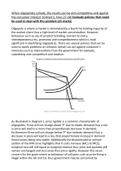
As illustrated in diagram 1, price rigidity is a common characteris c of
oligopolies. Firms will not charge above ‘P’ due to elas c demand thus a rise
in price will lead to a more than propor onate decrease in demand,
furthermore rms will not charge below ‘P’ due inelas c demand thus a
decrease in price will lead to a less that propor onate increase in demand
hence prices being very stable. Addi onally the discon nued or ver cal
sec on of the MR curve highlights that if costs increase (MC1 to MC2),
marginal cost will s ll equal to marginal revenue thus price and quan ty will
remain unchanged and vice-versa thus price rigidity. However this raises
concern for the government as behaviour of collusion such as price- xing is
illegal within the UK and EU; thus government may be concerned by
tifi fi titi ti ti titi ti ti titi ti tifi ti
titi titi ti tifiti
the consumer interest’ (Extract E, lines 27-28) Evaluate policies that could
be used to deal with this problem (25 marks)
Oligopoly is where a market is dominated by a few rms holding majority of
the market share thus a high level of market concentra on. However
behaviour such as use of product branding, barriers to entry,
interdependency etc. promotes an -compe veness which is most
signi cant in iden fying oligopolists. There are several policies that can be
used to tackle problems of collusion (which can act against consumer’s
interests) such as interven ons from the government for example;
subsidising new compe tors and taxa on.
As illustrated in diagram 1, price rigidity is a common characteris c of
oligopolies. Firms will not charge above ‘P’ due to elas c demand thus a rise
in price will lead to a more than propor onate decrease in demand,
furthermore rms will not charge below ‘P’ due inelas c demand thus a
decrease in price will lead to a less that propor onate increase in demand
hence prices being very stable. Addi onally the discon nued or ver cal
sec on of the MR curve highlights that if costs increase (MC1 to MC2),
marginal cost will s ll equal to marginal revenue thus price and quan ty will
remain unchanged and vice-versa thus price rigidity. However this raises
concern for the government as behaviour of collusion such as price- xing is
illegal within the UK and EU; thus government may be concerned by
tifi fi titi ti ti titi ti ti titi ti tifi ti
titi titi ti tifiti