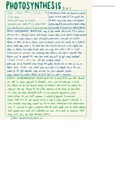
PHOTOSYNTHESIS s.si
" ""
6102 + 6 Hz 0 > to Hiroo +
602 CHEM 1 OSMOTIC THEORY each :
thylakoid enclosed is as
3- - stages
mais -
chamber into which protons 1h4 pumped from
are
capturing light energy by chlorophyll the stroma
using proton pumps in the thylakoid
Light dependent
-
reaction produces ATP Oz reduced NADP
:
, ,
membranes energy for this comes from electrons released
,
in photolysis
Light independent
-
reaction :
protons 1Mt) used to make sugars which also produces htlmountains conc . gradient thylakoid )
in
LIGHT -
DEPENDENT REACTION :
energy of light captured used to make ATP or photolysis
MAKING ATP :
chlorophyll absorbs light energy ,
increases energy excites electrons
,
to
higher energy level
•
electrons have enough energy
to leave chlorophyll photo ionisation -
chlorophyll are oxidised
•
electrons are takes up by an electron carrier Iis reduced ) ,
carries form transfer chain in
thylakoid
• electrons passed along carries is the transfer chain 1 redox reactions) each ,
carrier is at a
slightly lower
energy so electrons lose energy at each stage ,
some
energy
host is used in ATP + P → ADP
PHOTOLYSIS OF WATER : since
chlorophyll loses electrons when light is absorbed these
electrons must be replaced this comes from wake being split by Ight energy 1 photolysis )
2h20 4h +
lthrs also produces protons)
-
•
→ + Lie +
Oz
•
protons pass out of thylakoid space through
synathes channels and are taken ATP up by an
electron carrier -
NADP When NADP takes up protons it is reduced
. this is ,
the man
product of the
light dependent stage and enters the light independent reaction
-
-
.
•
oxygen produced lby product ) diffuses- out of the leaf or is used in respiration
LIGHT INDEPENDENT REACTION - : ATP and reduced NADP
from light dependent -
used to reduce 3- phosphate
are glycerite .
Calvin cycle which takes place in stroma
•
Coz diffuses into the leaf through stomata and dissolves in water around the walls of the
mesophyll cells then ,
through the all surface membrane into the stroma
-
of chloroplasts
•
LO z reacts with ribulose triphosphate IRUBP -
a 5 carbon compound) catalysed by rubisco
•
reaction between Oz and RUBP produces 2 molecules of glycerite 3-phosphate
. . . .. . ..... . .. . . . . .. ... ... . .
triose phosphate using energy supplied by ATP ,
this reforms NADP lgoes back to lryht dependent
-
reaction)
•
some TP converted to organic substances that the plant needs such as starch cellulose , ,
lipids glucose, ,
amino acids and nucleotides but most TP is used to regenerate RUBP
using AFP from the light dependent reaction
LEAF ADAPTATIONS →
" ""
6102 + 6 Hz 0 > to Hiroo +
602 CHEM 1 OSMOTIC THEORY each :
thylakoid enclosed is as
3- - stages
mais -
chamber into which protons 1h4 pumped from
are
capturing light energy by chlorophyll the stroma
using proton pumps in the thylakoid
Light dependent
-
reaction produces ATP Oz reduced NADP
:
, ,
membranes energy for this comes from electrons released
,
in photolysis
Light independent
-
reaction :
protons 1Mt) used to make sugars which also produces htlmountains conc . gradient thylakoid )
in
LIGHT -
DEPENDENT REACTION :
energy of light captured used to make ATP or photolysis
MAKING ATP :
chlorophyll absorbs light energy ,
increases energy excites electrons
,
to
higher energy level
•
electrons have enough energy
to leave chlorophyll photo ionisation -
chlorophyll are oxidised
•
electrons are takes up by an electron carrier Iis reduced ) ,
carries form transfer chain in
thylakoid
• electrons passed along carries is the transfer chain 1 redox reactions) each ,
carrier is at a
slightly lower
energy so electrons lose energy at each stage ,
some
energy
host is used in ATP + P → ADP
PHOTOLYSIS OF WATER : since
chlorophyll loses electrons when light is absorbed these
electrons must be replaced this comes from wake being split by Ight energy 1 photolysis )
2h20 4h +
lthrs also produces protons)
-
•
→ + Lie +
Oz
•
protons pass out of thylakoid space through
synathes channels and are taken ATP up by an
electron carrier -
NADP When NADP takes up protons it is reduced
. this is ,
the man
product of the
light dependent stage and enters the light independent reaction
-
-
.
•
oxygen produced lby product ) diffuses- out of the leaf or is used in respiration
LIGHT INDEPENDENT REACTION - : ATP and reduced NADP
from light dependent -
used to reduce 3- phosphate
are glycerite .
Calvin cycle which takes place in stroma
•
Coz diffuses into the leaf through stomata and dissolves in water around the walls of the
mesophyll cells then ,
through the all surface membrane into the stroma
-
of chloroplasts
•
LO z reacts with ribulose triphosphate IRUBP -
a 5 carbon compound) catalysed by rubisco
•
reaction between Oz and RUBP produces 2 molecules of glycerite 3-phosphate
. . . .. . ..... . .. . . . . .. ... ... . .
triose phosphate using energy supplied by ATP ,
this reforms NADP lgoes back to lryht dependent
-
reaction)
•
some TP converted to organic substances that the plant needs such as starch cellulose , ,
lipids glucose, ,
amino acids and nucleotides but most TP is used to regenerate RUBP
using AFP from the light dependent reaction
LEAF ADAPTATIONS →