Pierre Bourdieu - The Logic of Practice
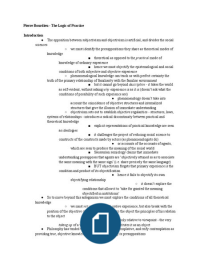
Introduction
● The opposition between subjectivism and objectivism is artificial, and divides the social
sciences
○ we must identify the presuppositions they share as theoretical modes of
knowledge
■ theoretical as opposed to the practical mode of
knowledge of ordinary experience
■ hence we must objectify the epistemological and social
conditions of both subjective and objective experience
○ phenomenological knowledge can teach us with perfect certainty the
truth of the primary relationship of familiarity with the familiar environment
■ but it cannot go beyond description - it takes the world
as self-evident, without asking why experience is as it is (doesn’t ask what the
conditions of possibility of such experience are)
● phenomenology doesn’t take into
account the coincidence of objective structures and internalized
structures that give the illusion of immediate understanding
○ objectivism sets out to establish objective regularities - structures, laws,
systems of relationships - introduces a radical discontinuity between practical and
theoretical knowledge
■ explicit representations of practical knowledge are seen
as ideologies
■ it challenges the project of reducing social science to
constructs of the constructs made by actors (as phenomenologists do)
● or accounts of the accounts of agents,
which are seen to produce the meaning of the social world
■ Saussurian semiology claims that immediate
understanding presupposes that agents are ‘objectively attuned so as to associate
the same meaning with the same sign’ (i.e. share precisely the same language)
■ BUT objectivism forgets that primary experience is the
condition and product of its objectification
● hence it fails to objectify its own
objectifying relationship
○ it doesn’t explore the
conditions that allow it to ‘take for granted the meaning
objectified in institutions’
● So to move beyond this antagonism we must explore the conditions of all theoretical
knowledge
○ we must not only break with native experience, but also break with the
position of the objective observer, who brings into the object the principles of his relation
to the object
■ knowledge is not only relative to viewpoint - the very
taking up of a viewpoint on a practice constitutes it as an object
● Philosophy has tended to reject practice as uncomtemplative, and reify contemplation as
providing true, objective knowledge, without questioning its presuppositions
Introduction
● The opposition between subjectivism and objectivism is artificial, and divides the social
sciences
○ we must identify the presuppositions they share as theoretical modes of
knowledge
■ theoretical as opposed to the practical mode of
knowledge of ordinary experience
■ hence we must objectify the epistemological and social
conditions of both subjective and objective experience
○ phenomenological knowledge can teach us with perfect certainty the
truth of the primary relationship of familiarity with the familiar environment
■ but it cannot go beyond description - it takes the world
as self-evident, without asking why experience is as it is (doesn’t ask what the
conditions of possibility of such experience are)
● phenomenology doesn’t take into
account the coincidence of objective structures and internalized
structures that give the illusion of immediate understanding
○ objectivism sets out to establish objective regularities - structures, laws,
systems of relationships - introduces a radical discontinuity between practical and
theoretical knowledge
■ explicit representations of practical knowledge are seen
as ideologies
■ it challenges the project of reducing social science to
constructs of the constructs made by actors (as phenomenologists do)
● or accounts of the accounts of agents,
which are seen to produce the meaning of the social world
■ Saussurian semiology claims that immediate
understanding presupposes that agents are ‘objectively attuned so as to associate
the same meaning with the same sign’ (i.e. share precisely the same language)
■ BUT objectivism forgets that primary experience is the
condition and product of its objectification
● hence it fails to objectify its own
objectifying relationship
○ it doesn’t explore the
conditions that allow it to ‘take for granted the meaning
objectified in institutions’
● So to move beyond this antagonism we must explore the conditions of all theoretical
knowledge
○ we must not only break with native experience, but also break with the
position of the objective observer, who brings into the object the principles of his relation
to the object
■ knowledge is not only relative to viewpoint - the very
taking up of a viewpoint on a practice constitutes it as an object
● Philosophy has tended to reject practice as uncomtemplative, and reify contemplation as
providing true, objective knowledge, without questioning its presuppositions