Term 2:
Creative-thinking and problem solving:
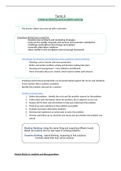
Creative thinking:
- The process where you come up with a new idea.
Creative thinking is used to:
Develop new products and marketing strategies
Improve the quality of goods and services and customer satisfaction
Challenge assumptions and change perceptions
Generate alternative solutions
Solve conflict in the workplace and encourage teamwork.
Advantages for business and employees when applying creative thinking:
- Meetings can be shorter and more productive
- Better and quicker problem-solving and decision making take place
- Planning and management = more effective and efficient
- More innovative ideas are created, which leads to better performance
Problem-solving skills:
- Employee performance/productivity can be benchmarked against the norms and standards
- If not reached, there could be a problem.
- Identify the problem and look for a solution
Problem-solving steps:
1. Define the problem. Identify the crisis and list possible reasons for the problem.
2. Collect data and information about the problem. Be as objective as you can.
3. Analyze all the facts and information to help you understand the problem.
4. Think of as many solutions to the problem as possible.
5. Evaluate and select alternative solutions.
6. Develop and implement an action plan to solve the problem.
7. Monitor and follow up to check the end result and see whether the problem was
solved.
Routine thinking: doing the same thing and expecting different result.
Break old routines and try new ways of solving problems.
Creative thinking : lateral thinking; reasoning to find solutions
Involves ideas that may not be obvious
Mental blocks to creativity and idea generation:
, - Barriers that prevent you from recognising a problem or finding a solution to that problem
Internal blocks Blocks that are ruled by emotions, fear,
judgement and reflections.
Perceptual blocks Blocks that prevent you from seeing the
problem clearly or finding a solution
Intellectual and expressive blocks Intellectual blocks - lead to poor strategies or
plans to try to solve the problem
Expressive blocks- ability to communicate ideas
is difficult
Cultural blocks Blocks that people do not want to go against
their traditional beliefs
Environmental blocks Blocks include the social and physical
environment in which we live and work. The
social environment is where there should be
honesty, trust and support.
Complex problem-solving techniques
1. Delphi technique:
- Participants are not in the same place, anonymous interviews/confidential questionnaire
Step 1: a problem is identified - ask participants to write down five possible solutions to this
problem
Step 2: each group participant completes the questionnaire alone and anonymous
Step 3: results analysed in a central place
Step 4: group members give new/revised solutions after results
Step 5: step 3&4 are repeated until all members agree.
2. Force field analysis
- Negative vs positive forces St Driving St
- Steps: re re
forces Restrain
1. List + discuss the forces in ng ng
ing
favour (driving forces) th th
Increased Force
2. List + discuss the forces against
efficiency
(restraining forces) 4 3
3. Weigh up the driving and Capital
restraining forces
No
Customer Ch
investme
chan
demand nt ang
3 7
ge e
Executive
5 mandate 4
Fear
Conventional vs non-conventional solutions: 4 trust in 3
Lack of
unit incentives
16 leader 17
Lack of
training
Creative-thinking and problem solving:
Creative thinking:
- The process where you come up with a new idea.
Creative thinking is used to:
Develop new products and marketing strategies
Improve the quality of goods and services and customer satisfaction
Challenge assumptions and change perceptions
Generate alternative solutions
Solve conflict in the workplace and encourage teamwork.
Advantages for business and employees when applying creative thinking:
- Meetings can be shorter and more productive
- Better and quicker problem-solving and decision making take place
- Planning and management = more effective and efficient
- More innovative ideas are created, which leads to better performance
Problem-solving skills:
- Employee performance/productivity can be benchmarked against the norms and standards
- If not reached, there could be a problem.
- Identify the problem and look for a solution
Problem-solving steps:
1. Define the problem. Identify the crisis and list possible reasons for the problem.
2. Collect data and information about the problem. Be as objective as you can.
3. Analyze all the facts and information to help you understand the problem.
4. Think of as many solutions to the problem as possible.
5. Evaluate and select alternative solutions.
6. Develop and implement an action plan to solve the problem.
7. Monitor and follow up to check the end result and see whether the problem was
solved.
Routine thinking: doing the same thing and expecting different result.
Break old routines and try new ways of solving problems.
Creative thinking : lateral thinking; reasoning to find solutions
Involves ideas that may not be obvious
Mental blocks to creativity and idea generation:
, - Barriers that prevent you from recognising a problem or finding a solution to that problem
Internal blocks Blocks that are ruled by emotions, fear,
judgement and reflections.
Perceptual blocks Blocks that prevent you from seeing the
problem clearly or finding a solution
Intellectual and expressive blocks Intellectual blocks - lead to poor strategies or
plans to try to solve the problem
Expressive blocks- ability to communicate ideas
is difficult
Cultural blocks Blocks that people do not want to go against
their traditional beliefs
Environmental blocks Blocks include the social and physical
environment in which we live and work. The
social environment is where there should be
honesty, trust and support.
Complex problem-solving techniques
1. Delphi technique:
- Participants are not in the same place, anonymous interviews/confidential questionnaire
Step 1: a problem is identified - ask participants to write down five possible solutions to this
problem
Step 2: each group participant completes the questionnaire alone and anonymous
Step 3: results analysed in a central place
Step 4: group members give new/revised solutions after results
Step 5: step 3&4 are repeated until all members agree.
2. Force field analysis
- Negative vs positive forces St Driving St
- Steps: re re
forces Restrain
1. List + discuss the forces in ng ng
ing
favour (driving forces) th th
Increased Force
2. List + discuss the forces against
efficiency
(restraining forces) 4 3
3. Weigh up the driving and Capital
restraining forces
No
Customer Ch
investme
chan
demand nt ang
3 7
ge e
Executive
5 mandate 4
Fear
Conventional vs non-conventional solutions: 4 trust in 3
Lack of
unit incentives
16 leader 17
Lack of
training