3.3 Break Even Analysis
• Break even analysis is an analytical tool business can use to determine the number of sales required
to cover the total costs
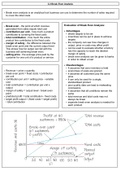
• Break even - the point at which revenue Evaluation of Break Even Analysis:
generated from sales equals total cost
• contribution per unit - how much a product • Advantages
contributes to covering the fixed costs • allows targets to be set
• total contribution - how much the entire • incentives can be put in place to achieve
product line contributes to the fixed costs targets
• margin of safety - the difference between the • the company can see how changes in
break even point and the current output level. output, price or costs may affect profit
This shows how far output can fall with the • can be used to evaluate whether a factory
business still achieving break even. has the capacity to reach the desired
• selling price - the average price paid by the margin of safety
customer for one unit of a product or service • break even analysis can be given to banks
in order to obtain a loan
• Disadvantages
• It assumes that zero inventory is held
• Revenue = price x quantity • economies of scale are ignored
• break even point = fixed costs / contribution • it assumes all customers pay the same
per unit price
• contribution per unit = selling price - variable • it can only be used for a single,
cost standardised product
• total contribution = contribution per unit x • poor quality data can lead to misleading
output conclusions
• margin of safety = output level - break even • it assumers that all conditions remain the
point same
• predicted profit = total contribution - fixed costs • total revenue and total costs may not
• target profit output = (fixed costs + target profit) always be linear
/ total contribution • separate break even analysis is needed for
each product
• Break even analysis is an analytical tool business can use to determine the number of sales required
to cover the total costs
• Break even - the point at which revenue Evaluation of Break Even Analysis:
generated from sales equals total cost
• contribution per unit - how much a product • Advantages
contributes to covering the fixed costs • allows targets to be set
• total contribution - how much the entire • incentives can be put in place to achieve
product line contributes to the fixed costs targets
• margin of safety - the difference between the • the company can see how changes in
break even point and the current output level. output, price or costs may affect profit
This shows how far output can fall with the • can be used to evaluate whether a factory
business still achieving break even. has the capacity to reach the desired
• selling price - the average price paid by the margin of safety
customer for one unit of a product or service • break even analysis can be given to banks
in order to obtain a loan
• Disadvantages
• It assumes that zero inventory is held
• Revenue = price x quantity • economies of scale are ignored
• break even point = fixed costs / contribution • it assumes all customers pay the same
per unit price
• contribution per unit = selling price - variable • it can only be used for a single,
cost standardised product
• total contribution = contribution per unit x • poor quality data can lead to misleading
output conclusions
• margin of safety = output level - break even • it assumers that all conditions remain the
point same
• predicted profit = total contribution - fixed costs • total revenue and total costs may not
• target profit output = (fixed costs + target profit) always be linear
/ total contribution • separate break even analysis is needed for
each product