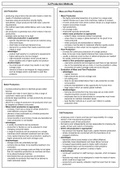
5.2 Production Methods
Job Production: Mass and Flow Production:
• producing unique items that are tailor-made to meet the • Mass Production
needs of individual customers • the highly automated assembly of a product on a large scale
• business using job production provide highly • capital intensive as it uses more machinery relative to workers
specialised, unique products that fulfil exact customer • involves production lines where workers remain at a single station
requirements • massive economies of scale
• the method uses highly skilled labour, and is very labour • high productivity
intensive • low average costs
• job production is generally slow which means it has low • employees typically demotivated
productivity • where mass production is appropriate
• average costs are likely to be high • suited to large, consumer product companies
• where job production is appropriate • where there is a large or global demand for the good to be
• specific requirement that cannot be matched using mass produced
other techniques • where products are standardised or identical
• client base is small and demand is low • company must be able to implement effective quality control
• demand for a product that meets customers exact techniques so that output can be regularly checked
needs or style • Flow Production
• advantages • involves the continuous production of a single product
• product built exactly to a customer’s requirements • likely to be even more capital intensive than mass production
• higher selling price can be charged • usually a relatively small number of skilled employees are needed
• high employee motivation which should lead to for quality control and maintenance
fewer mistakes and a higher quality end product • where is flow production appropriate
• disadvantages • used when products are homogenous and there is high demand
• the small scale of output may results in very high • due to the substantial set-up costs, it must be possible to utilise
average costs economies of scale if average costs are to be reduced
• demand is likely to be irregular for mega projects • Evaluation of Mass and Flow Production
such as bridges which could lead to cash flow • advantages
problems • capital intensive
• high productivity and low average cost
• low selling price
• likely to use less skilled labour than in job production so less
remuneration
Batch Production:
• products standardised to less opportunity for human error
• large output which can satisfy global markets
• involves producing items in identical groups called • disadvantages
batches
• factories and production lines have large set-up costs which
• changes are made in each batch so that a range of requires long-term sources of finance
customers’ needs can be fulfilled
• employees tend to be demotivated so companies must invest
• produces large quantities, so high productivity and lower resources to maintain motivation levels
average costs
• least flexible methods as it would cost millions to update
• allows for a range of products to be produced which can production lines
be targeted at different consumers
• Where batch production is appropriate
• company must have a range of similar products to
meet different consumer needs
Cell Production:
• demand is less predictable so a flexible production
process is desirable
• where benefits of economies of scale are desirable but • employees work in teams and take joint responsibility for a large
mass production is not feasible section of the manufacturing process
• advantages • considered a part of lean production
• a variety of products can be produced • the teams work independently and are responsible for checking the
quality of their work which is motivating
• production is flexible so can be adjusted to meet
changing consumer tastes • where cell production is appropriate
• a range of products can be produced on a single • any product that requires large-scale, capital intensive production
machines which reduced investment and set costs • where companies are concerned with the importance of an
engaged workforce
• more capital intensive than job production, leading to
higher productivity and lower average costs • advantages
• disadvantages • teamwork allows social needs to be fulfilled (Maslow)
• storage costs can potentially be high • potentially lower absenteeism and lower labour turnover
• workers jobs are likely to be repetitive leading to low • increased responsibility leads to higher staff motivation
motivation • empowered teams can find solutions to their problems
• productivity and average costs are likely to be higher • multi-skilled staff can perform a variety of tasks
than for mass/flow production as machines will have • disadvantages
to be altered between batches • continued investment in staff training is required, which increases
cost
• less flexible than job production and therefore
unsuitable for products that need to be tailored to • factories may need to be redesigned to meet the needs of teams
meet customers needs which could be a huge cost
• productivity and capacity utilisation might be lower than for mass
production
Job Production: Mass and Flow Production:
• producing unique items that are tailor-made to meet the • Mass Production
needs of individual customers • the highly automated assembly of a product on a large scale
• business using job production provide highly • capital intensive as it uses more machinery relative to workers
specialised, unique products that fulfil exact customer • involves production lines where workers remain at a single station
requirements • massive economies of scale
• the method uses highly skilled labour, and is very labour • high productivity
intensive • low average costs
• job production is generally slow which means it has low • employees typically demotivated
productivity • where mass production is appropriate
• average costs are likely to be high • suited to large, consumer product companies
• where job production is appropriate • where there is a large or global demand for the good to be
• specific requirement that cannot be matched using mass produced
other techniques • where products are standardised or identical
• client base is small and demand is low • company must be able to implement effective quality control
• demand for a product that meets customers exact techniques so that output can be regularly checked
needs or style • Flow Production
• advantages • involves the continuous production of a single product
• product built exactly to a customer’s requirements • likely to be even more capital intensive than mass production
• higher selling price can be charged • usually a relatively small number of skilled employees are needed
• high employee motivation which should lead to for quality control and maintenance
fewer mistakes and a higher quality end product • where is flow production appropriate
• disadvantages • used when products are homogenous and there is high demand
• the small scale of output may results in very high • due to the substantial set-up costs, it must be possible to utilise
average costs economies of scale if average costs are to be reduced
• demand is likely to be irregular for mega projects • Evaluation of Mass and Flow Production
such as bridges which could lead to cash flow • advantages
problems • capital intensive
• high productivity and low average cost
• low selling price
• likely to use less skilled labour than in job production so less
remuneration
Batch Production:
• products standardised to less opportunity for human error
• large output which can satisfy global markets
• involves producing items in identical groups called • disadvantages
batches
• factories and production lines have large set-up costs which
• changes are made in each batch so that a range of requires long-term sources of finance
customers’ needs can be fulfilled
• employees tend to be demotivated so companies must invest
• produces large quantities, so high productivity and lower resources to maintain motivation levels
average costs
• least flexible methods as it would cost millions to update
• allows for a range of products to be produced which can production lines
be targeted at different consumers
• Where batch production is appropriate
• company must have a range of similar products to
meet different consumer needs
Cell Production:
• demand is less predictable so a flexible production
process is desirable
• where benefits of economies of scale are desirable but • employees work in teams and take joint responsibility for a large
mass production is not feasible section of the manufacturing process
• advantages • considered a part of lean production
• a variety of products can be produced • the teams work independently and are responsible for checking the
quality of their work which is motivating
• production is flexible so can be adjusted to meet
changing consumer tastes • where cell production is appropriate
• a range of products can be produced on a single • any product that requires large-scale, capital intensive production
machines which reduced investment and set costs • where companies are concerned with the importance of an
engaged workforce
• more capital intensive than job production, leading to
higher productivity and lower average costs • advantages
• disadvantages • teamwork allows social needs to be fulfilled (Maslow)
• storage costs can potentially be high • potentially lower absenteeism and lower labour turnover
• workers jobs are likely to be repetitive leading to low • increased responsibility leads to higher staff motivation
motivation • empowered teams can find solutions to their problems
• productivity and average costs are likely to be higher • multi-skilled staff can perform a variety of tasks
than for mass/flow production as machines will have • disadvantages
to be altered between batches • continued investment in staff training is required, which increases
cost
• less flexible than job production and therefore
unsuitable for products that need to be tailored to • factories may need to be redesigned to meet the needs of teams
meet customers needs which could be a huge cost
• productivity and capacity utilisation might be lower than for mass
production