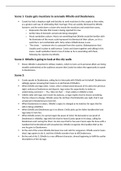
Scene 1- Cassio gets musicians to serenade Othello and Desdemona.
Cassio has had a sleepless night and decides to send musicians to the couple as they wake,
as a gesture and way of celebrating their marriage. They are quickly dismissed by Othello
however, and he sends down a clown who mocks the musicians and sends them away.
o Represents the idea that Cassio is being rejected for now.
o Anther idea of domestic and private being entangled.
o Music symbolises culture. Music not something that Othello would be familiar with-
his dismission of the music could represent his dismissal of their culture, as it is a
world he is not comfortable with. Only culture Othello knows is war.
o ‘The clown.’ - someone who is a peasant/from the country, Shakespearean fool.
Usually used in plays to add humour. Cassio and clown together and talking in this
scene- could symbolise Cassio’s loss of status as he is associating with them,
following his rejection by Othello.
Scene 2- Othello is going to look at the city walls
Shows Othello is absorbed in military matters, which is ironic as his personal affairs are being
steadily undermined as the audience assume that Cassio has taken the opportunity to speak
to Desdemona.
Scene 3:
Cassio speaks to Desdemona, asking her to intercede with Othello on his behalf. Desdemona
willingly agrees, knowing that Cassio is an old friend of Othello's.
When Othello and Iago enter, Cassio, who is embarrassed because of his antics the previous
night, embraces Desdemona and departs. Iago seizes the opportunity to make an
undermining comment — "Ha, I like not that" — that rankles in Othello's mind.
Othello talks with Iago and reveals his jealousy, as Iago implies that he knows something
that he refuses to divulge. Othello voices his old fears that Brabantio was right, that it was
unnatural for Desdemona to love him.
When Desdemona re-enters, Othello's aspect is changed as he watches for signs that his
wife is being unfaithful.
When Othello and Desdemona go in to dinner, Emilia picks up the fallen handkerchief and
Iago takes it from her.
When Othello enters, he cannot regain his peace of mind. He demands to see proof of
Desdemona’s infidelity. Iago tells him that he heard Cassio speak in his sleep, calling for
Desdemona and cursing the Moor. He also says that he has seen Cassio wipe his brow with a
handkerchief embroidered with strawberries; Othello recognizes this handkerchief as the
one he gave to Desdemona.
At the end of the scene Othello dismisses love and calls for vengeance. Othello wants Cassio
dead, Iago agrees to do it, and then Othello wonders how to kill Desdemona.
By the end of Act 3, Othello is a very different character, almost beginning to fulfil the earlier
descriptions of him by Iago.
, Imagery/ references to: thinking, seeing and knowing
This imagery demonstrates how Iago poisons Othello’s mind so effectively.
He first makes Othello suspicious when he draws attention to Cassio’s exit after he was
speaking with his wife: ‘I cannot think it That he would steal away so guilty-like Seeing you
coming.’
Iago comments on what looks like physical evidence, and starts to interpret events for
Othello making him think the worse of the situation. It is left to Othello’s imagination and he
quickly jumps to the worst. Iago realises that what Othello imagines will be more graphic
and shocking than the reality that Iago describes.
By refusing to share his thoughts, Iago makes Othello even more desperate to know what
they are. Iago says that he is reluctant to speak because his thoughts are ‘vile and false’,
leading Othello to think the worst and jump to conclusions.
Iago also hints towards knowledge, without revealing it, as a way of maintaining his façade
as ‘honest Iago’. He distances himself from the blame and the plan.
Ability to get inside Othello’s mind- his irritation is clear when he orders Iago to ‘show me
thy thought’… this later becomes angrier: ‘By heavens, I’ll know thy thoughts!’
Othello’s false belief in Desdemona’s treachery is also reflected in images of seeing and
knowing. Othello says to Iago: ‘If more thou dost perceive, let me know more. Set on thy
wife to observe.’- he relies on Iago’s perception. We know Othello’s thoughts have been
successfully infected when he asks Iago to ‘set on thy wife to observe’ Desdemona. He
clearly trusts Iago and what he has told him.
A03- idea of physiognomy, and because Iago looks honest, he is able to conceive his villainy.
The juxtaposition of love and war
Idea of dichotomy between domestic and political is already central to the play. In this
scene, love becomes war.
Desdemona blurs the boundaries between domestic and public life when she intercedes for
Cassio, making Othello uncomfortable. Ironically, Othello doesn’t want to hear his wife’s
words, suggesting he is beginning to see her as an enemy rather than an ally.
Ironically, just as Othello begins to feel at odds with Desdemona, Iago speaks to him using
the language of love: ‘My lord, you know I love you’ (line 119). This scene is a battle
between Desdemona’s true love and Iago’s false love. Because it’s Iago whose voice Othello
wishes to listen to, we know that true love will be defeated by false words.
Othello’s words about love are troubling even before Iago’s poison takes hold. When
Desdemona leaves, Othello says, ‘perdition catch my soul But I do love thee! and when I
love thee not Chaos is come again’. Othello is in the grip of emotions that he cannot handle,
even before he becomes overwhelmed by jealousy. The two negative abstract nouns,
‘perdition’ and ‘chaos’ foreshadow tragedy, and it’s ironic that Othello uses these words at
this point in the play. The sense of war and love is hence being juxtaposed even within the
lines of Othello’s speech, and structurally these boundaries are also becoming blurred. By
the end of this scene, Othello will be consumed by dark and chaotic thoughts, planning a
murder which he fears will damn his soul. In a metaphorical sense, perdition will soon catch
Othello's soul, and chaos will soon replace order in his life.
His reaction to his wife’s infidelity also shows how Othello is confused between the world of
love and war. His first resort is to till Desdemona and Cassio, as he only knows how to
respond to situations as a military commander.
Cassio has had a sleepless night and decides to send musicians to the couple as they wake,
as a gesture and way of celebrating their marriage. They are quickly dismissed by Othello
however, and he sends down a clown who mocks the musicians and sends them away.
o Represents the idea that Cassio is being rejected for now.
o Anther idea of domestic and private being entangled.
o Music symbolises culture. Music not something that Othello would be familiar with-
his dismission of the music could represent his dismissal of their culture, as it is a
world he is not comfortable with. Only culture Othello knows is war.
o ‘The clown.’ - someone who is a peasant/from the country, Shakespearean fool.
Usually used in plays to add humour. Cassio and clown together and talking in this
scene- could symbolise Cassio’s loss of status as he is associating with them,
following his rejection by Othello.
Scene 2- Othello is going to look at the city walls
Shows Othello is absorbed in military matters, which is ironic as his personal affairs are being
steadily undermined as the audience assume that Cassio has taken the opportunity to speak
to Desdemona.
Scene 3:
Cassio speaks to Desdemona, asking her to intercede with Othello on his behalf. Desdemona
willingly agrees, knowing that Cassio is an old friend of Othello's.
When Othello and Iago enter, Cassio, who is embarrassed because of his antics the previous
night, embraces Desdemona and departs. Iago seizes the opportunity to make an
undermining comment — "Ha, I like not that" — that rankles in Othello's mind.
Othello talks with Iago and reveals his jealousy, as Iago implies that he knows something
that he refuses to divulge. Othello voices his old fears that Brabantio was right, that it was
unnatural for Desdemona to love him.
When Desdemona re-enters, Othello's aspect is changed as he watches for signs that his
wife is being unfaithful.
When Othello and Desdemona go in to dinner, Emilia picks up the fallen handkerchief and
Iago takes it from her.
When Othello enters, he cannot regain his peace of mind. He demands to see proof of
Desdemona’s infidelity. Iago tells him that he heard Cassio speak in his sleep, calling for
Desdemona and cursing the Moor. He also says that he has seen Cassio wipe his brow with a
handkerchief embroidered with strawberries; Othello recognizes this handkerchief as the
one he gave to Desdemona.
At the end of the scene Othello dismisses love and calls for vengeance. Othello wants Cassio
dead, Iago agrees to do it, and then Othello wonders how to kill Desdemona.
By the end of Act 3, Othello is a very different character, almost beginning to fulfil the earlier
descriptions of him by Iago.
, Imagery/ references to: thinking, seeing and knowing
This imagery demonstrates how Iago poisons Othello’s mind so effectively.
He first makes Othello suspicious when he draws attention to Cassio’s exit after he was
speaking with his wife: ‘I cannot think it That he would steal away so guilty-like Seeing you
coming.’
Iago comments on what looks like physical evidence, and starts to interpret events for
Othello making him think the worse of the situation. It is left to Othello’s imagination and he
quickly jumps to the worst. Iago realises that what Othello imagines will be more graphic
and shocking than the reality that Iago describes.
By refusing to share his thoughts, Iago makes Othello even more desperate to know what
they are. Iago says that he is reluctant to speak because his thoughts are ‘vile and false’,
leading Othello to think the worst and jump to conclusions.
Iago also hints towards knowledge, without revealing it, as a way of maintaining his façade
as ‘honest Iago’. He distances himself from the blame and the plan.
Ability to get inside Othello’s mind- his irritation is clear when he orders Iago to ‘show me
thy thought’… this later becomes angrier: ‘By heavens, I’ll know thy thoughts!’
Othello’s false belief in Desdemona’s treachery is also reflected in images of seeing and
knowing. Othello says to Iago: ‘If more thou dost perceive, let me know more. Set on thy
wife to observe.’- he relies on Iago’s perception. We know Othello’s thoughts have been
successfully infected when he asks Iago to ‘set on thy wife to observe’ Desdemona. He
clearly trusts Iago and what he has told him.
A03- idea of physiognomy, and because Iago looks honest, he is able to conceive his villainy.
The juxtaposition of love and war
Idea of dichotomy between domestic and political is already central to the play. In this
scene, love becomes war.
Desdemona blurs the boundaries between domestic and public life when she intercedes for
Cassio, making Othello uncomfortable. Ironically, Othello doesn’t want to hear his wife’s
words, suggesting he is beginning to see her as an enemy rather than an ally.
Ironically, just as Othello begins to feel at odds with Desdemona, Iago speaks to him using
the language of love: ‘My lord, you know I love you’ (line 119). This scene is a battle
between Desdemona’s true love and Iago’s false love. Because it’s Iago whose voice Othello
wishes to listen to, we know that true love will be defeated by false words.
Othello’s words about love are troubling even before Iago’s poison takes hold. When
Desdemona leaves, Othello says, ‘perdition catch my soul But I do love thee! and when I
love thee not Chaos is come again’. Othello is in the grip of emotions that he cannot handle,
even before he becomes overwhelmed by jealousy. The two negative abstract nouns,
‘perdition’ and ‘chaos’ foreshadow tragedy, and it’s ironic that Othello uses these words at
this point in the play. The sense of war and love is hence being juxtaposed even within the
lines of Othello’s speech, and structurally these boundaries are also becoming blurred. By
the end of this scene, Othello will be consumed by dark and chaotic thoughts, planning a
murder which he fears will damn his soul. In a metaphorical sense, perdition will soon catch
Othello's soul, and chaos will soon replace order in his life.
His reaction to his wife’s infidelity also shows how Othello is confused between the world of
love and war. His first resort is to till Desdemona and Cassio, as he only knows how to
respond to situations as a military commander.