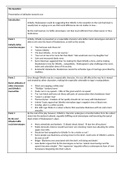
The Question:
Presentation of attitudes towards race
Introduction
Initially, Shakespeare could be suggesting that Othello is the exception to the rule that black is
usually bad, or urging us to see that racial differences do not matter in love…
By the end however, he fulfils stereotypes- not that much different from villain Aaron in Titus
Andronicus
Point 1 Initially, Othello is presented as a respectable character who defies racial stereotypes and who is
able to win over the heart of Desdemona, as well as the senate.
Initially defies
racial stereotypes ‘She had eyes and chose me’
‘Valiant Othello’
‘My dear Othello… O my fair warrior.’
‘Your son in law is far more fair than black’ ‘tale would win over my daughter too’
Calm and measured blank verse
Karen Newman suggested that ‘by making the black Othello a hero, and by making
Desdemona’s love for Othello… sympathetic,’ Shakespeare’s play challenges the racist,
sexist and colonialist views of his society.
Konstantin Stanislavski- Desdemona resists the orthodox type of marriage prescribed by
tradition.
Point 2 Even though Othello may be a respectable character, his race still affects the way he is viewed
and treated by other characters, making him especially vulnerable to Iago’s manipulations:
Racist attitudes of
other characters ‘Black ram tupping a white ewe’
and Othello’s ‘Thicklips’ ‘barbary horse’
insecurities ‘Rude I am in my speech… little of this great world I can speak’
‘For I am black and have not those soft parts of conversation that chamberers have’
‘Cassio’s a proper man’
Thomas Rymer- ‘maidens of fair quality should not run away with blackamoors’
Valerie Traub argues that Othello internalizes Iago’s negative view of black men
Cowhig- alien in a white society
Kim Hall- Iago thinks in a colour scheme that associates blackness with sin and errant
sexuality
Point 3 By the end of the play however, Othello’s character undergoes a transformation from the valiant
moor into the jealous husband, arguably fulfilling racial stereotypes and becoming the typical
By the end black villain of Shakespeare’s plays
Othello fulfils
racial stereotypes More animalistic and barbaric- ‘O blood, blood, blood.’ ‘ill tear her all to pieces’
Public domestic violence would have been very shocking- black man attacking his white,
upper class wife.
Should we feel sympathy for Othello? Is he a victim or not?
Some people saw blackness as being closer to the devil- could some of Othello’s actions
be seen as evil?
Briggs- ‘Blackness was associated with the devil, evil doing and death.’
Isaac Butler argues that he fits stereotypes as he has ‘violent mood swings and his
speech becomes simpler’. This ‘regression’ arguably reflects contemporary fears of non-
Europeans integrating into their culture.
Presentation of attitudes towards race
Introduction
Initially, Shakespeare could be suggesting that Othello is the exception to the rule that black is
usually bad, or urging us to see that racial differences do not matter in love…
By the end however, he fulfils stereotypes- not that much different from villain Aaron in Titus
Andronicus
Point 1 Initially, Othello is presented as a respectable character who defies racial stereotypes and who is
able to win over the heart of Desdemona, as well as the senate.
Initially defies
racial stereotypes ‘She had eyes and chose me’
‘Valiant Othello’
‘My dear Othello… O my fair warrior.’
‘Your son in law is far more fair than black’ ‘tale would win over my daughter too’
Calm and measured blank verse
Karen Newman suggested that ‘by making the black Othello a hero, and by making
Desdemona’s love for Othello… sympathetic,’ Shakespeare’s play challenges the racist,
sexist and colonialist views of his society.
Konstantin Stanislavski- Desdemona resists the orthodox type of marriage prescribed by
tradition.
Point 2 Even though Othello may be a respectable character, his race still affects the way he is viewed
and treated by other characters, making him especially vulnerable to Iago’s manipulations:
Racist attitudes of
other characters ‘Black ram tupping a white ewe’
and Othello’s ‘Thicklips’ ‘barbary horse’
insecurities ‘Rude I am in my speech… little of this great world I can speak’
‘For I am black and have not those soft parts of conversation that chamberers have’
‘Cassio’s a proper man’
Thomas Rymer- ‘maidens of fair quality should not run away with blackamoors’
Valerie Traub argues that Othello internalizes Iago’s negative view of black men
Cowhig- alien in a white society
Kim Hall- Iago thinks in a colour scheme that associates blackness with sin and errant
sexuality
Point 3 By the end of the play however, Othello’s character undergoes a transformation from the valiant
moor into the jealous husband, arguably fulfilling racial stereotypes and becoming the typical
By the end black villain of Shakespeare’s plays
Othello fulfils
racial stereotypes More animalistic and barbaric- ‘O blood, blood, blood.’ ‘ill tear her all to pieces’
Public domestic violence would have been very shocking- black man attacking his white,
upper class wife.
Should we feel sympathy for Othello? Is he a victim or not?
Some people saw blackness as being closer to the devil- could some of Othello’s actions
be seen as evil?
Briggs- ‘Blackness was associated with the devil, evil doing and death.’
Isaac Butler argues that he fits stereotypes as he has ‘violent mood swings and his
speech becomes simpler’. This ‘regression’ arguably reflects contemporary fears of non-
Europeans integrating into their culture.