

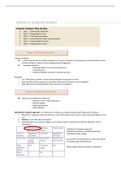
Lecture 6: Conjoint Analysis
Conjoint Analysis: Step by Step
• Step 1 | Defining the objectives
• Step 2 | Designing the study
• Step 3 | Checking assumptions
• Step 4 | Estimating the model and assessing fit
• Step 5 | Interpreting the results
• Step 6 | Validating the results
Step 1: Defining Objectives
Conjoint analysis is
´ … used to determine the relative importance of various attributes to respondents, and the preferred levels
of these attributes, based on their making trade-off judgments
´ … especially helpful in
- Selecting features of a new product/service
- Predicting sales
- Understanding the consumer’s decision process
Examples:
o UvT: What drives students’ choice of (and willingness to pay for) a room?
o How can Albert Heijn compose its assortment of cereals to improve customer appeal?
o Nike: What are the optimal features for a new type of sneakers?
Step 2: Designing the analysis
´ Involves crucial decisions related to …
- Selection of the conjoint approach
- Stimulus design
- Model specification
- Data collection
Selecting the conjoint approach: it is important in setting up a conjoint analysis that things work as follows:
1. Researcher is going to make up/ describe a set of alternatives (room close to university, good hygiene, price
x…)
2. Stimulus: each alternative description
3. Evaluation given by consumers (figure out through conjoint analysis how important attributes are for
consumers)
Traditional Adaptive/ Choice based
Traditional: full profile approach
Hybrid Individual consumers to evaluate (personal
Level of aggregate or individual aggregate or interviews/ online ratngs)
Analysis individual individual
Choice task Evaluate full Rate partial Choose from If consumers must evaluate too many alternatives
profile stimuli set of stimuli
the quality data will deteriorate
stimuli
Data Any Computer Any
collection Choice-based, larger restriction in attributes
based
format
Max # 9 30 6
attributes
, Stimulus design
´ Select attributes (= factors) (student room, distance, surface, price, sanitary)
- Number (9)
- Criteria:
§ Differentiate (between different alternatives in market place à jacuzzi not
relevant)
§ Able to communicate (different levels of an attribute à cosy not a good
one, difficult to measure)
§ Actionable (changeable)
- Price à Could enter as separate attribute, mind correlations or infeasible stimuli
´ Select attribute levels:
• Comparable number across attributes (1-3 km, 3-5 km, 5-8 km)
• Range: Feasible (possible), Relevant (consumer point), Stretch (variation, consumer can
distinguish them, higher and lower than expected)
Model specification
- Main effects (“additive model”) or interactions?
- Part worth, Ideal Point or Linear model?
´ Linear model: expect consumers utility to increase by the same amount if you move from low to high or
medium or high
´ Ideal point: no sugar, medium sugar, high sugar (highest utility or appeal for the intermediate level)
´ Part worth: most flexible, anything goes in this model
Linear Ideal Point
7,5 8
7 7
6
6,5
5
6
4
5,5
3
5 2
4,5 1
4 0
5 10 15 20 25 30 35 No sugar Medium Sweetness
Part Worth
8
7
6
5
4
3
2
1
0
1000cc 2000cc 3000cc
Data collection
´ Presentation:
- Full profile (Fractional factorial)?
´ Preference Measure:
- Ranking
- Rating
- Choice (no-)
´ Task per respondent
- Regular, Adaptive, Hybrid?
Conjoint Analysis: Step by Step
• Step 1 | Defining the objectives
• Step 2 | Designing the study
• Step 3 | Checking assumptions
• Step 4 | Estimating the model and assessing fit
• Step 5 | Interpreting the results
• Step 6 | Validating the results
Step 1: Defining Objectives
Conjoint analysis is
´ … used to determine the relative importance of various attributes to respondents, and the preferred levels
of these attributes, based on their making trade-off judgments
´ … especially helpful in
- Selecting features of a new product/service
- Predicting sales
- Understanding the consumer’s decision process
Examples:
o UvT: What drives students’ choice of (and willingness to pay for) a room?
o How can Albert Heijn compose its assortment of cereals to improve customer appeal?
o Nike: What are the optimal features for a new type of sneakers?
Step 2: Designing the analysis
´ Involves crucial decisions related to …
- Selection of the conjoint approach
- Stimulus design
- Model specification
- Data collection
Selecting the conjoint approach: it is important in setting up a conjoint analysis that things work as follows:
1. Researcher is going to make up/ describe a set of alternatives (room close to university, good hygiene, price
x…)
2. Stimulus: each alternative description
3. Evaluation given by consumers (figure out through conjoint analysis how important attributes are for
consumers)
Traditional Adaptive/ Choice based
Traditional: full profile approach
Hybrid Individual consumers to evaluate (personal
Level of aggregate or individual aggregate or interviews/ online ratngs)
Analysis individual individual
Choice task Evaluate full Rate partial Choose from If consumers must evaluate too many alternatives
profile stimuli set of stimuli
the quality data will deteriorate
stimuli
Data Any Computer Any
collection Choice-based, larger restriction in attributes
based
format
Max # 9 30 6
attributes
, Stimulus design
´ Select attributes (= factors) (student room, distance, surface, price, sanitary)
- Number (9)
- Criteria:
§ Differentiate (between different alternatives in market place à jacuzzi not
relevant)
§ Able to communicate (different levels of an attribute à cosy not a good
one, difficult to measure)
§ Actionable (changeable)
- Price à Could enter as separate attribute, mind correlations or infeasible stimuli
´ Select attribute levels:
• Comparable number across attributes (1-3 km, 3-5 km, 5-8 km)
• Range: Feasible (possible), Relevant (consumer point), Stretch (variation, consumer can
distinguish them, higher and lower than expected)
Model specification
- Main effects (“additive model”) or interactions?
- Part worth, Ideal Point or Linear model?
´ Linear model: expect consumers utility to increase by the same amount if you move from low to high or
medium or high
´ Ideal point: no sugar, medium sugar, high sugar (highest utility or appeal for the intermediate level)
´ Part worth: most flexible, anything goes in this model
Linear Ideal Point
7,5 8
7 7
6
6,5
5
6
4
5,5
3
5 2
4,5 1
4 0
5 10 15 20 25 30 35 No sugar Medium Sweetness
Part Worth
8
7
6
5
4
3
2
1
0
1000cc 2000cc 3000cc
Data collection
´ Presentation:
- Full profile (Fractional factorial)?
´ Preference Measure:
- Ranking
- Rating
- Choice (no-)
´ Task per respondent
- Regular, Adaptive, Hybrid?


