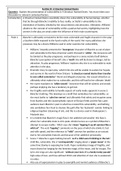
The Question:
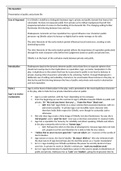
Presentation of public and private life
Line of Argument It is Othello’s inability to distinguish between Iago’s private and public domain that leaves him
vulnerable. He does not separate public from private as his military background has left him
inexperienced when it comes to the handling of his domestic life. The changing setting further
illuminates this blurring between love and war.
Shakespeare comments on how reputation has a great influence over characters public
personas- eg Othello values his honour so highly that he seeks revenge on his wife.
The strict hierarchy of the early modern period influenced social constructs, creating a male
dominating society
The strict hierarchy of the early modern period reflects the importance of reputation particularly
through the male characters who define their judgement based on public and private lives.
Othello is at the heart of the confusion made between private and public.
Introduction Shakespeare depicts the dynamic between public and private lives as separate spheres that
should not overlap due to the implications on reputation. Iago, as master manipulator in the
play, is duplicitous to the extent that how he is perceived in public is not how he behaves in
private, leaving other characters vulnerable to his scheming. Further, through Shakespeare’s
deliberate use of setting and subsidiary characters, he accentuates these tensions in the play, so
that by the end this blurring between the lines of public and private only results in destruction
and lost reputation.
Point 1 Iago is at the heart of destruction in the play, and is presented as the most duplicitous character
in the play, able to hide his true private intentions when in public.
Iago’s as master
manipulator, Iago is a code switcher, with his ‘face’ depending on his company.
From the beginning we see the contrast in Iago’s attitudes towards Othello in public and
private. ‘Sir’ ‘My Lord you know I love you’…. ‘I hate the Moor’ ‘black ram’.
o A05- Kim Hall: ‘Iago thinks in a colour scheme that associates blackness with sin
and errant sexuality.’ In private Iago is an incredibly racist character who
therefore holds little respect for Othello, even though he outwardly claims
otherwise.
Not only does Iago create a false image of Othello, but also Desdemona- he says she is
‘full of game’ and is ‘sport for Jove’- Jove was a notorious womanizer in classical myths.
Iago has a reputation for honesty, for reliability and direct speaking. Othello and others
in the play constantly refer to him as "honest Iago."
o A03- Perhaps this refers to the idea of physiognomy- because Iago does not look
evil, people trust him and therefore he is able to hide his true nature.
‘I follow him to serve my turn upon him’ ‘I am not what I am’- inversion of the worlds of
God in Exodus.
Iago swears on Janus, the God of duality- ‘By Janus I think so’- this only reiterates both
the dual nature of Iago but perhaps also his God-like power as a ‘master manipulator’
Act 4.1- Iago standing over Othello symbolises the power he secretly desires to have
over him. In private he revels in Othello’s misfortune- ‘work my medicine work.’
Act 4.2- Iago demonstrates his duplicitous nature in the way he speaks to Desdemona in
public and private. Addresses her as ‘Lady’ and ‘madam’, giving the impression that he
Presentation of public and private life
Line of Argument It is Othello’s inability to distinguish between Iago’s private and public domain that leaves him
vulnerable. He does not separate public from private as his military background has left him
inexperienced when it comes to the handling of his domestic life. The changing setting further
illuminates this blurring between love and war.
Shakespeare comments on how reputation has a great influence over characters public
personas- eg Othello values his honour so highly that he seeks revenge on his wife.
The strict hierarchy of the early modern period influenced social constructs, creating a male
dominating society
The strict hierarchy of the early modern period reflects the importance of reputation particularly
through the male characters who define their judgement based on public and private lives.
Othello is at the heart of the confusion made between private and public.
Introduction Shakespeare depicts the dynamic between public and private lives as separate spheres that
should not overlap due to the implications on reputation. Iago, as master manipulator in the
play, is duplicitous to the extent that how he is perceived in public is not how he behaves in
private, leaving other characters vulnerable to his scheming. Further, through Shakespeare’s
deliberate use of setting and subsidiary characters, he accentuates these tensions in the play, so
that by the end this blurring between the lines of public and private only results in destruction
and lost reputation.
Point 1 Iago is at the heart of destruction in the play, and is presented as the most duplicitous character
in the play, able to hide his true private intentions when in public.
Iago’s as master
manipulator, Iago is a code switcher, with his ‘face’ depending on his company.
From the beginning we see the contrast in Iago’s attitudes towards Othello in public and
private. ‘Sir’ ‘My Lord you know I love you’…. ‘I hate the Moor’ ‘black ram’.
o A05- Kim Hall: ‘Iago thinks in a colour scheme that associates blackness with sin
and errant sexuality.’ In private Iago is an incredibly racist character who
therefore holds little respect for Othello, even though he outwardly claims
otherwise.
Not only does Iago create a false image of Othello, but also Desdemona- he says she is
‘full of game’ and is ‘sport for Jove’- Jove was a notorious womanizer in classical myths.
Iago has a reputation for honesty, for reliability and direct speaking. Othello and others
in the play constantly refer to him as "honest Iago."
o A03- Perhaps this refers to the idea of physiognomy- because Iago does not look
evil, people trust him and therefore he is able to hide his true nature.
‘I follow him to serve my turn upon him’ ‘I am not what I am’- inversion of the worlds of
God in Exodus.
Iago swears on Janus, the God of duality- ‘By Janus I think so’- this only reiterates both
the dual nature of Iago but perhaps also his God-like power as a ‘master manipulator’
Act 4.1- Iago standing over Othello symbolises the power he secretly desires to have
over him. In private he revels in Othello’s misfortune- ‘work my medicine work.’
Act 4.2- Iago demonstrates his duplicitous nature in the way he speaks to Desdemona in
public and private. Addresses her as ‘Lady’ and ‘madam’, giving the impression that he