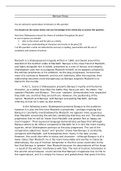
Banquo Essay
You are advised to spend about 40 minutes on this question.
You should use the extract below and your knowledge of the whole play to answer this question.
How does Shakespeare present the theme of ambition throughout the play?
In your response you should:
refer to the extract and the play as a whole;
show your understanding of characters and events in the play.[25]
5 of this question’s marks are allocated for accuracy in spelling, punctuation and the use of
vocabulary and sentence structures.
Macbeth is a Shakespearean tragedy written in 1606, and based around the
downfall of the Scottish noble of Macbeth. Banquo is the close friend of Macbeth,
and fights alongside him in battle, presented as a man of honour and integrity.
Shakespeare uses him to juxtapose Macbeth himself, as he appears unfazed by
the witches prophecies or his ambition. As the play progresses, he becomes
more of a contrast to Macbeth, and his evil intentions; after the regicide, their
relationship becomes more disingenuous as Banquo suspects Macbeth is to
blame for the murder.
In Act 1, Scene 2 Shakespeare presents Banquo’s loyalty and fearsome
character, as a soldier describes the battle they have just won. He states: ‘Our
captains Macbeth and Banquo.’ The noun ‘captains’ demonstrates how respected
they both are, and that they are both are. However, the positioning of the
names: ‘Macbeth and Banquo’ with Banquo proceeding Macbeth, perhaps
referring to how he is seen as less worthy.
In the following scene, Shakespeare presents Banquo to the audience
however it is also the first time Macbeth is presented – perhaps implying that
Banquo is constantly overshadowed by Macbeth. He appears more suspicious
than Macbeth concerning the witches, identifying that they are evil. The witches
prophesise that he will be ‘lesser than Macbeth and greater Not so happy yet
much happier’. Their equivocal language demonstrates perhaps that although
Banquo seems to be inferior compared to Macbeth he is in fact the more morally
superior, which Shakespeare portrays as the play progresses. The use of the
comparative adjectives ‘lesser’ and ‘greater’ shows how Banquo is constantly
compared with Macbeth, and foreshadows their rivalry in the later scenes.
However, this could also refer to status and character – although Banquo is of a
lower status than Macbeth, he is the more honourable and worthy in character.
Alternatively, the use of trochaic tetrameter in the first verse could refer to the
fact that Banquo is ‘greater’ than Macbeth because his descendants will be kings
– a result of the witches’ interference with fate. The lack of trochaic tetrameter in
the second verse however, could connote that Banquo’s happiness has no link to
the supernatural, and it is simply his honour and gratefulness that gives him this.
You are advised to spend about 40 minutes on this question.
You should use the extract below and your knowledge of the whole play to answer this question.
How does Shakespeare present the theme of ambition throughout the play?
In your response you should:
refer to the extract and the play as a whole;
show your understanding of characters and events in the play.[25]
5 of this question’s marks are allocated for accuracy in spelling, punctuation and the use of
vocabulary and sentence structures.
Macbeth is a Shakespearean tragedy written in 1606, and based around the
downfall of the Scottish noble of Macbeth. Banquo is the close friend of Macbeth,
and fights alongside him in battle, presented as a man of honour and integrity.
Shakespeare uses him to juxtapose Macbeth himself, as he appears unfazed by
the witches prophecies or his ambition. As the play progresses, he becomes
more of a contrast to Macbeth, and his evil intentions; after the regicide, their
relationship becomes more disingenuous as Banquo suspects Macbeth is to
blame for the murder.
In Act 1, Scene 2 Shakespeare presents Banquo’s loyalty and fearsome
character, as a soldier describes the battle they have just won. He states: ‘Our
captains Macbeth and Banquo.’ The noun ‘captains’ demonstrates how respected
they both are, and that they are both are. However, the positioning of the
names: ‘Macbeth and Banquo’ with Banquo proceeding Macbeth, perhaps
referring to how he is seen as less worthy.
In the following scene, Shakespeare presents Banquo to the audience
however it is also the first time Macbeth is presented – perhaps implying that
Banquo is constantly overshadowed by Macbeth. He appears more suspicious
than Macbeth concerning the witches, identifying that they are evil. The witches
prophesise that he will be ‘lesser than Macbeth and greater Not so happy yet
much happier’. Their equivocal language demonstrates perhaps that although
Banquo seems to be inferior compared to Macbeth he is in fact the more morally
superior, which Shakespeare portrays as the play progresses. The use of the
comparative adjectives ‘lesser’ and ‘greater’ shows how Banquo is constantly
compared with Macbeth, and foreshadows their rivalry in the later scenes.
However, this could also refer to status and character – although Banquo is of a
lower status than Macbeth, he is the more honourable and worthy in character.
Alternatively, the use of trochaic tetrameter in the first verse could refer to the
fact that Banquo is ‘greater’ than Macbeth because his descendants will be kings
– a result of the witches’ interference with fate. The lack of trochaic tetrameter in
the second verse however, could connote that Banquo’s happiness has no link to
the supernatural, and it is simply his honour and gratefulness that gives him this.