Macbeth Essay
You are advised to spend about 40 minutes on this question.
You should use the extract below and your knowledge of the whole play to answer this question.
How does Shakespeare present the character of Macbeth throughout the play?
In your response you should:
refer to the extract and the play as a whole;
show your understanding of characters and events in the play.[25]
5 of this question’s marks are allocated for accuracy in spelling, punctuation and the use of
vocabulary and sentence structures
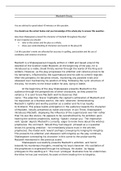
Macbeth is a Shakespearean tragedy written in 1606 and based around the
downfall of the Scottish noble Macbeth. At the beginning of the play, he is
introduced as a noble, blood thirsty warrior through the words of the King and
soldiers. However, as the play progresses his ambition and violence prove to be
his hamartia’s, influenced by the supernatural and his wife to commit regicide.
After this peripetia, he becomes erratic, murdering any possible rivals and
obsessed over maintaining his position of King. Following the cyclic structure of
the play, he reverts to the brave soldier he was, dying in battle.
At the beginning of the play Shakespeare presents Macbeth to the
audience through the perspectives of other characters, as they praise his
valiance. It is said ‘brave Macbeth well he deserves that
name.’ The adjective ‘brave’ highlights the captain's admiration of Macbeth and
his reputation as a fearless warrior, the verb ‘deserves’ demonstrating
Macbeth’s rightful and worthy position as a soldier and his true loyalty
to Scotland. This praise builds anticipation in the audience towards the character
of Macbeth, initially presented as noble and brave. In Act Three, Shakespeare
introduces Macbeth, displaying the influence of the supernatural over him rather
than his war-like stance. He appears to be overwhelmed by his ambition upon
hearing the witches prophecies, stating: ‘Speak I charge you.’ The imperative
verb ‘speak’ depicts Macbeth’s curiosity, eager to know more about the witches
prophecies. His comment: ‘Would they had stayed,’ phrased as a o question
shows his growing ambition - he immediately places trust in the witches
prophecies, the modal verb ‘would’ perhaps conveying his longing for kingship.
This presents his ambition and obsession with kingship as the play continues,
Shakespeare contrasting his character in this scene to the praise-worthy
Macbeth mentioned in the previous scene.
Shakespeare successfully presents Macbeth’s ambition, and horror
towards his murderous thoughts, revealing his loyal character. His vacillation of
the prophecies is expressed through his soliloquy. He states: ‘as happy
prologues to the swelling act.’ The noun ‘prologue' illustrates how he undermines
the titles he has just received, focused on them leading him to kingship,
You are advised to spend about 40 minutes on this question.
You should use the extract below and your knowledge of the whole play to answer this question.
How does Shakespeare present the character of Macbeth throughout the play?
In your response you should:
refer to the extract and the play as a whole;
show your understanding of characters and events in the play.[25]
5 of this question’s marks are allocated for accuracy in spelling, punctuation and the use of
vocabulary and sentence structures
Macbeth is a Shakespearean tragedy written in 1606 and based around the
downfall of the Scottish noble Macbeth. At the beginning of the play, he is
introduced as a noble, blood thirsty warrior through the words of the King and
soldiers. However, as the play progresses his ambition and violence prove to be
his hamartia’s, influenced by the supernatural and his wife to commit regicide.
After this peripetia, he becomes erratic, murdering any possible rivals and
obsessed over maintaining his position of King. Following the cyclic structure of
the play, he reverts to the brave soldier he was, dying in battle.
At the beginning of the play Shakespeare presents Macbeth to the
audience through the perspectives of other characters, as they praise his
valiance. It is said ‘brave Macbeth well he deserves that
name.’ The adjective ‘brave’ highlights the captain's admiration of Macbeth and
his reputation as a fearless warrior, the verb ‘deserves’ demonstrating
Macbeth’s rightful and worthy position as a soldier and his true loyalty
to Scotland. This praise builds anticipation in the audience towards the character
of Macbeth, initially presented as noble and brave. In Act Three, Shakespeare
introduces Macbeth, displaying the influence of the supernatural over him rather
than his war-like stance. He appears to be overwhelmed by his ambition upon
hearing the witches prophecies, stating: ‘Speak I charge you.’ The imperative
verb ‘speak’ depicts Macbeth’s curiosity, eager to know more about the witches
prophecies. His comment: ‘Would they had stayed,’ phrased as a o question
shows his growing ambition - he immediately places trust in the witches
prophecies, the modal verb ‘would’ perhaps conveying his longing for kingship.
This presents his ambition and obsession with kingship as the play continues,
Shakespeare contrasting his character in this scene to the praise-worthy
Macbeth mentioned in the previous scene.
Shakespeare successfully presents Macbeth’s ambition, and horror
towards his murderous thoughts, revealing his loyal character. His vacillation of
the prophecies is expressed through his soliloquy. He states: ‘as happy
prologues to the swelling act.’ The noun ‘prologue' illustrates how he undermines
the titles he has just received, focused on them leading him to kingship,