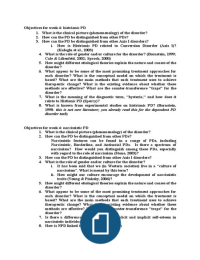
Objectives for week 4: histrionic PD
1. What is the clinical picture (phenomenology) of the disorder?
2. How can the PD be distinguished from other PDs?
3. How can the PD be distinguished from other Axis I disorders?
i. How is Histrionic PD related to Conversion Disorder (Axis I)?
(Kuloglu et al., 2003)
4. What is the role of gender and/or culture for the disorder? (Bornstein, 1999;
Cale & Lilienfeld, 2002; Sprock, 2000)
5. How might different etiological theories explain the nature and causes of the
disorder?
6. What appear to be some of the most promising treatment approaches for
each disorder? What is the conceptual model on which the treatment is
based? What are the main methods that each treatment uses to achieve
therapeutic change? What is the existing evidence about whether these
methods are effective? What are the counter-transference "traps" for the
disorder?
7. What is the meaning of the diagnostic term, "hysteria," and how does it
relate to Histionic PD (Sperry)?
8. What is known from experimental studies on histrionic PD? (Bornstein,
1998- this is not new literature; you already read this for the dependent PD
disorder task)
Objectives for week 4: narcissistic PD
1. What is the clinical picture (phenomenology) of the disorder?
2. How can the PD be distinguished from other PDs?
Narcissistic features can be found in a range of PDs, including
Narcissistic, Borderline, and Antisocial PDs. Is there a spectrum of
narcissism? How would you distinguish among these PDs, especially
with regard to the role of narcissism (Stone, 2003)?
3. How can the PD be distinguished from other Axis I disorders?
4. What is the role of gender and/or culture for the disorder?
i. It has been said that we (in Western societies) live in a “culture of
narcissism”. What is meant by this term?
ii. How might our culture encourage the development of narcissistic
traits (Young & Pinksky, 2006)?
5. How might different etiological theories explain the nature and causes of the
disorder?
6. What appear to be some of the most promising treatment approaches for
each disorder? What is the conceptual model on which the treatment is
based? What are the main methods that each treatment uses to achieve
therapeutic change? What is the existing evidence about whether these
methods are effective? What are the counter-transference "traps" for the
disorder?
7. Is there a difference between levels of explicit and implicit self-esteem in
narcissistic individuals? (Campbell, 2007)
8. How is NPD linked to anger? (Twenge, 2003)
, 9. What is meant by the term, “narcissistic vulnerability?” What role might
narcissistic vulnerability play in the development of stress-related disorders
(Bachar et al., 2005)?
___________________________________________________________________________
HISTRONIC
What is the clinical picture (phenomenology) of the disorder?
ABSTRACT: HPD is de enige DSm PD die expliciet gelinkt is aan iemands fysieke uiterlijk.
Deze studie doet odnerzoek naar de HPD-aantrekkelijkheids link met een gemengde geslachts
sample van studenten. HPD vrouwen scoren hoger op aantrekkelijkheid dan vrouwen met
andere PD of geen PD. Een gelijke aantrekklijkheidsbevinding werd bij mannen niet
geconstateerd. Vrouwen met HPD hadden, in vergelijking met andere vrouwen, een meer
gevarieerd en steunend netwerk, uiten meer negatieve gedragingen in belangrijke relaties en
toonden meer kinderachtige verdedigingsmechanieken, minder vertrouwen op beeld-distortie,
zelfopoffering en volwassen verdediging. Dezelfde aantrekklijkheids
verdedigingsmechanieken werden gevonden in mannen.
HPD heeft een lange geschiedenis…
Moderne formulaties van HPD:
Kerncomponenten zijn egocentrisme, verleiding, theatrale emoties, ontkenning of boosheid en
vijandigheid en een diffuse cognitieve stijl. Andere kenmerken: manipulatie, lage-frustratie
tolerantie, hypersexualiteit, suggestiviteit en somatiserende neigingen. Deze kenmerken
worden mooi onschreven in de acht criteria van de DSM voor HPD. Voglens de DSM is de
centrale feature van HPD:
- discomfort in situaties waarin hij of zij niet in het middelpunt staat
- sexueel verleidend of provocatief gedrag
- vlakke expressie van emoties
- het gebruik van fysiek uiterlijk om aandacht te trekken
- overdreven impressionele stijl van praten
- zelf-dramatisatie, theatraliteit en overdreven emotionele expressie
- suggestiviteit
- perceptie van grotere intimiteit dan daadwerkelijk het geval is
(Bornstein, 1999)
How can the PD be distinguished from other PDs?
DPD en HPD worden beiden geassocieerd met hoge levels van impliciete
afhankelijkheidsbehoeften. Het verschil zit hem er in dat DPD bewuste
afhankelijkheidsbehoeften enkel bestaan bij DPD, en niet bij HPD. Deze hypothese wordt ook
bevestigd aan de hand van de studie.
HPD en DPD mensen vertonen zeer verschillend gedrag. Bij DPD:
1. What is the clinical picture (phenomenology) of the disorder?
2. How can the PD be distinguished from other PDs?
3. How can the PD be distinguished from other Axis I disorders?
i. How is Histrionic PD related to Conversion Disorder (Axis I)?
(Kuloglu et al., 2003)
4. What is the role of gender and/or culture for the disorder? (Bornstein, 1999;
Cale & Lilienfeld, 2002; Sprock, 2000)
5. How might different etiological theories explain the nature and causes of the
disorder?
6. What appear to be some of the most promising treatment approaches for
each disorder? What is the conceptual model on which the treatment is
based? What are the main methods that each treatment uses to achieve
therapeutic change? What is the existing evidence about whether these
methods are effective? What are the counter-transference "traps" for the
disorder?
7. What is the meaning of the diagnostic term, "hysteria," and how does it
relate to Histionic PD (Sperry)?
8. What is known from experimental studies on histrionic PD? (Bornstein,
1998- this is not new literature; you already read this for the dependent PD
disorder task)
Objectives for week 4: narcissistic PD
1. What is the clinical picture (phenomenology) of the disorder?
2. How can the PD be distinguished from other PDs?
Narcissistic features can be found in a range of PDs, including
Narcissistic, Borderline, and Antisocial PDs. Is there a spectrum of
narcissism? How would you distinguish among these PDs, especially
with regard to the role of narcissism (Stone, 2003)?
3. How can the PD be distinguished from other Axis I disorders?
4. What is the role of gender and/or culture for the disorder?
i. It has been said that we (in Western societies) live in a “culture of
narcissism”. What is meant by this term?
ii. How might our culture encourage the development of narcissistic
traits (Young & Pinksky, 2006)?
5. How might different etiological theories explain the nature and causes of the
disorder?
6. What appear to be some of the most promising treatment approaches for
each disorder? What is the conceptual model on which the treatment is
based? What are the main methods that each treatment uses to achieve
therapeutic change? What is the existing evidence about whether these
methods are effective? What are the counter-transference "traps" for the
disorder?
7. Is there a difference between levels of explicit and implicit self-esteem in
narcissistic individuals? (Campbell, 2007)
8. How is NPD linked to anger? (Twenge, 2003)
, 9. What is meant by the term, “narcissistic vulnerability?” What role might
narcissistic vulnerability play in the development of stress-related disorders
(Bachar et al., 2005)?
___________________________________________________________________________
HISTRONIC
What is the clinical picture (phenomenology) of the disorder?
ABSTRACT: HPD is de enige DSm PD die expliciet gelinkt is aan iemands fysieke uiterlijk.
Deze studie doet odnerzoek naar de HPD-aantrekkelijkheids link met een gemengde geslachts
sample van studenten. HPD vrouwen scoren hoger op aantrekkelijkheid dan vrouwen met
andere PD of geen PD. Een gelijke aantrekklijkheidsbevinding werd bij mannen niet
geconstateerd. Vrouwen met HPD hadden, in vergelijking met andere vrouwen, een meer
gevarieerd en steunend netwerk, uiten meer negatieve gedragingen in belangrijke relaties en
toonden meer kinderachtige verdedigingsmechanieken, minder vertrouwen op beeld-distortie,
zelfopoffering en volwassen verdediging. Dezelfde aantrekklijkheids
verdedigingsmechanieken werden gevonden in mannen.
HPD heeft een lange geschiedenis…
Moderne formulaties van HPD:
Kerncomponenten zijn egocentrisme, verleiding, theatrale emoties, ontkenning of boosheid en
vijandigheid en een diffuse cognitieve stijl. Andere kenmerken: manipulatie, lage-frustratie
tolerantie, hypersexualiteit, suggestiviteit en somatiserende neigingen. Deze kenmerken
worden mooi onschreven in de acht criteria van de DSM voor HPD. Voglens de DSM is de
centrale feature van HPD:
- discomfort in situaties waarin hij of zij niet in het middelpunt staat
- sexueel verleidend of provocatief gedrag
- vlakke expressie van emoties
- het gebruik van fysiek uiterlijk om aandacht te trekken
- overdreven impressionele stijl van praten
- zelf-dramatisatie, theatraliteit en overdreven emotionele expressie
- suggestiviteit
- perceptie van grotere intimiteit dan daadwerkelijk het geval is
(Bornstein, 1999)
How can the PD be distinguished from other PDs?
DPD en HPD worden beiden geassocieerd met hoge levels van impliciete
afhankelijkheidsbehoeften. Het verschil zit hem er in dat DPD bewuste
afhankelijkheidsbehoeften enkel bestaan bij DPD, en niet bij HPD. Deze hypothese wordt ook
bevestigd aan de hand van de studie.
HPD en DPD mensen vertonen zeer verschillend gedrag. Bij DPD: