-The Working Memory Model:
-WM is the same as STM.
-Devised by Baddeley and Hitch (1974).
-Baddeley: Participants were asked to generate random lists of numbers whilst also attempting to
switch between typing numbers and letters on a keyboard.
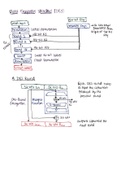
-WMM:
Central Executive
/ | \
Visuo-spatial sketchpad (VSS) Episodic buffer Phonological Loop (PL)
| | Articulatory control system - Phonological store
\ | /
Long Term Memory
-The Central Executive:
Receives information and delegates to the VSS or PL.
Focuses, divides and switches limited attention between slave systems. This improves with
attention (driving).
The problem solver and solves mental arithmetic.
Multi modal coding but short capacity and duration.
-Phonological loop:
A slave system that deals with auditory information and codes acoustically. Written words
are converted to acoustic coding. It is divided into:
Phonological store- stores verbal information acoustically
Articulatory process- the inner voice which rehearses information. 2 second duration.
Baddeley- Participants with monosyballic words had much better recall than those with
multisyballic words= word length effect. 2 seconds of what you can see.
-Visuo-spatial sketchpad:
Stores and manipulates visual information, input is from the eyes or LTM.
The visual cache is passive and stores data about what something looks like e.g., colour and
form.
The inner scribe is active and concerned with spatial awareness and manipulation of objects.
Can hold about 4 objects.
Case study of KF shows that auditory and visual information is dealt with separately in the
brain.
-Episodic buffer:
Binds together the information from the other components of working memory with
information about time and order.
Also prepares memories for storage in LTM.
-Evaluation:
-WM is the same as STM.
-Devised by Baddeley and Hitch (1974).
-Baddeley: Participants were asked to generate random lists of numbers whilst also attempting to
switch between typing numbers and letters on a keyboard.
-WMM:
Central Executive
/ | \
Visuo-spatial sketchpad (VSS) Episodic buffer Phonological Loop (PL)
| | Articulatory control system - Phonological store
\ | /
Long Term Memory
-The Central Executive:
Receives information and delegates to the VSS or PL.
Focuses, divides and switches limited attention between slave systems. This improves with
attention (driving).
The problem solver and solves mental arithmetic.
Multi modal coding but short capacity and duration.
-Phonological loop:
A slave system that deals with auditory information and codes acoustically. Written words
are converted to acoustic coding. It is divided into:
Phonological store- stores verbal information acoustically
Articulatory process- the inner voice which rehearses information. 2 second duration.
Baddeley- Participants with monosyballic words had much better recall than those with
multisyballic words= word length effect. 2 seconds of what you can see.
-Visuo-spatial sketchpad:
Stores and manipulates visual information, input is from the eyes or LTM.
The visual cache is passive and stores data about what something looks like e.g., colour and
form.
The inner scribe is active and concerned with spatial awareness and manipulation of objects.
Can hold about 4 objects.
Case study of KF shows that auditory and visual information is dealt with separately in the
brain.
-Episodic buffer:
Binds together the information from the other components of working memory with
information about time and order.
Also prepares memories for storage in LTM.
-Evaluation: