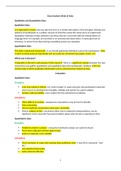
Data Analysis: Kinds of Data
Qualitative and Quantitative Data
Qualitative Data
It is expressed in words and may take the form of a written description of the thoughts, feelings and
opinions of participants or a written account of what the researcher observed in an experiment.
Qualitative methods of data collection raw those that are concerned with the interpretation of
language from, for example, an interview or an unstructured observation. A transcript from an
interview, or extract from diary during counselling session are examples.
Quantitative Data
This data is expressed numerically. It can include gathering individual scores from participants. Data
is open to being analysed statistically and can easily be converted into graphs, charts, etc.
Which one is the best?
It depends on the aim’s and purpose of the research. There is a significant overlap between the two:
researchers may gather quantitative and qualitative data from participants. Similarly, there are
several ways in which qualitative information can be converted into numerical data.
Evaluation
Qualitative Data
Strengths:
A lot more detail is offered. It is much broader in scope and gives the participant/researcher
more licence to develop their thoughts, feelings and opinion on a given subject.
Greater external validity- more insight into the participants worldview.
Limitations:
Often difficult to analyse- comparisons and patterns may be hard to identify.
Time consuming.
Hard to replicate and produce same data- unreliable.
May be subject to bias- conclusions often rely on subjective interpretations; can be
significant is the researcher has preconception about what he/she is expecting to find.
Quantitative Data
Strengths:
Relatively simple to analyse- comparisons between groups can easily be drawn.
Much more objective and less open to bias.
Easier to replicate- more reliable.
Limitations:
Much narrower in scope and meaning than qualitative data. It may fail to represent “real-
life.”
Less detailed information.
Lacks external reflective.
1
Qualitative and Quantitative Data
Qualitative Data
It is expressed in words and may take the form of a written description of the thoughts, feelings and
opinions of participants or a written account of what the researcher observed in an experiment.
Qualitative methods of data collection raw those that are concerned with the interpretation of
language from, for example, an interview or an unstructured observation. A transcript from an
interview, or extract from diary during counselling session are examples.
Quantitative Data
This data is expressed numerically. It can include gathering individual scores from participants. Data
is open to being analysed statistically and can easily be converted into graphs, charts, etc.
Which one is the best?
It depends on the aim’s and purpose of the research. There is a significant overlap between the two:
researchers may gather quantitative and qualitative data from participants. Similarly, there are
several ways in which qualitative information can be converted into numerical data.
Evaluation
Qualitative Data
Strengths:
A lot more detail is offered. It is much broader in scope and gives the participant/researcher
more licence to develop their thoughts, feelings and opinion on a given subject.
Greater external validity- more insight into the participants worldview.
Limitations:
Often difficult to analyse- comparisons and patterns may be hard to identify.
Time consuming.
Hard to replicate and produce same data- unreliable.
May be subject to bias- conclusions often rely on subjective interpretations; can be
significant is the researcher has preconception about what he/she is expecting to find.
Quantitative Data
Strengths:
Relatively simple to analyse- comparisons between groups can easily be drawn.
Much more objective and less open to bias.
Easier to replicate- more reliable.
Limitations:
Much narrower in scope and meaning than qualitative data. It may fail to represent “real-
life.”
Less detailed information.
Lacks external reflective.
1