P2. Explain how two contrasting businesses are influenced by stakeholders.
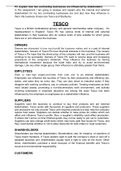
In this assignment I am going to analyse and explain who the internal and external
stakeholders for my two contrasting businesses are and also how they influence in
them. My business chosen are Tesco and Starbucks.
TESCO
Tesco is a British multinational grocery and general merchandise seller company. It’s
headquartered in England. Tesco Plc has various kinds of internal and external
stakeholders in their business who do various kinds of jobs suitable for which group
there are in and influence the business.
OWNERS
Owners are interested in how much profit the business makes and is a part of internal
stakeholders. Owners of Tesco Plc have financial interests in the business. The owners
of Tesco s Plc hope that the share price of the company will rise, and the business will
continue to be successful. Owners of Tesco Plc want to receive large and increasing
proportions of the company’s dividends. They influence the business by having
international investment because the trade fairly and try to avoid environmental
damage. Like any other single group, their influence is ultimately greater than theirs.
EMPLOYEES
Want to earn high wages and keep their jobs and is an internal stakeholders.
Employees can influence the success of Tesco by their productivity and efficiency job,
duties, and tasks they do every day. They can also resort to industrial action if they
disagree with working conditions, pay or company policies. Treating employees as their
most valued assets, promoting a non-discriminatory work environment, and actively
involving employees in important decisions are among the ways Tesco has been
influenced by the emphasis on employees as a stakeholder influence.
SUPPLIERS
Suppliers want the business to continue to buy their products and are external
stakeholders. Tesco works with thousands of suppliers and producers. These suppliers
and producers not only provide Tesco with required products but also help the company
reduce food waste. Suppliers can decide whether to raise prices for orders which can
affect and influence Tesco’s profits. Also, a supplier’s reliability could affect production.
If orders don’t arrive on time finished goods may not be ready to put out to customers.
Suppliers can also change credit terms which may have cash flow issues for Tesco, and
they could decide whether or not to allow discounts for bulk orders or loyal customers.
SHAREHOLDERS
Shareholders are internal stakeholders. Shareholders vote, for instance, on elections of
Tesco board members. If Tesco leaders want to split the company’s stock or spin off a
separate business unit, shareholders usually have a right to vote on the move. Other
times, shareholders purchase a stock because of the financial benefits and Tesco’s
social and environmental responsibility.
CUSTOMERS
In this assignment I am going to analyse and explain who the internal and external
stakeholders for my two contrasting businesses are and also how they influence in
them. My business chosen are Tesco and Starbucks.
TESCO
Tesco is a British multinational grocery and general merchandise seller company. It’s
headquartered in England. Tesco Plc has various kinds of internal and external
stakeholders in their business who do various kinds of jobs suitable for which group
there are in and influence the business.
OWNERS
Owners are interested in how much profit the business makes and is a part of internal
stakeholders. Owners of Tesco Plc have financial interests in the business. The owners
of Tesco s Plc hope that the share price of the company will rise, and the business will
continue to be successful. Owners of Tesco Plc want to receive large and increasing
proportions of the company’s dividends. They influence the business by having
international investment because the trade fairly and try to avoid environmental
damage. Like any other single group, their influence is ultimately greater than theirs.
EMPLOYEES
Want to earn high wages and keep their jobs and is an internal stakeholders.
Employees can influence the success of Tesco by their productivity and efficiency job,
duties, and tasks they do every day. They can also resort to industrial action if they
disagree with working conditions, pay or company policies. Treating employees as their
most valued assets, promoting a non-discriminatory work environment, and actively
involving employees in important decisions are among the ways Tesco has been
influenced by the emphasis on employees as a stakeholder influence.
SUPPLIERS
Suppliers want the business to continue to buy their products and are external
stakeholders. Tesco works with thousands of suppliers and producers. These suppliers
and producers not only provide Tesco with required products but also help the company
reduce food waste. Suppliers can decide whether to raise prices for orders which can
affect and influence Tesco’s profits. Also, a supplier’s reliability could affect production.
If orders don’t arrive on time finished goods may not be ready to put out to customers.
Suppliers can also change credit terms which may have cash flow issues for Tesco, and
they could decide whether or not to allow discounts for bulk orders or loyal customers.
SHAREHOLDERS
Shareholders are internal stakeholders. Shareholders vote, for instance, on elections of
Tesco board members. If Tesco leaders want to split the company’s stock or spin off a
separate business unit, shareholders usually have a right to vote on the move. Other
times, shareholders purchase a stock because of the financial benefits and Tesco’s
social and environmental responsibility.
CUSTOMERS