Psychopathology
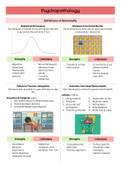
Definitions of Abnormality
Statistical Infrequency Deviation from Social Norms
Any behaviour outside of the normal distribution Some behaviours are (culture-specific) socially
is abnormal (the extreme 2%s) undesirable = abnormal
Strengths Limitations Strengths Limitations
- Objective - Not all infrequent - Considers culture - Eccentricity is not
- Value free behaviours are and location always mental
- Measurable abnormal (vice illness
criteria and versa) - Norms change
severity - Cut off is over time
subjective
Failure to Function Adequately Deviation from Ideal Mental Health
Someone who is unable to cope with day-to-day Not meeting the criteria for good mental health
life
Jahoda criteria:
Rosenhan & Seligman signs: 1. No symptoms 5. Copes with stress
1. Not conforming to interpersonal rules 2. Rational 6. Realistic views
2. Severe personal distress 3. Accurate self 7. Self-esteem
3. Irrational/dangerous behaviour perception 8. Independence
4. Reaching potential 9. Work, love & enjoy
Strengths Limitations Strengths Limitations
- Consideers - Subjective - Comprehensive - Culture specific
patient’s - Crossover with definition - Unrealistic high
experience deviation from S.N - Positive approach standards
- Some objective - Hard to measure
measures do exist
, Phobias
A persistent and unreasonable fear of a specific object, activity or situation (Comer, 2008)
1. Specific 2. Social 3. Agoraphobia
Characteristics:
Behavioural Emotional Cognitive
Phobias = anxiety disorder
⤷ Emotional responses of 1. Selective attention to
1. Panic
anxiety and fear stimulus
2. Avoidance
2. Irrational beliefs
3. endurance
Disproportionate and interferes 3. Cognitive distortions
with everyday life
Behavioural Explanation
Mowrer (1960): 2 Process Model Example: Watson & Rayner - Little Albert
Acquisition → result of classical conditioning Noise becomes associated with rat = acquisition
(pairing stimuli)
Maintenance → result of operant conditioning Escape from stimulus (relief) is a negative
(consequence & reinforcement) reinforcement
Strengths Limitations
- Good explanation power - explains Alt. Explanation - Buck = safety is greater
mechanisms behind acquisition and motivator (eg. agoraphobia = anxiety reduction)
maintenance Incomplete exp. - Seligman: we fear old threats to
- Applied in therapy - prevention of ancestors eg. snakes
conditioned response Doesn't always follow trauma
Doesn’t explain cognitive characteristics -
selective attachment + distortions
Behavioural Treatments - relaxation + preventing avoidance
Systematic Desensitisation Flooding
Associates relaxation (counter-conditioning)
Reciprocal Inhibition - replacing emotions
Overwhelms P with stimulus (no steps or relaxation)
1. Anxiety hierarchy - staged approach = no avoidance behaviours leads to extinction:
constructed by patient
2. Relaxation techniques - breathing etc. CS (dog) without UCS (biting) = no CR (fear)
3. Exposure - stimulus + relaxation
⤷ Anxiety = 0 before next step
Strengths Limitations Strengths Limitations
Effective - Slow process Ethics Ineffective for social phobias
Gilroy et al. 33 considered - P’s due to negative thoughts
mth P’s = lower Practically difficult - eg. consent to
anxiety + low difficult to source snakes etc. process Traumatic process = high
attrition, P in Cost effective attrition
control Faster process
Definitions of Abnormality
Statistical Infrequency Deviation from Social Norms
Any behaviour outside of the normal distribution Some behaviours are (culture-specific) socially
is abnormal (the extreme 2%s) undesirable = abnormal
Strengths Limitations Strengths Limitations
- Objective - Not all infrequent - Considers culture - Eccentricity is not
- Value free behaviours are and location always mental
- Measurable abnormal (vice illness
criteria and versa) - Norms change
severity - Cut off is over time
subjective
Failure to Function Adequately Deviation from Ideal Mental Health
Someone who is unable to cope with day-to-day Not meeting the criteria for good mental health
life
Jahoda criteria:
Rosenhan & Seligman signs: 1. No symptoms 5. Copes with stress
1. Not conforming to interpersonal rules 2. Rational 6. Realistic views
2. Severe personal distress 3. Accurate self 7. Self-esteem
3. Irrational/dangerous behaviour perception 8. Independence
4. Reaching potential 9. Work, love & enjoy
Strengths Limitations Strengths Limitations
- Consideers - Subjective - Comprehensive - Culture specific
patient’s - Crossover with definition - Unrealistic high
experience deviation from S.N - Positive approach standards
- Some objective - Hard to measure
measures do exist
, Phobias
A persistent and unreasonable fear of a specific object, activity or situation (Comer, 2008)
1. Specific 2. Social 3. Agoraphobia
Characteristics:
Behavioural Emotional Cognitive
Phobias = anxiety disorder
⤷ Emotional responses of 1. Selective attention to
1. Panic
anxiety and fear stimulus
2. Avoidance
2. Irrational beliefs
3. endurance
Disproportionate and interferes 3. Cognitive distortions
with everyday life
Behavioural Explanation
Mowrer (1960): 2 Process Model Example: Watson & Rayner - Little Albert
Acquisition → result of classical conditioning Noise becomes associated with rat = acquisition
(pairing stimuli)
Maintenance → result of operant conditioning Escape from stimulus (relief) is a negative
(consequence & reinforcement) reinforcement
Strengths Limitations
- Good explanation power - explains Alt. Explanation - Buck = safety is greater
mechanisms behind acquisition and motivator (eg. agoraphobia = anxiety reduction)
maintenance Incomplete exp. - Seligman: we fear old threats to
- Applied in therapy - prevention of ancestors eg. snakes
conditioned response Doesn't always follow trauma
Doesn’t explain cognitive characteristics -
selective attachment + distortions
Behavioural Treatments - relaxation + preventing avoidance
Systematic Desensitisation Flooding
Associates relaxation (counter-conditioning)
Reciprocal Inhibition - replacing emotions
Overwhelms P with stimulus (no steps or relaxation)
1. Anxiety hierarchy - staged approach = no avoidance behaviours leads to extinction:
constructed by patient
2. Relaxation techniques - breathing etc. CS (dog) without UCS (biting) = no CR (fear)
3. Exposure - stimulus + relaxation
⤷ Anxiety = 0 before next step
Strengths Limitations Strengths Limitations
Effective - Slow process Ethics Ineffective for social phobias
Gilroy et al. 33 considered - P’s due to negative thoughts
mth P’s = lower Practically difficult - eg. consent to
anxiety + low difficult to source snakes etc. process Traumatic process = high
attrition, P in Cost effective attrition
control Faster process