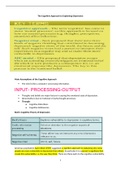
The Cognitive Approach to Explaining Depression
Main Assumptions of the Cognitive Approach
The mind is like a computer- processing information.
INPUT- PROCESSING-OUTPUT
Thoughts and beliefs are major factors in causing the emotional state of depression.
Abnormality is due to irrational or faulty thought processes.
Through:
o Cognitive Distortions
o Cognitive Deficiencies
Beck’s Cognitive Theory of Depression
American psychiatrist Aaron Beck (1967) suggested a cognitive approach to explaining why some
people are more vulnerable to depression than others. In particular it is a person’s cognitions that
create this vulnerability, i.e. the way they think. There are three parts to the cognitive vulnerability.
1
, Faulty Information Processing/ Cognitive Bias
Depressed people are prone to distorting and misinterpreting information, a process known as
cognitive bias. One type of bias is over-generalizations, where a depressed person makes a sweeping
conclusion based on a single incident. If they have failed one end of unit test, they will fail all their A
Level exams.
Some may experience catasrophising, where they exaggerate a minor setback and believe that it is a
complete disaster. If they have failed one end of unit test, they may believe they are never going to
get a job.
When depressed we attend to the negative aspects of a situation and ignore positives. We also tend
to blow small problems out of proportion and think in “black and white” terms.
Negative self-schemas
A schema is a “package” of ideas and information developed through experience and acts as a
mental framework for the interpretation of sensory information. A self-schema is the package of
information we have about ourselves. Through a negative self-schema we interpret all information
about ourselves in a negative way.
The negative triad
A person develops a dysfunctional view of themselves
because of three types of negative thinking that occurs
automatically, regardless of the reality of what is
happening at the time.
1. Negative view of the world- this creates the impression
that there is no hope anywhere.
2. Negative view of the future- “the economy won’t get
any better”. Such thoughts reduce hopefulness and
enhance depression.
3. Negative view of the self- thinking of yourself as a
failure. Such thoughts enhance any existing depressive
feelings because they confirm the existing emotions of low self-esteem.
Evaluation
It has good supporting evidence
A range of evidence supports the idea that depression is associated with faulty information
processing, negative self-schemas and the cognitive triad of negative automatic thinking. It has high
internal validity.
Grazioli and Terry (2000) assessed 65 pregnant women for cognitive vulnerability and depression
before and after birth. They found that those women judged to have been high in cognitive
vulnerability were more likely to suffer post-natal depression.
2
Main Assumptions of the Cognitive Approach
The mind is like a computer- processing information.
INPUT- PROCESSING-OUTPUT
Thoughts and beliefs are major factors in causing the emotional state of depression.
Abnormality is due to irrational or faulty thought processes.
Through:
o Cognitive Distortions
o Cognitive Deficiencies
Beck’s Cognitive Theory of Depression
American psychiatrist Aaron Beck (1967) suggested a cognitive approach to explaining why some
people are more vulnerable to depression than others. In particular it is a person’s cognitions that
create this vulnerability, i.e. the way they think. There are three parts to the cognitive vulnerability.
1
, Faulty Information Processing/ Cognitive Bias
Depressed people are prone to distorting and misinterpreting information, a process known as
cognitive bias. One type of bias is over-generalizations, where a depressed person makes a sweeping
conclusion based on a single incident. If they have failed one end of unit test, they will fail all their A
Level exams.
Some may experience catasrophising, where they exaggerate a minor setback and believe that it is a
complete disaster. If they have failed one end of unit test, they may believe they are never going to
get a job.
When depressed we attend to the negative aspects of a situation and ignore positives. We also tend
to blow small problems out of proportion and think in “black and white” terms.
Negative self-schemas
A schema is a “package” of ideas and information developed through experience and acts as a
mental framework for the interpretation of sensory information. A self-schema is the package of
information we have about ourselves. Through a negative self-schema we interpret all information
about ourselves in a negative way.
The negative triad
A person develops a dysfunctional view of themselves
because of three types of negative thinking that occurs
automatically, regardless of the reality of what is
happening at the time.
1. Negative view of the world- this creates the impression
that there is no hope anywhere.
2. Negative view of the future- “the economy won’t get
any better”. Such thoughts reduce hopefulness and
enhance depression.
3. Negative view of the self- thinking of yourself as a
failure. Such thoughts enhance any existing depressive
feelings because they confirm the existing emotions of low self-esteem.
Evaluation
It has good supporting evidence
A range of evidence supports the idea that depression is associated with faulty information
processing, negative self-schemas and the cognitive triad of negative automatic thinking. It has high
internal validity.
Grazioli and Terry (2000) assessed 65 pregnant women for cognitive vulnerability and depression
before and after birth. They found that those women judged to have been high in cognitive
vulnerability were more likely to suffer post-natal depression.
2