Definitions of Abnormality
Statistical Infrequency
The most obvious way to define anything as “normal” or “abnormal” is according to the number of
times we observe it. According to the stastical definition any relatively usual behaviour or
characteristic can be thought of as “normal” and any behaviour different to this as “abnormal”. This
is stastical infrequency.
Example: IQ and Intellectual Disability Disorder
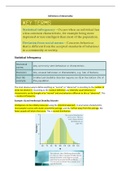
Intelligence can be reliably measured using the statistical approach. In any human characteristic,
most people’s scores will cluster around the average, and the further away from the average, the
fewer people will attain that score. This is normal distribution.
1
, The average IQ is set at 100. Most people (68%) have an IQ between the range from 85 to 115. Only
2% of people have a score below 70. These individuals are usually very unusual or “abnormal” and
are liable to receive a diagnosis of psychological disorder- intellectual disability disorder.
Evaluation
Real-life application
It has real-life application in the diagnosis of intellectual disability disorder- therefore there is a place
for statistical infrequency in thinking about what are normal and abnormal behaviours and
characteristics. All assessments of patients with mental disorders includes some of kind of
measurement of how severe their symptoms are as compared to statistical norms (as distinct from
social norms). It is a useful part of clinical assessment. This definition can look at the whole picture,
taking all the population into account so it can give a useful insight into the whole picture of a
particular characteristic. The mathematical nature means that it is clear what is defined as abnormal
and what is not. There is no opinion involved, which means there is no bias.
Unusual characteristics can be positive
IQ scores over 130 are just as unusual as under 70, but we wouldn’t think of super-intelligence as an
undesirable characteristic that needs treatment. Just because a behaviour is statistically abnormal it
does not mean it requires treatment to return to normal. This is a serious limitation to the concept
of statistical infrequency and means that it would never be used alone to make a diagnosis.
Some disorders are not statistically rare
Depression is an example, where it is argued that 25% of the population will experience a mental
health issue each year in England. Depression is an abnormality because it can create significant
changes in behavioural, emotional, and cognitive domains. But if we followed the statistically
infrequency definition, it would mean that depression is not an abnormality because it is not
statistically anomalous. It states that scores in the top and bottom 2.5% of the population are
abnormal, but we know that there is some behaviour which is deemed abnormal by the diagnostic
manuals for mental illness that would not fit within that definition.
Similarly, 3% of the population is thought to suffer from OCD but some of those individuals may not
be seen as abnormal because they are within 2 standard deviations of the mean. This means that the
definition and the current criteria for defining mental health issues are at odds with each other.
In order to be effective, there must be some overlap between the definitions and the DSM-5 (the
current diagnostic manual for mental disorders). There is too much inflexibility with the definition
which means that if we followed the statistical infrequency definition alone then there is risk of
creating disagreements in the field. Many rare behaviours or characteristics have no bearing on
normality or abnormality. Some characteristics are regarded as abnormal even though they are quite
frequent. This reduces the validity of statistical frequency as a definition of abnormality because if it
excludes very prominent disorders such as depression, how can we effectively use it?
Not everyone unusual benefits from a label
Where someone is living a happy fulfilled life, there is no benefit to them being labelled as abnormal
regardless of how unusual they are. If a person with very low IQ was not distressed and quite
capable of working, they would not need a diagnosis of intellectual disability. If that person was
2
Statistical Infrequency
The most obvious way to define anything as “normal” or “abnormal” is according to the number of
times we observe it. According to the stastical definition any relatively usual behaviour or
characteristic can be thought of as “normal” and any behaviour different to this as “abnormal”. This
is stastical infrequency.
Example: IQ and Intellectual Disability Disorder
Intelligence can be reliably measured using the statistical approach. In any human characteristic,
most people’s scores will cluster around the average, and the further away from the average, the
fewer people will attain that score. This is normal distribution.
1
, The average IQ is set at 100. Most people (68%) have an IQ between the range from 85 to 115. Only
2% of people have a score below 70. These individuals are usually very unusual or “abnormal” and
are liable to receive a diagnosis of psychological disorder- intellectual disability disorder.
Evaluation
Real-life application
It has real-life application in the diagnosis of intellectual disability disorder- therefore there is a place
for statistical infrequency in thinking about what are normal and abnormal behaviours and
characteristics. All assessments of patients with mental disorders includes some of kind of
measurement of how severe their symptoms are as compared to statistical norms (as distinct from
social norms). It is a useful part of clinical assessment. This definition can look at the whole picture,
taking all the population into account so it can give a useful insight into the whole picture of a
particular characteristic. The mathematical nature means that it is clear what is defined as abnormal
and what is not. There is no opinion involved, which means there is no bias.
Unusual characteristics can be positive
IQ scores over 130 are just as unusual as under 70, but we wouldn’t think of super-intelligence as an
undesirable characteristic that needs treatment. Just because a behaviour is statistically abnormal it
does not mean it requires treatment to return to normal. This is a serious limitation to the concept
of statistical infrequency and means that it would never be used alone to make a diagnosis.
Some disorders are not statistically rare
Depression is an example, where it is argued that 25% of the population will experience a mental
health issue each year in England. Depression is an abnormality because it can create significant
changes in behavioural, emotional, and cognitive domains. But if we followed the statistically
infrequency definition, it would mean that depression is not an abnormality because it is not
statistically anomalous. It states that scores in the top and bottom 2.5% of the population are
abnormal, but we know that there is some behaviour which is deemed abnormal by the diagnostic
manuals for mental illness that would not fit within that definition.
Similarly, 3% of the population is thought to suffer from OCD but some of those individuals may not
be seen as abnormal because they are within 2 standard deviations of the mean. This means that the
definition and the current criteria for defining mental health issues are at odds with each other.
In order to be effective, there must be some overlap between the definitions and the DSM-5 (the
current diagnostic manual for mental disorders). There is too much inflexibility with the definition
which means that if we followed the statistical infrequency definition alone then there is risk of
creating disagreements in the field. Many rare behaviours or characteristics have no bearing on
normality or abnormality. Some characteristics are regarded as abnormal even though they are quite
frequent. This reduces the validity of statistical frequency as a definition of abnormality because if it
excludes very prominent disorders such as depression, how can we effectively use it?
Not everyone unusual benefits from a label
Where someone is living a happy fulfilled life, there is no benefit to them being labelled as abnormal
regardless of how unusual they are. If a person with very low IQ was not distressed and quite
capable of working, they would not need a diagnosis of intellectual disability. If that person was
2