The Cognitive Approach to treating Depression
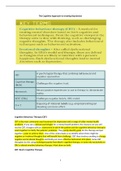
Cognitive Behaviour Therapy (CBT)
CBT is the most commonly used treatment for depression and a range of other mental health
problems. If you see a clinical psychologist for a mental health problem, the chances are you will
receive CBT. It begins with an assessment in which the patient and the cognitive behaviour therapist
work together to clarify the patients’ problems. They jointly identify goals for the therapy and put
together a plan to achieve them. One of the central tasks is to identify where there might be
negative or irrational thoughts that will benefit from challenge. CBT then involves working to change
negative and irrational thoughts and finally put more effective behaviours into place. Some CBT
therapists do this using techniques purely from Beck’s cognitive therapy, or some rely exclusively on
Ellis's rational emotive behaviour therapy. Most draw on both.
CBT: Beck’s Cognitive Therapy
1
Cognitive Behaviour Therapy (CBT)
CBT is the most commonly used treatment for depression and a range of other mental health
problems. If you see a clinical psychologist for a mental health problem, the chances are you will
receive CBT. It begins with an assessment in which the patient and the cognitive behaviour therapist
work together to clarify the patients’ problems. They jointly identify goals for the therapy and put
together a plan to achieve them. One of the central tasks is to identify where there might be
negative or irrational thoughts that will benefit from challenge. CBT then involves working to change
negative and irrational thoughts and finally put more effective behaviours into place. Some CBT
therapists do this using techniques purely from Beck’s cognitive therapy, or some rely exclusively on
Ellis's rational emotive behaviour therapy. Most draw on both.
CBT: Beck’s Cognitive Therapy
1