Free Will and Determinism
Free Will
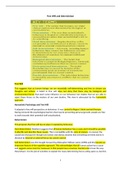
This suggests that as human beings, we are essentially self-determining and free to choose our
thoughts and actions. A belief in free will does not deny that there may be biological and
environmental forces that exert some influence on our behaviour but implies that we are able to
reject these forces as the masters of our own destiny. This view is advocated by the humanistic
approach.
Humanistic Psychology and Free Will
It adopted a free will perspective on behaviour. It was central to Rogers’ client-centred therapy.
Having removed the psychological barriers that may be preventing personal growth, people are free
to work towards their potential (self-actualisation).
Determinism
This proposes that free will has no place in explaining behaviour.
Hard determinism (fatalism) suggests that all human behaviour has a cause and it should be possible
to identify and describe these causes. This is compatible with the aims of science- to uncover the
causal laws that govern thought and action and always assumes that everything we think and do is
dictated by internal or external forces we cannot control.
Soft Determinism was first bought forward by philosopher William James (1890) and this became an
important feature of the cognitive approach. This acknowledges that all human action has a cause
and suggests some room for maneuver in that people have conscious mental control over the way
they behave. It is the job of scientists to explain the many determining forces acting upon us, but this
1
Free Will
This suggests that as human beings, we are essentially self-determining and free to choose our
thoughts and actions. A belief in free will does not deny that there may be biological and
environmental forces that exert some influence on our behaviour but implies that we are able to
reject these forces as the masters of our own destiny. This view is advocated by the humanistic
approach.
Humanistic Psychology and Free Will
It adopted a free will perspective on behaviour. It was central to Rogers’ client-centred therapy.
Having removed the psychological barriers that may be preventing personal growth, people are free
to work towards their potential (self-actualisation).
Determinism
This proposes that free will has no place in explaining behaviour.
Hard determinism (fatalism) suggests that all human behaviour has a cause and it should be possible
to identify and describe these causes. This is compatible with the aims of science- to uncover the
causal laws that govern thought and action and always assumes that everything we think and do is
dictated by internal or external forces we cannot control.
Soft Determinism was first bought forward by philosopher William James (1890) and this became an
important feature of the cognitive approach. This acknowledges that all human action has a cause
and suggests some room for maneuver in that people have conscious mental control over the way
they behave. It is the job of scientists to explain the many determining forces acting upon us, but this
1