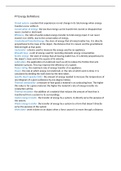
P7 Energy Definitions:
Closed system- a system that experiences no net change in its total energy when energy
transfers occur within it.
Conservation of energy- the law that energy can be transferred, stored or dissipated but
never created or destroyed.
Efficiency- the ratio of useful output energy transfer to total energy input. It can never
exceed 1 (or 100%), due to the conservation of energy.
Gravitational Potential Energy- the store of energy that all raised matter has. It is directly
proportional to the mass of the object, the distance that it is raised, and the gravitational
field strength at that point.
Joulemeter- a device used to measure the energy used by an appliance.
Kilowatt-hour- a unit of energy used for recording domestic energy consumption.
Kinetic energy- the store of energy that all moving matter has. It is directly proportional to
the object’s mass and to the square of its velocity.
Lubrication- the application of a lubricant (such as oil) to reduce the friction that acts
between surfaces. This may improve the efficiency of a system.
Power-rating- the maximum rate of energy transfer of an appliance.
Power- the rate at which energy is transferred, or the rate at which work is done. It is
calculated by dividing the work done by the time taken.
Specific Heat Capacity (SHC)- the amount of energy needed to increase the temperature of
one kilogram of a given substance by one degree Celsius.
Thermal conductivity- a measure of how good a material is at conducting heat. The higher
this value is for a given material, the higher the material’s rate of energy transfer via
conduction will be.
Thermal insulation- the addition of a material that reduces the amount of heat that is
transferred from a system to its surroundings.
Useful energy transfer- the transfer of energy by a system, to directly serve the purpose of
the system.
Waste energy transfer- the transfer of energy by a system to a form that doesn’t directly
serve the purpose of the system.
Work done- work is done on an object when a force causes it to move through a distance.
Closed system- a system that experiences no net change in its total energy when energy
transfers occur within it.
Conservation of energy- the law that energy can be transferred, stored or dissipated but
never created or destroyed.
Efficiency- the ratio of useful output energy transfer to total energy input. It can never
exceed 1 (or 100%), due to the conservation of energy.
Gravitational Potential Energy- the store of energy that all raised matter has. It is directly
proportional to the mass of the object, the distance that it is raised, and the gravitational
field strength at that point.
Joulemeter- a device used to measure the energy used by an appliance.
Kilowatt-hour- a unit of energy used for recording domestic energy consumption.
Kinetic energy- the store of energy that all moving matter has. It is directly proportional to
the object’s mass and to the square of its velocity.
Lubrication- the application of a lubricant (such as oil) to reduce the friction that acts
between surfaces. This may improve the efficiency of a system.
Power-rating- the maximum rate of energy transfer of an appliance.
Power- the rate at which energy is transferred, or the rate at which work is done. It is
calculated by dividing the work done by the time taken.
Specific Heat Capacity (SHC)- the amount of energy needed to increase the temperature of
one kilogram of a given substance by one degree Celsius.
Thermal conductivity- a measure of how good a material is at conducting heat. The higher
this value is for a given material, the higher the material’s rate of energy transfer via
conduction will be.
Thermal insulation- the addition of a material that reduces the amount of heat that is
transferred from a system to its surroundings.
Useful energy transfer- the transfer of energy by a system, to directly serve the purpose of
the system.
Waste energy transfer- the transfer of energy by a system to a form that doesn’t directly
serve the purpose of the system.
Work done- work is done on an object when a force causes it to move through a distance.