C1 Particles Definitions:
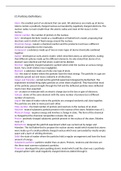
Atom- the smallest part of an element that can exist. All substances are made up of atoms.
Atoms contain a positively charged nucleus surrounded by negatively charged electrons. The
nuclear radius is much smaller than the atomic radius and most of the mass is in the
nucleus.
Atomic number- the number of protons in the nucleus.
Bohr- developed the Bohr model as a modification of Rutherford’s model, proposing that
electrons exist in shells of fixed energy around the nucleus.
Chemical change- require a chemical reaction and the products must have a different
chemical composition to the reactants.
Compound- a substance made up of two or more types of atoms chemically combined
together.
Dalton- developed an early atomic model, which described atoms as solid spheres, stating
that different spheres made up the different elements. He also stated that atoms of an
element were identical and that atoms could not be divided.
Electron- negatively charged subatomic particle which orbit the nucleus at various energy
levels. Very small relative mass (negligible).
Element- a substance made up of only one type of atom.
Gas- the state of matter where the particles have the most energy. The particles in a gas are
relatively spread out and move randomly in all directions.
Geiger and Marsden- carried out the gold foil experiment designed by Rutherford. The
experiment involved firing alpha particles at a thin sheet of gold foil. They found that most
of the particles passed straight through the foil and the deflected particles were deflected
much more than expected.
Ion- an atom or molecule with an electric charge due to the loss or gain of electrons.
Isotope- atoms of the same element with the same number of protons but a different
number of neutrons.
Liquid- the state of matter where the particles are arranged randomly and close together.
The particles are able to move past each other.
Mass number- the total number of protons and neutrons in the nucleus of an atom.
Neutron- neutral subatomic particle present in the nucleus of the atom. Relative mass of 1.
Physical change- requires energy and involves a change in state. The form of the chemical
is changed but the chemical composition remains the same.
Proton- positively charged subatomic particle present in the nucleus of the atom. Relative
mass of 1.
Rutherford- designed the gold foil experiment which was carried out by Geiger and
Marsden. This led Rutherford to propose the nuclear atomic model which stated that atoms
were made up of a small positively charged nucleus which was surrounded by mostly empty
space and a layer of orbiting electrons.
Solid- the state of matter where the particles hold a regular arrangement and have the least
amount of energy.
Subatomic particles- particles smaller than an atom. Protons, neutrons and electrons are
the three most common subatomic particles.
Thomson- developed the plum pudding atomic model which said the atom was a positively
charged sphere with small negatively charged electrons dotted through it.
Atom- the smallest part of an element that can exist. All substances are made up of atoms.
Atoms contain a positively charged nucleus surrounded by negatively charged electrons. The
nuclear radius is much smaller than the atomic radius and most of the mass is in the
nucleus.
Atomic number- the number of protons in the nucleus.
Bohr- developed the Bohr model as a modification of Rutherford’s model, proposing that
electrons exist in shells of fixed energy around the nucleus.
Chemical change- require a chemical reaction and the products must have a different
chemical composition to the reactants.
Compound- a substance made up of two or more types of atoms chemically combined
together.
Dalton- developed an early atomic model, which described atoms as solid spheres, stating
that different spheres made up the different elements. He also stated that atoms of an
element were identical and that atoms could not be divided.
Electron- negatively charged subatomic particle which orbit the nucleus at various energy
levels. Very small relative mass (negligible).
Element- a substance made up of only one type of atom.
Gas- the state of matter where the particles have the most energy. The particles in a gas are
relatively spread out and move randomly in all directions.
Geiger and Marsden- carried out the gold foil experiment designed by Rutherford. The
experiment involved firing alpha particles at a thin sheet of gold foil. They found that most
of the particles passed straight through the foil and the deflected particles were deflected
much more than expected.
Ion- an atom or molecule with an electric charge due to the loss or gain of electrons.
Isotope- atoms of the same element with the same number of protons but a different
number of neutrons.
Liquid- the state of matter where the particles are arranged randomly and close together.
The particles are able to move past each other.
Mass number- the total number of protons and neutrons in the nucleus of an atom.
Neutron- neutral subatomic particle present in the nucleus of the atom. Relative mass of 1.
Physical change- requires energy and involves a change in state. The form of the chemical
is changed but the chemical composition remains the same.
Proton- positively charged subatomic particle present in the nucleus of the atom. Relative
mass of 1.
Rutherford- designed the gold foil experiment which was carried out by Geiger and
Marsden. This led Rutherford to propose the nuclear atomic model which stated that atoms
were made up of a small positively charged nucleus which was surrounded by mostly empty
space and a layer of orbiting electrons.
Solid- the state of matter where the particles hold a regular arrangement and have the least
amount of energy.
Subatomic particles- particles smaller than an atom. Protons, neutrons and electrons are
the three most common subatomic particles.
Thomson- developed the plum pudding atomic model which said the atom was a positively
charged sphere with small negatively charged electrons dotted through it.