Grade: A
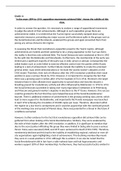
‘In the years 1894 to 1914, opposition movements achieved little’. Assess the validity of this
view.
In order to answer the question, it is necessary to analyse a range of oppositional movements
to judge the extent of their achievements. Although in each opposition group there are
achievements visible, it is evident that the Tsarist regime successfully clamped down using
repressive measures, preventing any major success and furthermore splits in the groups such as
the Social Democrats and the Liberals, weakened the groups and again prevented them from
posing any serious threat to the regime.
In assessing the threat that revolutionary opposition posed to the Tsarist regime, although
achievements are evident and their potential to be a strong opposition to the Tsar was there,
the reality is that they only achieved little. The Social Democrats were weakened at first in 1903
by the split into the Bolsheviks and Mensheviks. Furthermore, the membership of the party was
limited and a significant majority of the party was in exile, prison or abroad. Consequently the
exiled leaders such as Lenin failed to exercise effective control over the parties within Russia
leading to a lack of achievement. Further failures include the inability to create the promised
general strike, mass street demonstrations or recreate the society worker’s deputies on the
1905 model. Therefore, their lack of influence after the 1905 revolution underlines their weak
position to pose a serious threat by 1914. However, it is important to recognise the fact that
there was a growing wave in strikes after 1912 for example 2574 in 1914. Moreover, the larger
industrial base in cities allowed more opportunity to spread ideas and factories became a
breeding ground for revolutionary activity and often influenced by Bolshevism. In 1912 to 1914
the Social Democrats succeeded in taking over many legal labour institutions in St Petersburg
and Moscow and gained 6 worker’s deputies in elections to the 4th Duma. However, this success
could be granted to the fact that they were helped because of the Social Revolutionaries’
boycott. There is additional evidence of achievement in the growing working class unrest, which
lead to more support for the Bolsheviks, and importantly the Pravda newspaper was launched
in April 1912 achieving the circulation of 40,000 copies per issue. Therefore, discontent within
the regime on a low level is omnipresent and it could be argued that with the continued growth
of the working class and spread of Marxist ideas, there was potential for a threat in the future if
conditions warranted.
However, further evidence for the fact that revolutionary opposition did achieve little can be
gathered from when looking at the Social Revolutionaries. Similarly, they were weakened by
the exile of their leaders after the 1905 revolution. In addition, it is significant to mention that
due to the secret police infiltrating this group they were limited in being able to pose a serious
threat. Many were executed (2365) and 4579 were sentenced to death (1901-1909). Therefore,
membership declined and this lead to the inability of establishing regional, national or even all-
city organisations again highlighting a lack of achievement. This declining membership meant
they were in a weak position in 1914. Although this is evident, it can also be noted that the
Social Revolutionaries did in fact have a wide national base and had huge peasantry and
workers support (50% of their membership). Furthermore, they had successful tactics evident in
‘In the years 1894 to 1914, opposition movements achieved little’. Assess the validity of this
view.
In order to answer the question, it is necessary to analyse a range of oppositional movements
to judge the extent of their achievements. Although in each opposition group there are
achievements visible, it is evident that the Tsarist regime successfully clamped down using
repressive measures, preventing any major success and furthermore splits in the groups such as
the Social Democrats and the Liberals, weakened the groups and again prevented them from
posing any serious threat to the regime.
In assessing the threat that revolutionary opposition posed to the Tsarist regime, although
achievements are evident and their potential to be a strong opposition to the Tsar was there,
the reality is that they only achieved little. The Social Democrats were weakened at first in 1903
by the split into the Bolsheviks and Mensheviks. Furthermore, the membership of the party was
limited and a significant majority of the party was in exile, prison or abroad. Consequently the
exiled leaders such as Lenin failed to exercise effective control over the parties within Russia
leading to a lack of achievement. Further failures include the inability to create the promised
general strike, mass street demonstrations or recreate the society worker’s deputies on the
1905 model. Therefore, their lack of influence after the 1905 revolution underlines their weak
position to pose a serious threat by 1914. However, it is important to recognise the fact that
there was a growing wave in strikes after 1912 for example 2574 in 1914. Moreover, the larger
industrial base in cities allowed more opportunity to spread ideas and factories became a
breeding ground for revolutionary activity and often influenced by Bolshevism. In 1912 to 1914
the Social Democrats succeeded in taking over many legal labour institutions in St Petersburg
and Moscow and gained 6 worker’s deputies in elections to the 4th Duma. However, this success
could be granted to the fact that they were helped because of the Social Revolutionaries’
boycott. There is additional evidence of achievement in the growing working class unrest, which
lead to more support for the Bolsheviks, and importantly the Pravda newspaper was launched
in April 1912 achieving the circulation of 40,000 copies per issue. Therefore, discontent within
the regime on a low level is omnipresent and it could be argued that with the continued growth
of the working class and spread of Marxist ideas, there was potential for a threat in the future if
conditions warranted.
However, further evidence for the fact that revolutionary opposition did achieve little can be
gathered from when looking at the Social Revolutionaries. Similarly, they were weakened by
the exile of their leaders after the 1905 revolution. In addition, it is significant to mention that
due to the secret police infiltrating this group they were limited in being able to pose a serious
threat. Many were executed (2365) and 4579 were sentenced to death (1901-1909). Therefore,
membership declined and this lead to the inability of establishing regional, national or even all-
city organisations again highlighting a lack of achievement. This declining membership meant
they were in a weak position in 1914. Although this is evident, it can also be noted that the
Social Revolutionaries did in fact have a wide national base and had huge peasantry and
workers support (50% of their membership). Furthermore, they had successful tactics evident in